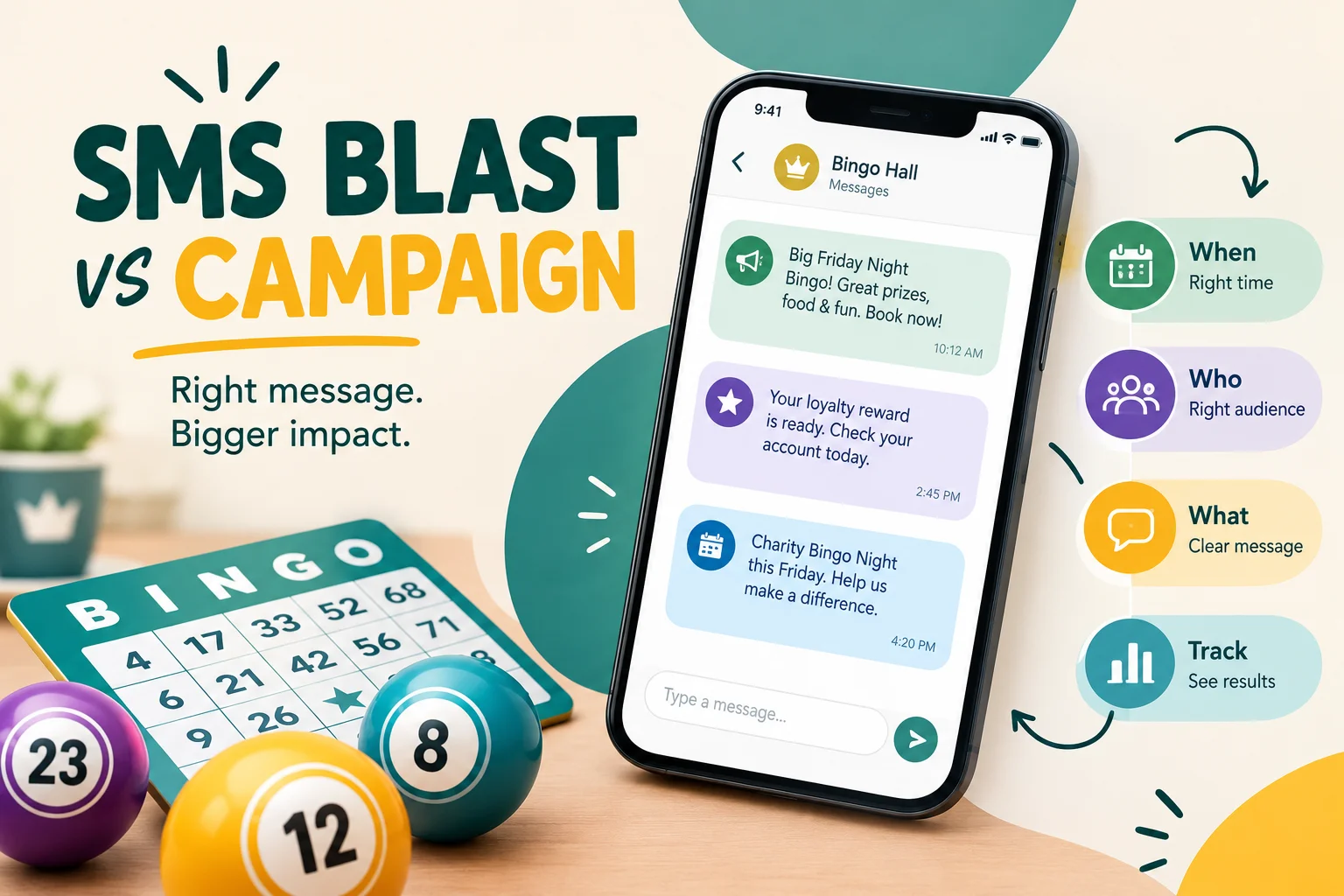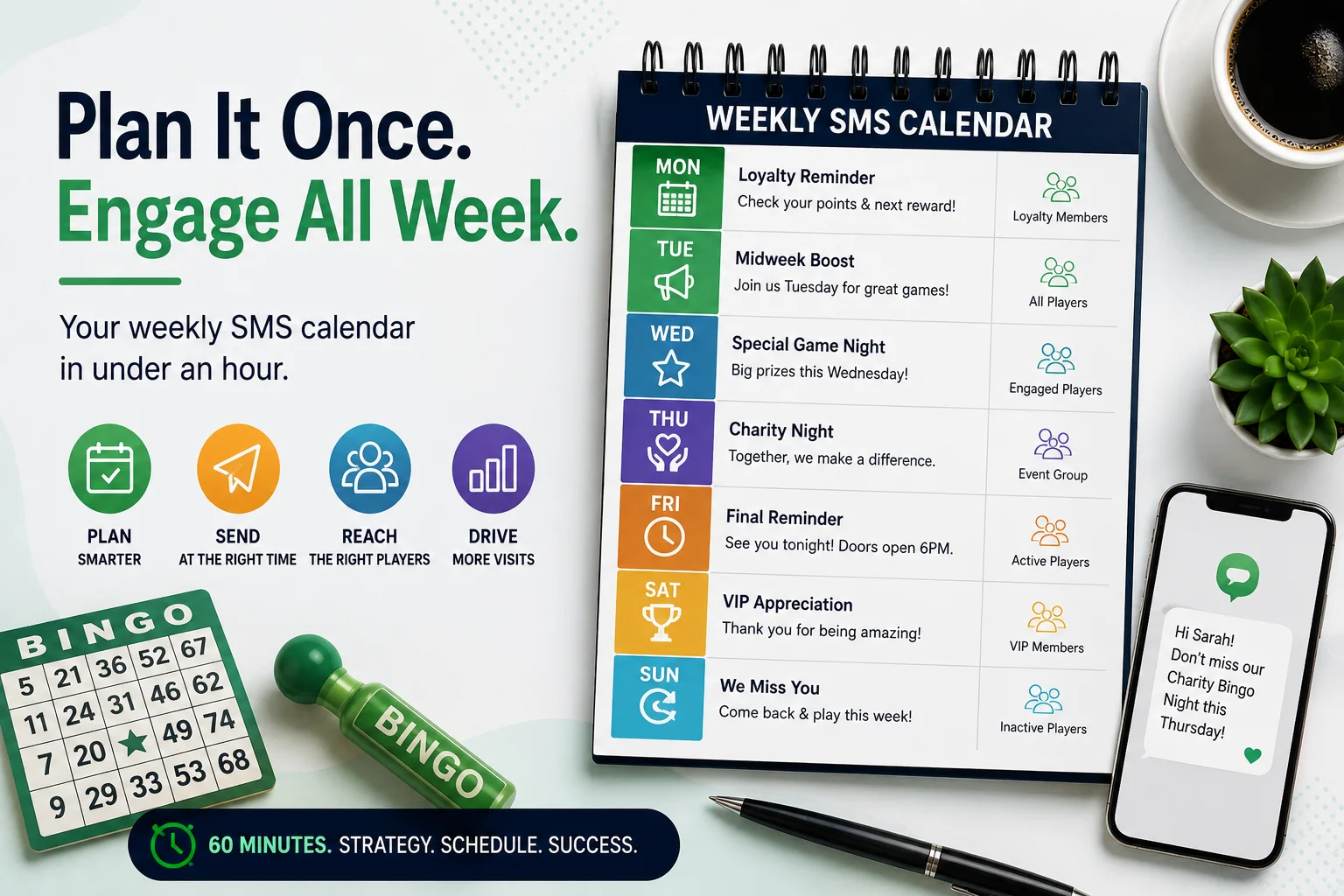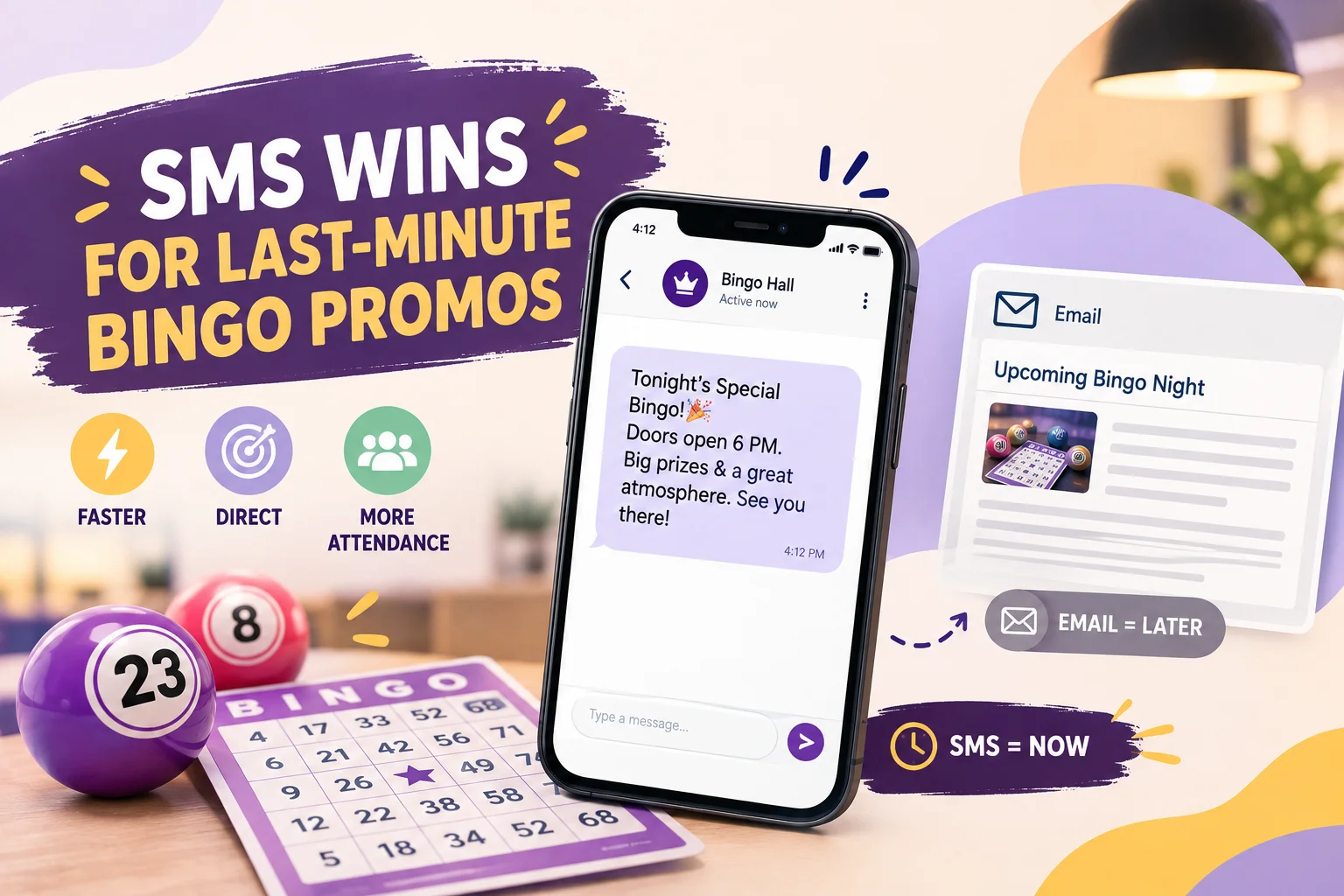
It's 3:30 PM.
Tonight's bingo session starts at 7:00.
You still have seats available, the jackpot is worth promoting, and the team has just confirmed a special offer for tonight.
You could send an email.
But there is a problem.
The email might arrive alongside dozens of other messages competing for attention. Some customers won't open it until tomorrow. Others may never see it.
For a last-minute bingo promotion, time is the product of the message.
This is where SMS blasts have a natural advantage.
A text message puts the communication directly in front of the player at a moment when they can still decide whether to visit the hall.
That doesn't mean email is useless. Email can be valuable for newsletters, longer announcements, detailed event information, and relationship marketing.
But when the goal is:
“We want more people to know about tonight's bingo session right now,”
SMS is often the more immediate channel.
The Difference Is Really About Timing
Consider how the two channels fit into a customer's day.
An email arrives.
The customer sees the notification but is busy. They plan to read it later.
Later becomes tomorrow.
Tomorrow becomes next week.
The opportunity has passed.
An SMS arrives while the event is still relevant.
The player reads it.
They check the time.
They decide whether to attend.
That is the fundamental difference.
Email can be excellent for planned communication.
SMS is particularly useful when the decision needs to happen soon.
A Bingo Hall Has More Last-Minute Opportunities Than Most Businesses
Physical venues regularly have situations where a customer's decision is time-sensitive.
For example:
- Tonight's bingo session has remaining capacity
- A special game starts in a few hours
- A jackpot has increased
- A themed night is happening tonight
- A charity event has spaces available
- A limited-time promotion ends today
- A weather-related attendance concern requires a timely update
- An unexpected event has been added to the schedule
These are not necessarily situations where you need a long newsletter.
You need attention.
And you need it before the doors open.
What Makes SMS So Useful for Last-Minute Promotion?
The strength of an SMS blast is its immediacy.
The customer doesn't have to open an inbox and search through a subject line.
The communication arrives as a direct notification on a device they are likely already carrying.
For a bingo hall, that can create a much shorter path:
Message → Awareness → Decision → Visit
Compare that with a longer email journey:
Email notification → Inbox → Open email → Read → Consider → Decide → Visit
Every additional step creates another opportunity for the customer to postpone the decision.
But Don't Turn Every SMS Into an Emergency
The word “last-minute” doesn't mean every campaign needs artificial urgency.
If an event is three weeks away, sending:
“LAST CHANCE! TONIGHT!”
isn't useful.
The message should reflect reality.
Good SMS timing creates genuine relevance.
If the event is tonight, say that.
If registration closes at 6 PM, communicate the actual deadline.
If the promotion ends today, make the timing clear.
Urgency works best when it is real rather than manufactured.
The Message Needs to Be Short Because the Decision Is Simple
A customer deciding whether to attend tonight's bingo does not necessarily need your entire event brochure.
They need the information that affects the decision.
For example:
Tonight's Special Bingo 🎉 Doors open at 6 PM. Join us for tonight's session and check out the latest promotion.
The exact details will vary by venue.
But notice the structure:
What?
Tonight's special bingo.
When?
Tonight, with the relevant time.
Why?
There is something worth knowing about the session.
What next?
Join the venue.
That's enough to start the decision.
Email Has a Different Job
The comparison shouldn't become “SMS good, email bad.”
That misses the point.
Email and SMS are useful for different situations.
Email is better suited to communication that benefits from more space.
For example:
- Monthly newsletters
- Detailed event announcements
- Community updates
- Longer loyalty communications
- Event recaps
- Fundraising stories
- Detailed programme information
SMS is better suited to moments where brevity and timing matter.
Think:
“Tonight.”
“Tomorrow.”
“Your reward is ready.”
“Your event starts soon.”
“Registration closes today.”
The smartest bingo marketing strategy can use both channels rather than forcing one to replace the other.
Why a Generic Newsletter Isn't Enough for a Busy Bingo Hall
Imagine your monthly email contains:
- This month's bingo schedule
- Three upcoming events
- A charity announcement
- Loyalty programme information
- A seasonal promotion
- A player story
- A newsletter article
That's useful content.
But suppose you need to promote tonight's special session at 4 PM.
Adding another paragraph to the newsletter isn't necessarily the best solution.
The information can get lost among everything else.
An SMS can give that specific event its own moment.
The “Tonight” Message Is Different From the “This Month” Message
This distinction can completely change how you plan communication.
Monthly Communication
“Here's what's happening at our hall this month.”
Email works well.
Weekly Communication
“Here are this week's sessions and events.”
Email and SMS can both contribute.
Last-Minute Communication
“Tonight's event starts in a few hours.”
SMS becomes particularly useful.
This is why an effective communication strategy shouldn't ask:
“Should we use SMS or email?”
It should ask:
“What does the customer need to know, and how quickly do they need to act?”
Use SMS to Fill Gaps in the Schedule
One of the most practical applications is supporting quieter sessions.
Suppose Wednesday attendance is normally lower than Friday.
At 2 PM on Wednesday, the operator sees that tonight's session still has plenty of availability.
Rather than sending a broad newsletter, the venue can send an SMS to an appropriate audience.
The message could focus on tonight's session and provide a simple reason to attend.
This makes the communication responsive to what is actually happening at the venue.
The Audience Still Matters
An SMS blast can reach a broad audience, but “blast” shouldn't mean “send to absolutely everyone.”
Consider whether the message is relevant to:
- Regular bingo players
- Players who usually attend that day
- Recent visitors
- Loyalty members
- Event attendees
- New members
- Inactive players
- Other eligible customers
For example, if the promotion is specifically designed to encourage Wednesday attendance, customers who regularly attend Wednesdays may be particularly relevant.
The broader lesson is simple:
Reach is useful only when the audience makes sense.
Don't Send the Same Message to Everyone
Suppose you have two groups.
Group A: Regular Friday attendees.
Group B: Players who haven't visited in two months.
They may both receive information about Friday's event, but their reasons for responding may be different.
Group A may only need a reminder.
Group B may need a stronger reason to return.
That can influence both the message and the campaign structure.
The Best Last-Minute SMS Often Has One Objective
A common mistake is trying to fit the entire marketing programme into one text.
For example:
Tonight's bingo starts at 7 PM! Don't forget our loyalty programme, new referral rewards, VIP tiers, charity fundraiser, gift cards and next week's event!
There may be good information in there.
But the customer doesn't know what matters most.
Instead, choose the immediate objective.
If the goal is tonight's attendance, make tonight's attendance the focus.
Other campaigns can have their own messages.
Use a Clear Call to Action
A last-minute SMS should make the next step obvious.
Depending on the campaign, that might be:
- Visit tonight
- Book a place
- Register for the event
- Check a reward
- Open the loyalty app
- Claim an eligible offer
- Reply for information
Don't make customers guess what they are supposed to do.
What About Links?
Links can be useful when the customer needs additional information.
For example, a message might provide a short event description and direct the player to the relevant registration or information page.
But the SMS should still make sense without forcing the recipient to click immediately.
The first few words should communicate why the message matters.
Last-Minute Does Not Mean Last-Second
There is a difference between timely communication and poor planning.
If an event starts at 7 PM, sending the first message at 6:55 PM may be too late.
A better strategy can involve several stages.
Earlier in the week: Build awareness.
On the day: Remind relevant players.
Closer to the session: Send a final concise reminder if appropriate.
This creates a communication sequence instead of relying entirely on one last-minute blast.
What Should You Track?
The real advantage of a digital SMS campaign is that you can learn from it.
Don't stop at:
“We sent 4,000 texts.”
That tells you about activity.
It doesn't tell you whether the campaign worked.
Depending on your setup, look at measures such as:
- Delivery rate
- Engagement
- Link activity
- Registrations
- Offer redemptions
- Attendance
- Repeat visits
- Loyalty activity
- Re-engagement
- Campaign cost
The most important measure should connect directly to the reason you sent the message.
If the goal was to increase attendance tonight, attendance matters.
Track SMS Against the Event, Not in Isolation
Suppose you normally have 300 players at a particular Wednesday session.
You send a targeted SMS promotion.
Attendance reaches 380.
That doesn't prove the SMS caused every additional visit.
Other factors may have contributed.
But it gives you something meaningful to investigate.
Compare similar sessions.
Look at campaign timing.
Review audience selection.
Compare different messages.
Over time, these observations can help you develop a more reliable communication strategy.
What If Email Was Sent Too?
This is where the channels can work together.
Imagine:
Monday: Email announces the week's events.
Wednesday afternoon: SMS promotes tonight's special session.
Wednesday evening: Attendance-focused follow-up where appropriate.
The email provides broader information.
The SMS creates immediacy.
They are not competing with each other.
They are doing different jobs.
Avoid the Biggest SMS Mistakes
Sending Too Frequently
If every day is treated as an emergency, customers will stop treating your messages as important.
Writing Long Messages
Keep the primary purpose obvious.
Using Fake Urgency
Don't manufacture deadlines or scarcity.
Ignoring Consent and Opt-Out Requirements
SMS marketing must be managed responsibly and in accordance with applicable requirements.
Sending to the Wrong Audience
A broad campaign should still have a reason for its audience selection.
Measuring Only Delivery
Delivered messages are not the same as successful campaigns.
Forgetting the Follow-Up
If someone responds to your campaign, that behaviour can inform future engagement.
A Better Way to Think About “Blast” Marketing
The term “SMS blast” can sound like a purely mass-marketing activity.
It doesn't have to be.
A well-planned blast is simply a broad communication sent for a specific reason.
The operator still decides:
Who should receive it?
Why are they receiving it?
When should it arrive?
What action should they take?
What result will we measure?
That makes the campaign much more intentional.
Where an SMS Blast Marketing Platform Helps
The more campaigns a bingo hall runs, the more difficult it becomes to manage communication manually.
Lists need updating.
Messages need scheduling.
Campaigns need tracking.
Different audiences need different communications.
Results need reviewing.
Trying to manage all of this through spreadsheets and disconnected tools can create unnecessary work.
A dedicated SMS solution can bring campaign management into a more structured workflow.
JustKonnect's SMS Marketing feature is designed specifically around bingo hall communication, with a focus on attendance, player engagement, and campaign visibility rather than generic retail marketing.
The platform describes SMS blast marketing as a way to send messages to players with minimal setup, support automated and targeted campaigns, and refine campaigns based on attendance data.
A Simple Last-Minute Campaign Formula
When tonight's session needs a push, use this structure:
1. Identify the opportunity
What needs attention tonight?
2. Select the audience
Who is most likely to care?
3. Choose the single objective
What action are you trying to encourage?
4. Write the message
Keep it short, relevant, and accurate.
5. Send at the right moment
Give players enough time to act.
6. Track the result
Measure the outcome that matters.
7. Learn from it
Use the result to improve the next campaign.
The process is simple enough to repeat every week.
Frequently Asked Questions
Are SMS blasts better than email newsletters for bingo halls?
For time-sensitive promotions, SMS can offer greater immediacy because messages reach customers through their phones and can be read quickly. Email remains useful for longer and more detailed communication.
When should a bingo hall send a last-minute SMS?
It should be sent early enough for the recipient to realistically act on it. The ideal timing depends on the event, audience, and venue, so operators should test and measure different schedules.
What should a bingo hall include in a last-minute SMS?
Focus on the event or offer, timing, the main reason it matters, and a clear next action. Avoid trying to include multiple unrelated promotions in one message.
Should SMS blasts be sent to the entire customer database?
Not automatically. A broad campaign should still be sent only to an appropriate audience that is eligible and has the necessary communication consent.
How can bingo halls measure whether an SMS blast worked?
Track the metric connected to the campaign objective. This could include attendance, registrations, redemptions, engagement, reactivation, or loyalty activity, alongside delivery and other campaign metrics.
Can bingo halls use SMS and email together?
Yes. Email can handle broader, detailed communication while SMS can reinforce time-sensitive events, reminders, and actions. Using both channels strategically can create a more complete communication journey.
The Last-Minute Advantage Comes Down to Relevance
A customer deciding whether to attend bingo tonight doesn't necessarily need another newsletter.
They need a reason to act while tonight is still an option.
That's where SMS has its strongest role.
Email can explain the month.
A website can provide the details.
Social media can build awareness.
But when the clock is moving, and the venue wants to put tonight's opportunity directly in front of players, SMS can provide the immediacy that other channels often lack.
The key is not simply sending a message quickly.
It is knowing when a message is worth sending, who should receive it, what it should say, and what happens afterward.
For bingo halls looking to make time-sensitive communication easier to manage and more measurable, JustKonnect's SMS Blast Marketing feature provides a purpose-built approach to player communication.
When tonight matters, don't wait for tomorrow's inbox.