A bingo hall can have a full calendar and still have empty seats.
The issue is often not a lack of events. Players may simply need the right reminder at the right time.
A special Friday session is coming up. A charity fundraiser has limited spaces. Tuesday is usually quieter than the weekend. A jackpot has changed. A seasonal promotion is ending.
These are all moments when SMS can be useful.
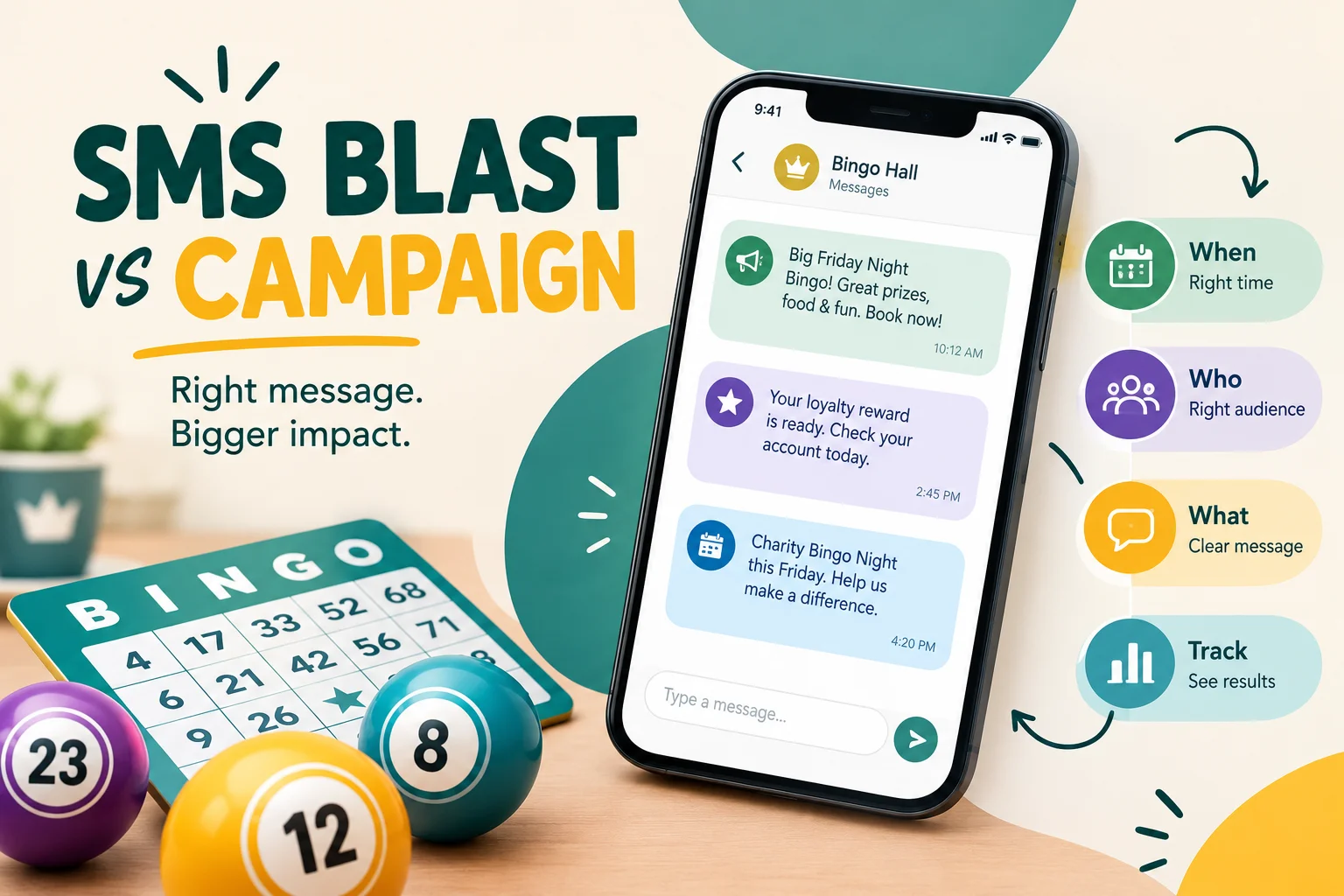
But there is a difference between sending an SMS blast and having an effective SMS campaign.
A blast sends a message to a large audience at once.
A campaign starts with a reason for communicating, chooses an appropriate audience, delivers a clear message, and measures what happened afterward.
For bingo halls, that distinction matters.
Because when every message becomes “Don't forget to come tonight,” customers eventually stop paying attention.
The better question is:
When does a mass SMS make sense, what should it say, and how do you know whether it worked?
When an SMS Blast Makes Sense
Not every piece of communication needs a large audience.
If a message only applies to VIP players, a targeted campaign makes more sense.
If it concerns a particular loyalty reward, there is little reason to send it to the entire database.
An SMS blast is most useful when the information genuinely applies to a broad section of your audience.
Think of moments where many players need to know the same thing at roughly the same time.
A Major Event Is Coming Up
A large themed bingo night, anniversary event, holiday session, or charity fundraiser can justify broader communication.
The event itself gives the message a clear purpose.
There Is a Time-Sensitive Promotion
If an offer or event is ending soon, SMS can provide a timely reminder.
The message should make the deadline clear rather than relying on vague urgency.
A Significant Schedule Change Occurs
Sometimes the most valuable SMS is not promotional.
A change to opening times, a session schedule, or another important operational detail may need to reach a broad audience quickly.
A Major Community or Charity Event Is Happening
A fundraiser can be an appropriate reason to contact a wider audience, particularly when the event is relevant to the venue's broader player community.
You Need to Re-Engage a Broad Audience
There are occasions when a wider re-engagement campaign makes sense.
However, even then, it is worth considering whether the entire database should receive the same message or whether inactive players should have their own campaign.
The Three-Second Test
Before sending a blast, look at the message as if you were the customer.
Can you understand it almost immediately?
A useful SMS usually answers three things:
What is happening?
Why should I care?
What should I do next?
For example:
Friday Charity Night is this week. Join us for an evening of bingo and fundraising. Reserve your place today.
The message is straightforward.
Now compare that with a message trying to include the full event schedule, several promotions, loyalty information, multiple links, and every available detail.
The second message may contain more information, but it creates more work for the reader.
SMS is a short-form channel.
Use it like one.
What Should a Bingo Hall Actually Say?
The best SMS copy depends on the purpose of the campaign.
Instead of creating one generic template for every situation, build messages around the moment.
For an Upcoming Event
Tell people what is happening and when.
Saturday Night Bingo is coming up. Join us this Saturday for a special evening at the hall. Check the event details and book your place.
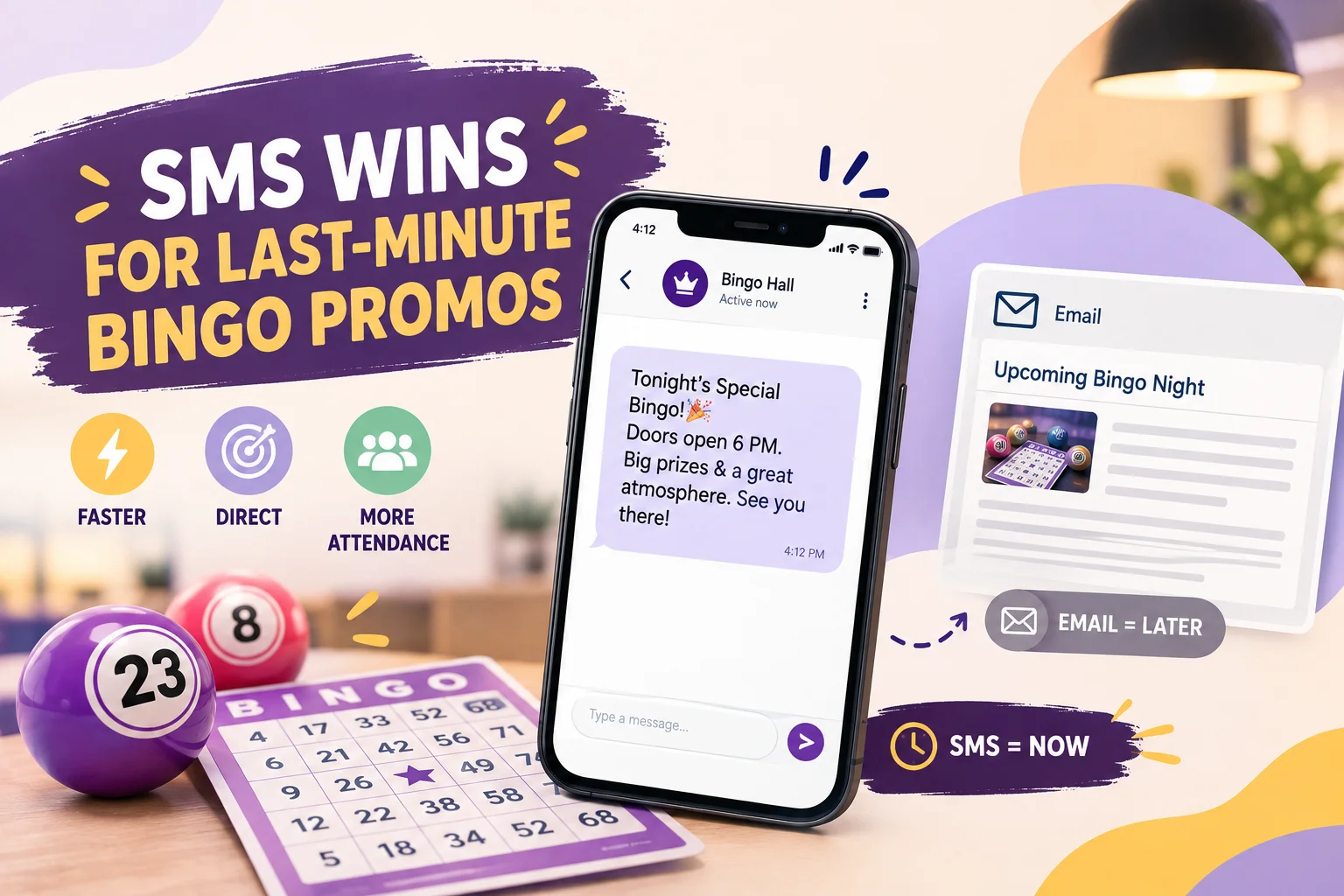
For a Last-Minute Reminder
Focus on timing.
Tonight's special bingo session starts soon. If you're planning to join us, now is the time to get ready.
For a Charity Fundraiser
Put the event and cause at the centre.
Our Charity Bingo Night is this Friday. Join us for a great night of bingo while supporting [Charity/Cause]. Find out more today.
For a Seasonal Campaign
Make the theme immediately recognisable.
Our Holiday Bingo Challenge starts this week. Join the campaign, complete the challenges and see how far you can progress.
For a Loyalty Promotion
Connect the message to something the player already values.
Your loyalty reward is waiting. Check your available reward before your next visit.
The wording should always reflect the actual offer, eligibility requirements, and applicable communication rules.
Don't Write an Advertisement When a Reminder Would Work Better
Bingo halls sometimes approach every SMS as if it needs to be a full sales pitch.
It doesn't.
If a player already knows about Friday's event, the second message doesn't need to explain the entire event again.
It might simply say:
Friday's special session is tomorrow. Have you got your place?
The purpose of the second message is different from the first.
First message: Awareness.
Second message: Reminder.
Final message: Action.
Thinking about the role of each message makes campaigns feel much less repetitive.
Timing Can Change the Result
The same SMS can have very different value depending on when it arrives.
A message promoting tonight's session is unlikely to have the same purpose as one promoting an event two weeks away.
Think in terms of the customer's decision window.
Too Early
The customer may forget.
Too Late
The customer may already have made other plans.
Well Timed
The message arrives while the customer can still realistically act on it.
This is why an SMS blast should be planned around the event rather than simply sent because “we haven't messaged anyone today.”
Build a Sequence for Bigger Events
For a major fundraiser or seasonal event, one blast may not be enough.
A simple sequence could look like this:
7 days before: Introduce the event.
3 days before: Remind interested or relevant players.
Event day: Send a concise final reminder.
After the event: Thank participants and communicate the outcome or next opportunity.
This creates continuity.
The customer isn't receiving four identical advertisements.
They are receiving four different pieces of communication at different stages of the event.
The Audience Matters More Than the Word “Blast”
“Blast” can sometimes create the impression that every customer should receive everything.
That is rarely the best approach.
Before sending, consider whether the message applies to:
- All opted-in players
- Regular attendees
- Players who attend a particular day
- Event participants
- Loyalty members
- New members
- VIP customers
- Inactive players
A broad audience can still be carefully selected.
That is the difference between mass communication and indiscriminate communication.
Use Behaviour to Improve the Next Campaign
Suppose you send a Friday event announcement to 4,000 eligible players.
After the event, you discover that engagement was much stronger among customers who had attended a Friday session during the previous month.
That is useful information.
For the next similar event, you could create a more focused audience.
Over time, your campaigns become less dependent on guesswork.
You begin to understand which groups respond to which types of communication.
Give Your SMS a Single Job
One of the easiest ways to improve a blast is to remove information.
Imagine the campaign objective is to fill an upcoming charity event.
The SMS probably doesn't need to simultaneously promote:
- The next five bingo sessions
- A loyalty reward
- A VIP programme
- A referral campaign
- A separate weekend promotion
Those things can have their own communications.
If the objective is attendance at the charity event, make that the centre of the message.
A clear campaign is easier to understand and easier to measure.
What Happens After Someone Clicks?
An SMS campaign shouldn't end when someone receives the message.
Think about the next step.
If you're promoting an event, where does the customer go?
If you're promoting a loyalty reward, how do they access it?
If you're promoting a fundraiser, how do they register or find the relevant details?
The destination should make the action obvious.
There is little value in writing an excellent SMS if the customer reaches a page that doesn't clearly explain what to do next.
Tracking Turns a Blast Into a Campaign
Imagine sending 5,000 messages.
You know they were sent.
But do you know whether they achieved anything?
That's where campaign tracking becomes important.
Depending on the campaign and available data, you may want to monitor:
- Messages delivered
- Engagement
- Link activity
- Event registrations
- Attendance
- Reward redemptions
- Loyalty activity
- Returning players
- Re-engagement
- Campaign cost
- Other defined conversion actions
The important metric depends on the purpose.
If your objective is attendance, don't judge success purely by how many people received the SMS.
Start With the Number That Matters
Before launching a campaign, write down the outcome you want.
For example:
Objective: Increase attendance at Tuesday's special session.
Then decide what you will measure.
Primary measure: Attendance.
Supporting measures: SMS engagement, registrations, and offer redemptions.
This gives you something concrete to evaluate afterward.
Without that step, reporting can become a collection of numbers without a conclusion.
Compare Campaigns, Not Just Individual Messages
One campaign tells you something.
Several campaigns reveal patterns.
Suppose your venue runs three event campaigns.
| Campaign | Audience | Engagement | Attendance |
| Friday Special | Regular players | High | Strong |
| Tuesday Promotion | Broad database | Medium | Moderate |
| Charity Night | Event-focused audience | High | Strong |
The point isn't to focus on one number.
Look for patterns.
Perhaps targeted audiences consistently perform better.
Perhaps reminders close to the event work better than early messages.
Perhaps certain event types generate stronger engagement.
That information can shape your next calendar.
Don't Ignore the Players Who Didn't Respond
Campaign reporting shouldn't only focus on successful responses.
Non-response can also tell you something.
If a large audience receives a message and almost nobody engages, investigate.
Was the audience too broad?
Was the offer irrelevant?
Was the timing poor?
Was the call to action unclear?
Was the event itself not attractive enough?
Was the message simply too generic?
The answer may not be “send more SMS.”
Sometimes the better solution is to change the campaign.
A Simple Post-Campaign Review
You don't need a complicated marketing report after every blast.
Spend a few minutes answering five questions:
1. Who received it?
Was the audience appropriate?
2. Why did we send it?
Was the objective clear?
3. What happened?
Look at engagement and the relevant conversion metric.
4. What surprised us?
Did a particular audience respond better or worse than expected?
5. What will we change next time?
This final question is the most valuable.
Marketing improves when every campaign teaches you something.
Where an SMS Blast Fits Into a Bigger Communication Strategy
An SMS blast shouldn't become the entire communication strategy for a bingo hall.
It is one tool within a broader system.
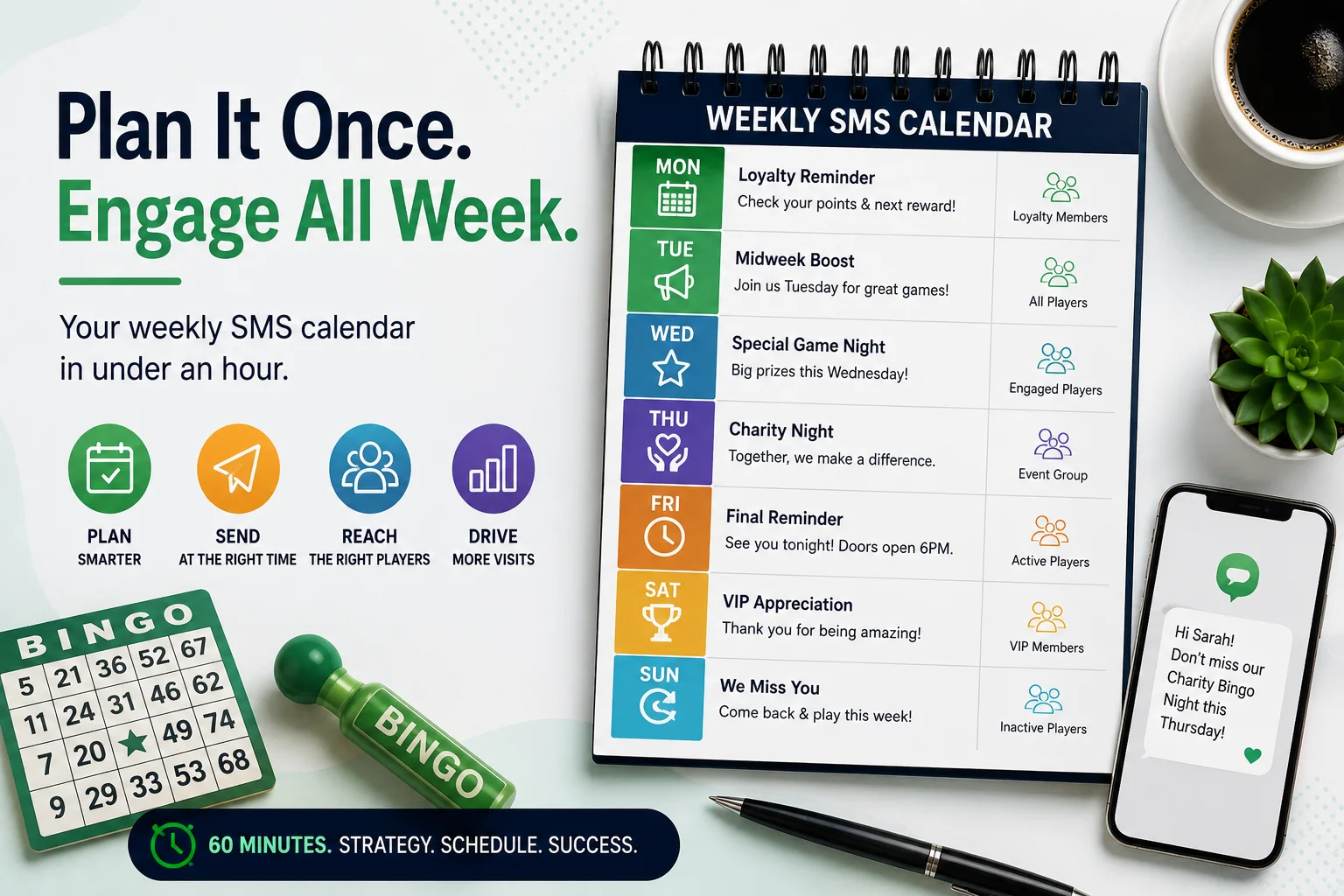
A venue might use:
Targeted SMS for specific player groups.
SMS blasts for broad, important announcements.
Automated messages for defined customer journeys.
Loyalty communication for rewards and milestones.
Event campaigns for upcoming activities.
Re-engagement campaigns for inactive players.
The challenge is keeping all of those activities organised.
When each campaign is managed separately, teams can lose track of who received what and when.
A centralised approach makes the overall communication strategy easier to manage.
Why Centralised SMS Management Matters
Imagine running five campaigns in one week.
One promotes a charity event.
Another targets VIP players.
A third reminds regular Friday attendees.
A fourth re-engages inactive customers.
The fifth announces a seasonal promotion.
Without a central system, managing audience lists, scheduling, campaign history, and results can become unnecessarily complicated.
A dedicated SMS marketing solution gives the team a clearer place to manage these activities.
For bingo halls, this is particularly useful because communication often needs to connect with the venue's wider player engagement strategy.
How JustKonnect Supports SMS Blast Marketing
JustKonnect provides an SMS Blast Marketing feature designed around the communication needs of venues such as bingo halls.
The purpose isn't simply to give operators another place to type messages.
It provides a more structured way to manage broad SMS campaigns alongside the wider player communication process.
That means operators can think about the campaign as a complete process:
Audience → Message → Timing → Action → Result
This is a much more useful approach than treating every SMS blast as an isolated send.
A Repeatable SMS Blast Checklist
Before pressing send, run through this short checklist:
Purpose
- What are we trying to achieve?
Audience
- Who actually needs this message?
Message
- Is the main point obvious immediately?
Timing
- Is this the right moment to send it?
Action
- What should the recipient do next?
Compliance
- Are consent, opt-out, and applicable marketing requirements being followed?
Tracking
- What result will determine whether the campaign worked?
If all seven have a clear answer, the campaign is ready for a much more informed send.
Frequently Asked Questions
What is an SMS blast campaign for a bingo hall?
An SMS blast is a message sent to a broad group of customers at approximately the same time. Bingo halls can use blasts for major events, important announcements, seasonal campaigns, fundraisers, and other communications relevant to a large audience.
When should a bingo hall use an SMS blast instead of a targeted message?
Use a broad blast when the information genuinely applies to a large portion of the customer base. If the message only applies to a particular player group, a targeted campaign may be more appropriate.
How long should a bingo hall SMS be?
Keep it concise and focused. The recipient should be able to understand the main message, its relevance, and the next action without having to work through unnecessary information.
How often should bingo halls send SMS blasts?
There is no universal frequency. The right approach depends on the venue's schedule, audience, consent, communication preferences, and the value of each message. Sending messages simply to maintain frequency can reduce their usefulness.
How do you measure an SMS blast campaign?
Start with the campaign objective. Depending on the goal, useful measures can include delivery, engagement, registrations, attendance, redemptions, loyalty activity, reactivation, and other defined conversions.
Can SMS blast marketing work with other bingo hall marketing activities?
Yes. SMS can complement loyalty programmes, event marketing, gamification, CRM activity, rewards, and re-engagement campaigns. Connecting these activities can make customer communication more organised and relevant.
The Best SMS Blast Is the One With a Reason Behind It
A bingo hall doesn't need to send an SMS every time it has something to say.
It needs to recognise the moments when a message can actually influence what a player does next.
A major event.
A timely reminder.
A charity night.
A seasonal campaign.
A meaningful loyalty update.
A reason to return.
Once the purpose is clear, the rest becomes easier: choose the right audience, write one focused message, send it at an appropriate time, and measure what happened.
That is what turns an SMS blast from a bulk message into a useful marketing campaign.
For bingo operators looking for a more organised way to manage broad player communication, JustKonnect's SMS Blast Marketing feature can help bring that process into a centralised workflow.
Because the goal isn't to fill your customers' phones with more messages.
It's to make the messages you send worth paying attention to.