A bingo hall rarely runs out of things to communicate.
There is the regular weekly schedule, special game nights, charity events, loyalty rewards, VIP updates, promotions, last-minute changes, and messages designed to bring inactive players back.
The problem is that communication can become reactive.
Monday arrives, someone remembers that Thursday's event needs promoting. Tuesday brings another message. By Wednesday, the team is deciding who should receive it and when. Then Friday arrives with three different campaigns competing for attention.
Before long, SMS marketing becomes a series of last-minute decisions.
A weekly SMS communication calendar changes that.
Instead of deciding what to send every morning, operators can spend less than an hour planning the week's communication, matching each message with the right audience, objective, and timing.
The result isn't necessarily more messages.
It is better organised communication.
Start With the Week Your Players Are Actually Having
The calendar should begin with your venue's schedule, not with a list of marketing messages.
Look at the week ahead and identify what is happening.
For example:
| Day | Venue Activity | Communication Opportunity |
| Monday | Normal session | Loyalty or upcoming-event message |
| Tuesday | Quiet night | Attendance-focused campaign |
| Wednesday | Special promotion | Reminder to relevant players |
| Thursday | Charity event | Event communication |
| Friday | Busy bingo night | Final reminder or VIP message |
| Saturday | Major session | Attendance and engagement |
| Sunday | No major event | Follow-up or re-engagement |
This simple exercise gives you the foundation for the calendar.
You're no longer asking, “What SMS should we send today?”
You're asking, “What does the customer need to know or do this week?”
That is a much easier question to answer.
The 60-Minute Planning Method
You don't need a complicated marketing meeting to build the calendar.
A repeatable one-hour process is enough.
Minutes 0–10: Check the Venue Calendar
Start with the upcoming seven days.
Write down:
- Regular bingo sessions
- Special events
- Fundraisers
- Promotions
- Loyalty campaigns
- VIP activities
- Quiet nights
- Important deadlines
- Any operational announcements
Don't write the SMS yet.
Just identify the moments that may require communication.
Minutes 10–20: Choose the Audience
For each opportunity, decide who actually needs to hear about it.
Your audience could include:
- All opted-in players
- New members
- Regular attendees
- Players who attend particular days
- VIP members
- Loyalty members
- Inactive players
- Event participants
- Customers who qualify for a particular reward
This step prevents the common habit of sending every message to everyone.
Minutes 20–35: Assign One Purpose to Each Message
Every SMS should have a job.
That job might be:
Inform
Tell players about an upcoming event.
Remind
Prompt someone about something they already know about.
Reactivate
Give an inactive player a reason to return.
Reward
Tell a customer they have unlocked something.
Convert
Encourage a specific action such as registering for an event.
Engage
Direct players toward a loyalty or gamification activity.
If you cannot explain why a message is being sent, it probably doesn't belong in the calendar.
Minutes 35–50: Write the Messages
Now write the actual SMS copy.
Keep the message focused on one action.
Instead of trying to explain the entire promotion in one text, give the player the essential information and a clear next step.
For example:
Thursday is Community Night 🎉 Your loyalty challenge is live. Check your progress and join us this Thursday.
The exact wording will depend on the venue, campaign, audience, and communication requirements.
The important point is that the message has a purpose.
Minutes 50–60: Review Timing and Overlap
Finally, look at the entire week's calendar.
Ask:
- Are we messaging the same people too frequently?
- Are two campaigns competing for attention?
- Is the reminder arriving early enough?
- Are we sending something when there is nothing meaningful to say?
- Does each message have a clear audience?
- Are opt-outs and other communication requirements being respected?
Then schedule the campaigns.
Your week is planned.
A Useful Rule: One Message, One Job
SMS messages become messy when operators try to achieve five objectives at once.
Imagine an SMS that says:
“Join our Friday bingo, earn loyalty points, check your VIP status, invite a friend, play our mini game, and don't forget Saturday's fundraiser.”
Everything may be important.
Nothing is easy to understand.
A better calendar separates those objectives.
For example:
Monday: Introduce Friday's event.
Wednesday: Promote the relevant loyalty challenge.
Friday: Send the final event reminder.
Saturday: Thank attendees and introduce the next opportunity.
The customer receives a sequence rather than a wall of information.
Build the Calendar Around Customer Moments
A strong SMS calendar follows the player's journey.
Think about what happens before, during, and after a visit.
Before the Visit
The player needs a reason to attend.
That could be:
- An upcoming event
- A special session
- A loyalty milestone
- A challenge
- A relevant reward
During the Visit
Communication may support the experience rather than sell something.
For example, players could be reminded about an achievement or digital challenge.
After the Visit
The venue has an opportunity to maintain the relationship.
A thank-you message, loyalty update, achievement notification, or invitation to another relevant event can continue the conversation.
This creates a simple rhythm:
Before → Visit → After → Next visit
SMS becomes part of that journey rather than a collection of unrelated broadcasts.
Don't Fill Every Day Just Because You Can
A seven-day calendar does not need seven promotional SMS messages.
Some days should be quiet.
If nothing useful needs to be communicated, don't manufacture a reason to send something.
This is particularly important for physical venues where customers may already receive messages from several businesses.
The goal is not:
“How many SMS messages can we send?”
It is:
“How can we make each communication useful?”
Use Quiet Nights as a Planning Opportunity
A weekly calendar becomes much more strategic when it reflects attendance patterns.
Suppose Friday and Saturday are consistently strong while Tuesday is quiet.
Your calendar might deliberately give Tuesday more attention.
For example:
Monday: Introduce Tuesday's campaign.
Tuesday morning: Send a final reminder to the appropriate audience.
Wednesday: Begin promoting the next major event.
Rather than discounting everything, the venue can use targeted communication to focus attention where it is most useful.
The same principle can apply to specific events, customer segments, or periods where attendance traditionally drops.
Keep Regular Events on a Predictable Rhythm
Players appreciate consistency.
If Friday bingo happens every week, you don't necessarily need a completely different marketing strategy every Friday.
The calendar can use a recurring structure:
Early week: Upcoming event
Midweek: Relevant reminder or loyalty message
Event day: Final reminder
After event: Follow-up
The content can change while the communication rhythm stays familiar.
That makes the planning process faster too.
Create Different Calendars for Different Audiences
Not every customer needs the same weekly schedule.
A new player may need more introductory communication.
A regular player may need fewer reminders because they already understand the schedule.
A VIP member may receive communications about exclusive benefits.
An inactive player may need a carefully timed re-engagement message.
You can therefore think of your SMS calendar as several smaller journeys rather than one giant broadcast schedule.
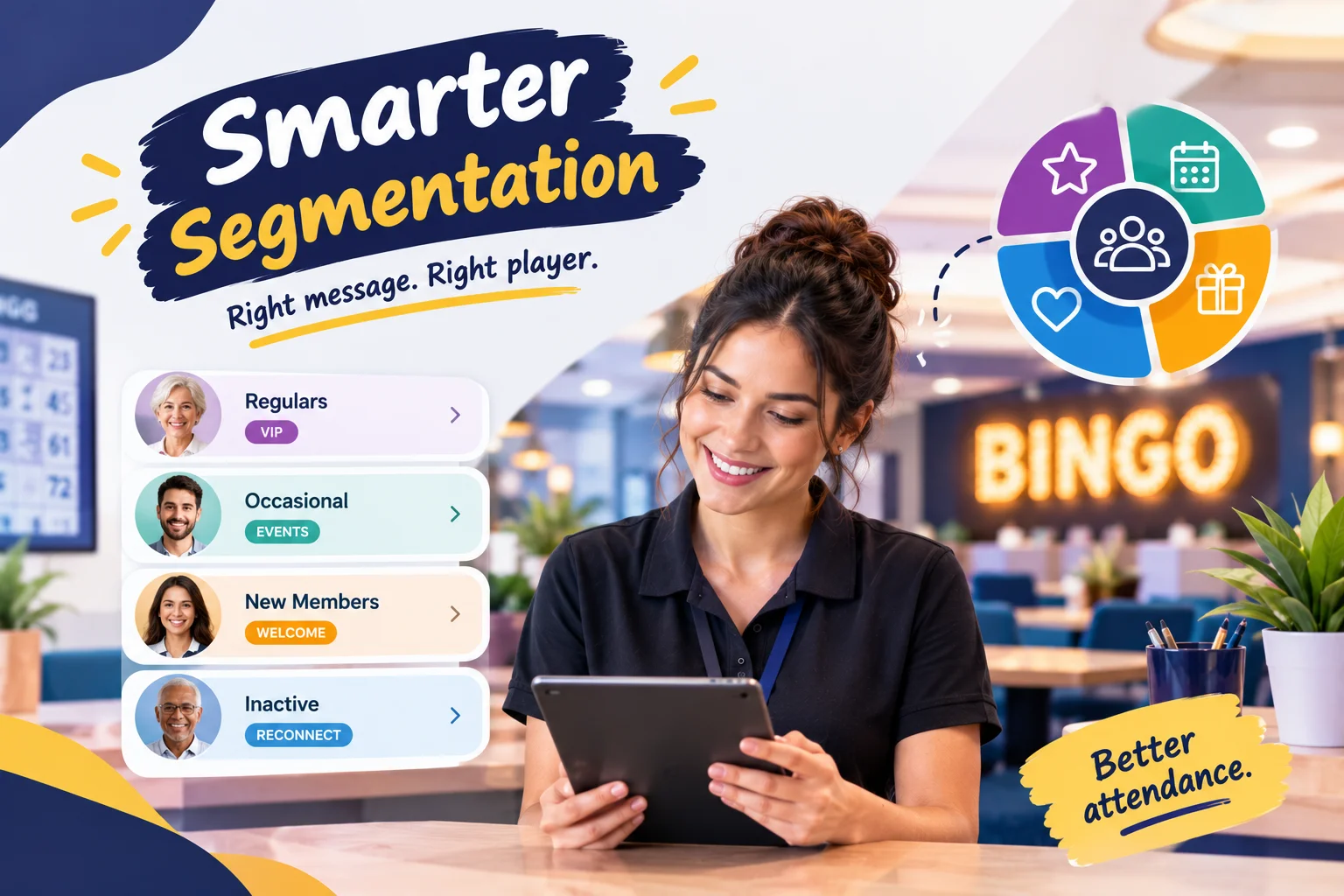
New Members
Focus on helping them understand the venue and loyalty programme.
Regular Players
Focus on relevant sessions, events, and loyalty activity.
VIPs
Focus on recognition, benefits, and appropriate exclusive communications.
Inactive Players
Focus on giving them a meaningful reason to return.
This is where customer segmentation becomes particularly useful.
Make Loyalty Part of the Calendar
SMS doesn't have to be limited to event promotion.
A loyalty programme creates natural reasons to communicate.
For example:
“You've reached your next loyalty milestone.”
“Your reward is ready.”
“You're close to unlocking your next achievement.”
“Your weekly challenge ends tonight.”
These messages are different from traditional promotional blasts because they relate to something the player has already done.
That makes them easier to integrate into a weekly communication plan.
Use Gamification When It Gives the Player a Reason to Act
If your venue uses gamification, add those moments to the calendar too.
A simple weekly sequence could be:
Monday: New challenge launches.
Wednesday: Progress reminder.
Friday: Challenge deadline.
The messages don't need to explain the entire gamification programme every time.
They simply bring the player's attention back to an activity that is already available.
This can help connect SMS with features such as challenges, achievement badges, loyalty points, or other engagement mechanics.
Plan Event Communication in Layers
A major fundraiser shouldn't rely on one SMS sent the night before.
A more deliberate approach might look like this:
Seven Days Before
Introduce the event.
Three Days Before
Remind the relevant audience and highlight what makes the event worth attending.
Event Day
Send a concise final reminder.
After the Event
Thank participants and communicate the next relevant step.
The exact schedule should be adjusted to the event and your customers.
Some events may need more lead time. Others may work better with a shorter campaign.
The important part is having a plan before the event becomes urgent.
Leave Space for Real-Time Messages
Planning a week doesn't mean locking yourself into every message.
Leave room for unexpected communication.
For example:
- An event sells out
- A session changes
- A new promotion becomes available
- A charity campaign reaches an important milestone
- Weather affects attendance
- An operational update needs to reach customers
Your calendar should create structure without removing flexibility.
Measure the Messages That Matter
Once the week is finished, spend a few minutes reviewing what happened.
You don't need to become a data analyst.
Start with straightforward questions.
Which campaigns were sent?
Which audiences received them?
Which messages generated engagement?
Did attendance change?
Did inactive players return?
Did players interact with the loyalty programme?
Did a promoted event perform as expected?
Over several weeks, patterns become easier to spot.
You may discover that event reminders work particularly well when sent two days before an event.
Or that a certain audience responds better to loyalty-related messages than general promotions.
The purpose of tracking isn't to create complicated reports.
It is to make next week's decisions easier.
Don't Let Your SMS Calendar Become a Spreadsheet Problem
Ironically, a communication calendar can become another administrative task if everything is maintained manually.
One spreadsheet might contain customer lists.
Another might contain campaign dates.
The SMS platform contains the actual messages.
The loyalty system contains player activity.
Then someone has to keep everything aligned.
This is where centralised SMS marketing becomes valuable.
With a dedicated SMS marketing hub, operators can manage campaigns and customer communication from a more connected environment rather than constantly moving between unrelated systems.
A Practical Weekly Template
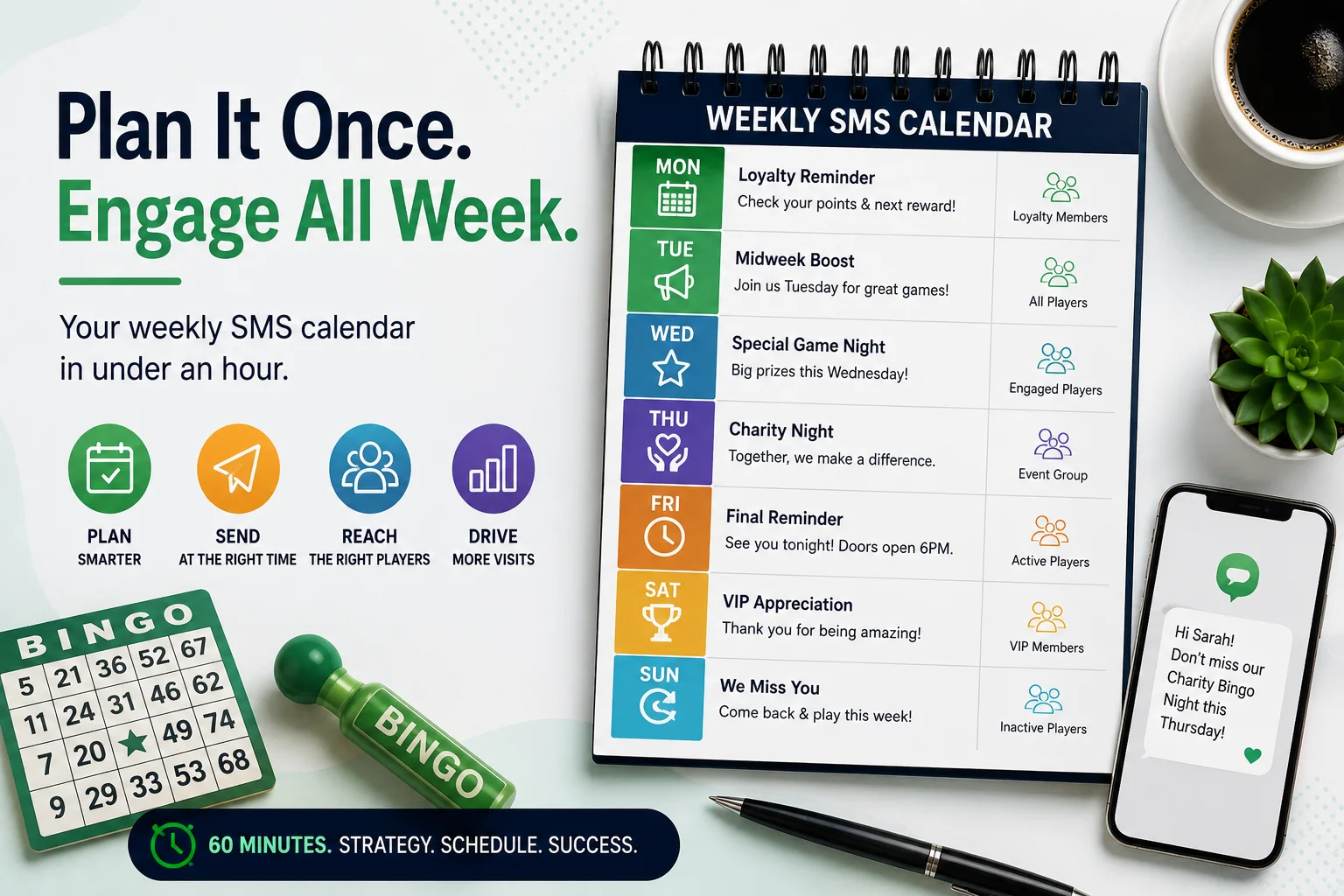
Here is a simple framework an operator could adapt:
| Day | Communication | Audience | Purpose |
| Monday | Upcoming event | Relevant players | Awareness |
| Tuesday | Loyalty/challenge update | Engaged members | Engagement |
| Wednesday | Event reminder | Targeted audience | Attendance |
| Thursday | Special-session reminder | Eligible players | Conversion |
| Friday | Final event message | Expected attendees | Reminder |
| Saturday | Follow-up | Participants | Retention |
| Sunday | No planned SMS | — | — |
This is only a starting point.
Your actual calendar should follow your venue's schedule and customer behaviour.
The important part is that you can see the entire week at once.
The 60-Minute Habit That Changes the Process
Once the basic structure is established, the weekly planning process becomes surprisingly simple.
10 minutes: Check the venue calendar.
10 minutes: Review audiences.
15 minutes: Decide campaign objectives.
15 minutes: Write the messages.
10 minutes: Review timing, overlap, and compliance requirements.
That's it.
One focused hour can replace dozens of small decisions scattered across the week.
And because the process repeats, the team gets faster over time.
How JustKonnect Fits Into the Workflow
An SMS marketing calendar works best when it is connected to the rest of the venue's player engagement strategy.
JustKonnect's SMS Marketing Hub gives bingo operators a central place to manage player communication rather than treating every campaign as a separate manual task.
That becomes particularly useful when SMS needs to work alongside loyalty programmes, player data, promotions, gamification, rewards, and other venue engagement activities.
Instead of maintaining a communication plan in one place and executing it somewhere else, operators can work toward a more connected process:
Audience → Campaign → SMS → Engagement → Outcome
That makes it easier to move from simply sending messages to understanding why each message is being sent and what happened afterward.
Frequently Asked Questions
How many SMS messages should a bingo hall send each week?
There is no universal number. It depends on your event schedule, audience segments, consent, communication preferences, and the value of each message. A smaller number of relevant messages is generally more useful than sending frequent messages without a clear purpose.
What should be included in a bingo hall SMS calendar?
Include upcoming bingo sessions, special events, fundraisers, loyalty updates, relevant promotions, re-engagement campaigns, and important customer communications. Also leave some space for unexpected operational messages.
How far in advance should bingo events be promoted by SMS?
The ideal timing depends on the event and audience. Major events generally benefit from earlier awareness followed by appropriately timed reminders, while routine sessions may need less lead time.
Should every player receive every SMS?
No. Where appropriate and permitted, segment customers according to relevant factors such as engagement, attendance patterns, loyalty status, event participation, or campaign eligibility. Always follow applicable consent and communication requirements.
Can SMS marketing be connected with loyalty programmes?
Yes. SMS can communicate loyalty milestones, rewards, challenges, achievements, VIP progress, and other player activity when the relevant systems support those connections.
How long does it take to create a weekly SMS calendar?
Once the process is established, a basic weekly calendar can be planned in around an hour. The biggest time savings come from having reusable campaign structures, defined audience segments, and a central system for managing communication.
A Better Week Starts Before Monday
The easiest way to make SMS marketing feel chaotic is to manage it one message at a time.
A better approach is to look at the entire week.
What is happening at the venue?
Which players need to know?
What action matters?
When should they hear from you?
What will you measure afterward?
Once those decisions are made together, SMS becomes much easier to manage.
The calendar doesn't need to be complicated. It needs to be intentional.
And when the communication is managed through a central platform rather than scattered across spreadsheets, contact lists, and disconnected tools, the process becomes easier to repeat.
For bingo halls that want to make SMS a more organised part of player engagement, JustKonnect's SMS Marketing Hub is worth exploring.
Plan the week in one place, communicate with more purpose, and give every message a reason to exist.