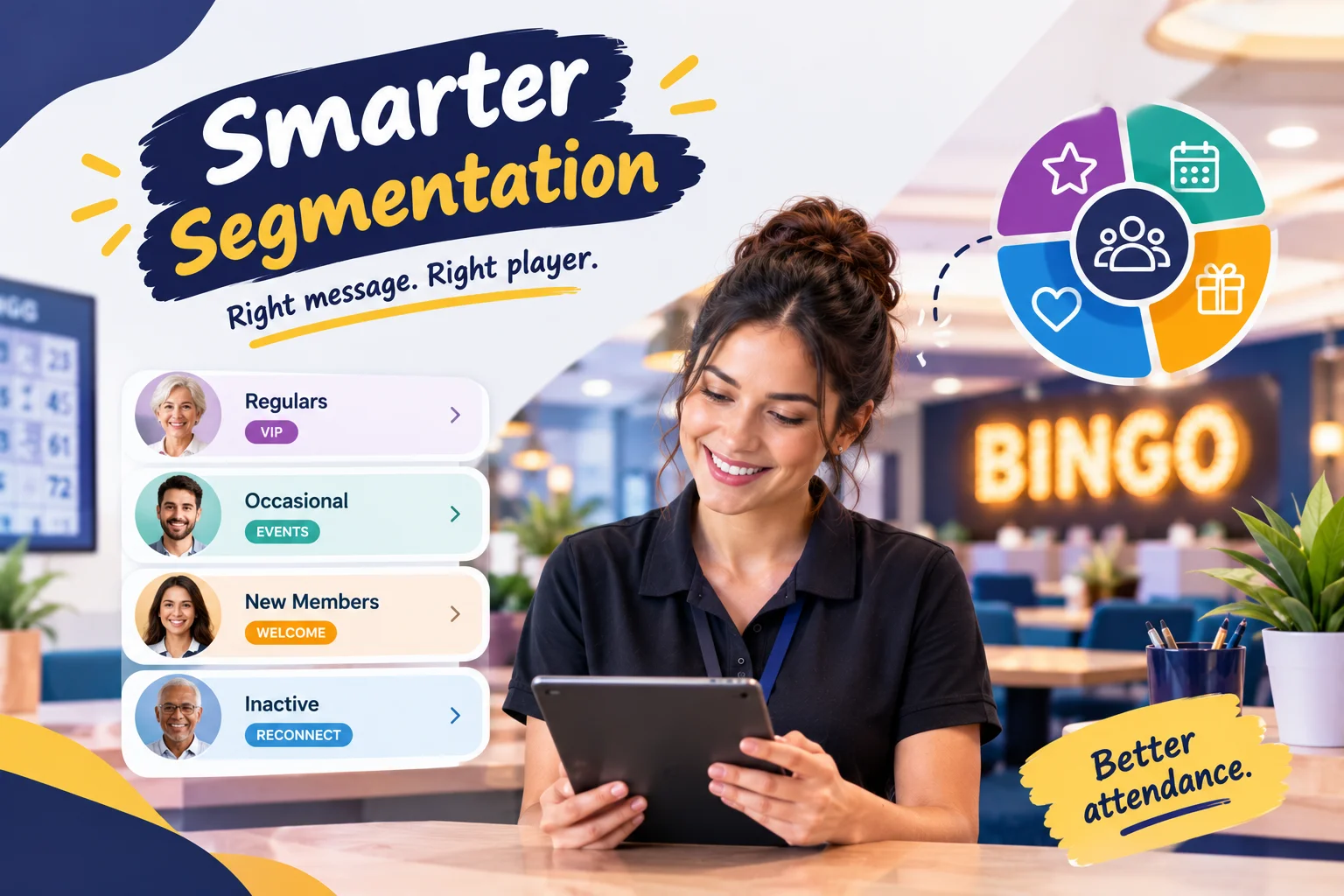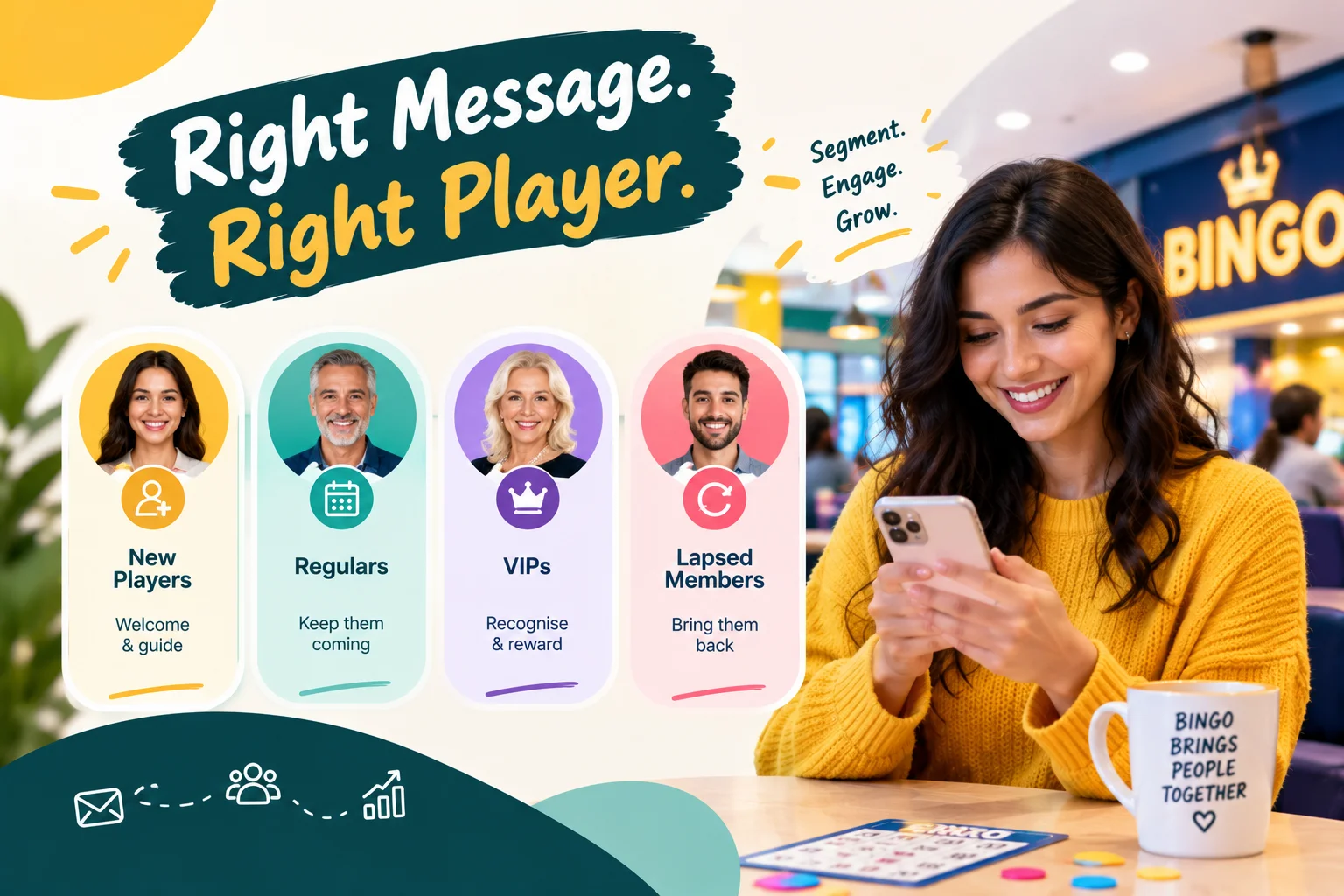
A first-time visitor walks into your bingo hall, enjoys the session, and leaves with a positive impression. A regular player already knows the schedule and rarely needs an introduction. A VIP member expects recognition for their continued involvement. Meanwhile, someone who used to attend every week has not walked through the door for months.
All four people may appear in the same customer database. But they are at very different stages of their relationship with your hall.
This is where bingo hall marketing often misses an opportunity. When every contact receives the same event announcement, promotional offer, and reminder, the communication may be relevant to some players but unnecessary or ineffective for others.
The better approach is to match each campaign to the relationship you are trying to build or maintain.
By separating new players, regulars, VIPs, and lapsed members into meaningful audience groups, operators can make welcome communications more useful, strengthen established habits, recognise loyalty, and create appropriate opportunities for inactive players to return.
Here is how to approach each segment, what to communicate, and how to determine whether your strategy is working.
1. New Players: Turn a First Visit Into a Second Visit
Acquiring a new player is only the beginning. The next challenge is helping that person feel comfortable enough to return.
First-time visitors may not know which sessions suit them, how your loyalty programme works, what events are coming up, or what makes your hall different from other entertainment options. A generic promotional message does little to answer those questions.
The first stage of your marketing should make the next visit feel familiar and straightforward.
What new players need from your marketing
Think about the questions someone might have after their first session:
- When is the next suitable session?
- What should I know before coming back?
- Can I participate in a loyalty programme?
- Are there upcoming events worth attending?
- Where can I find accurate information about schedules and offers?
Your follow-up communications should address these practical questions rather than immediately pushing multiple promotions.
For example, a welcome message could thank the player for visiting, provide a link to the upcoming session schedule, and explain how to receive future event updates if they have opted in.
A later communication might introduce your loyalty programme or highlight an upcoming event that fits your usual audience.
Build a simple new-player journey
A welcome journey does not need to be complicated. Start with three useful touchpoints.
After the first visit: Send a welcome or thank-you message where permitted. Make it easy for the player to find essential information about the hall.
Before a relevant upcoming session: Share accurate event details, including the date, time, and any information a returning visitor needs.
After the next visit: Where your records support it, acknowledge the player's continued involvement and introduce an appropriate next step, such as loyalty benefits or future events.
The timing should reflect your session schedule, available data, and communication permissions. Avoid sending messages simply because a preset number of days has passed.
What to measure
For this segment, the most useful question is whether new members are developing a repeat attendance habit.
Track measures such as:
- Percentage of first-time visitors who attend again within a defined period.
- Time between the first and second visit.
- Engagement with welcome communications.
- Loyalty programme enrolment, where relevant.
These measures help distinguish between a campaign that simply delivers messages and one that supports the next stage of the player relationship.
2. Regular Players: Give People Reasons to Keep Choosing Your Hall
Regular players have already established a relationship with your venue. They understand the basics, recognise familiar staff, and may have a preferred session or routine.
Marketing to them should not feel like marketing to strangers.
A regular who attends every Friday probably does not need another explanation of how your hall works. They may, however, appreciate timely information about a special event, a change to the schedule, or a session they would not normally consider.
The objective is to maintain engagement without making routine attendance feel like an endless sales opportunity.
Replace generic announcements with relevant invitations
Suppose your hall is organising a special midweek event.
Sending the same introductory message to every member wastes space explaining familiar details to regulars. Instead, use a concise message that focuses on what is different about the upcoming session.
For example:
“Planning your usual visit this week? Our special Wednesday session is coming up on [date]. Check the schedule for details and join us for another evening at the hall.”
This is illustrative copy. The actual message should reflect the event and the information players need.
You can also use regular-player campaigns to:
- Announce schedule changes before players arrive.
- Introduce special sessions or seasonal events.
- Share relevant loyalty programme updates.
- Invite players to events outside their usual routine.
- Provide reminders based on their known attendance patterns, where available.
The important distinction is relevance. A message should give the recipient a useful reason to pay attention.
Protect the relationship from over-messaging
Frequent attendees are often among the easiest audiences to contact because they are familiar with the venue. That does not mean they should receive every campaign.
A regular player might qualify for a general event announcement, a loyalty message, and a birthday campaign in the same week. Without coordination, individually reasonable messages can create an excessive overall frequency.
Before sending a campaign, consider whether the player needs that information, whether another message already covers it, and whether the communication adds something useful.
What to measure
Regular-player marketing should focus on maintaining attendance and introducing relevant opportunities rather than simply increasing message volume.
Useful measures include:
- Visit frequency over time.
- Attendance at promoted versus routine sessions.
- Response to special-event communications.
- Loyalty participation and reward redemption.
- Opt-out rates and engagement trends.
Compare results across appropriate periods. A busy week does not automatically prove that a campaign caused the increase; seasonal patterns, special events, and other factors can influence attendance.
3. VIPs: Recognise Loyalty Without Making Every Interaction About Rewards
VIP members often have a longer or more engaged relationship with a hall. Depending on how the programme is defined, they may attend frequently, participate actively in loyalty rewards, or qualify for a particular membership tier.
The mistake is to assume that VIP marketing means sending bigger offers more often.
Recognition can be valuable even when it does not involve a discount or financial incentive. Clear communication, relevant invitations, consistent service, and acknowledgement of membership can all help a loyalty programme feel more meaningful.
Start by defining what VIP actually means
Every venue should establish its own transparent criteria for VIP status. These might involve a defined loyalty tier, qualifying attendance, programme participation, or another legitimate measure supported by the hall's policies.
Avoid assigning VIP status based on an employee's informal opinion or a vague assumption about a player's value.
A consistent definition helps staff understand who qualifies and helps operators apply benefits fairly.
It also makes marketing easier to evaluate because the segment is based on explicit criteria rather than a subjective label.
Make recognition specific and useful
VIP communication should reflect the actual benefits and experiences your hall offers.
Depending on your programme, that might include:
- Invitations to eligible member events.
- Updates about relevant VIP benefits.
- Recognition of membership milestones.
- Information about available loyalty rewards.
- Early communication about selected events, where genuinely offered.
For example, if your venue offers a defined VIP event, an appropriate message could be:
“As a member of our VIP programme, you're invited to our upcoming member event on [date]. Review the event details and let us know if you plan to attend.”
Only use this type of message when the invitation is a real programme benefit and the recipient is eligible.
Avoid turning VIP status into a constant sales pitch
The purpose of a VIP segment is not to maximise the number of promotions sent to its members. It is to make communications reflect the relationship the hall has established with them.
A player who receives a meaningful membership update may feel better recognised than someone who receives another generic discount message.
Operators should also monitor the effect of incentives. If every campaign relies on an extra reward, it becomes harder to understand whether members value the broader programme or simply respond to individual offers.
What to measure
Evaluate VIP campaigns against their specific purpose.
If the goal is event participation, monitor eligible invitations, responses, and attendance. If the goal is loyalty engagement, review participation and redemption where available. If the objective is retention, monitor changes in attendance over time.
Do not assume that VIP members will remain active indefinitely. A high-engagement member can change their routine, and an established relationship still needs attention.
4. Lapsed Members: Reopen the Conversation With a Relevant Reason to Return
Lapsed players require a different approach because the relationship has changed.
These are people who previously attended or engaged with your hall but have become less active. Some may have lost track of upcoming sessions. Others may have changed their schedules, moved away, or simply decided that the venue is no longer a priority.
The database alone cannot tell you why a person stopped visiting.
That uncertainty matters. A message that assumes every inactive member has forgotten about the hall may feel irrelevant to someone whose circumstances have changed.
Define inactivity according to the player's usual pattern
There is no universal inactivity threshold that works for every bingo hall.
A player who normally attends several times a week has a different routine from someone who visits for occasional special events. If both are classified as lapsed after the same number of days, the segment may contain people with very different needs.
Use available visit history to establish reasonable criteria. Where possible, distinguish between recently inactive players and those who have been absent for a much longer period.
Review these rules periodically so that the segment reflects real attendance patterns rather than an arbitrary date.
Give the player a reason to reconsider
A re-engagement campaign should make returning feel worthwhile without suggesting that the hall knows why the person stopped attending.
Possible approaches include:
A straightforward invitation: Share an upcoming session with clear details and a welcoming tone.
A relevant event update: Highlight a genuine event or programme development that may give the recipient a reason to visit again.
An eligible incentive: If appropriate under your programme and applicable rules, offer a defined benefit with accurate terms and an expiry date.
For example:
“It's been a while since your last visit, and we'd love to welcome you back. Our upcoming sessions are listed here: [link]. Take a look and see if there's a date that suits you.”
This message is deliberately simple. It opens the door without demanding an explanation or assuming that an incentive is necessary.
If a special offer is available, explain its conditions clearly rather than hiding important details behind promotional language.
Know when to stop sending re-engagement messages
Not every inactive player will return, and continued contact is not always the right response.
Set sensible limits on how many re-engagement messages a person can receive. Respect opt-outs and communication preferences, and avoid repeatedly sending the same offer to someone who has not responded.
Where permitted and supported by your data, compare different message approaches to learn what appears useful. Do not interpret silence as permission to increase message frequency.
What to measure
For lapsed-member campaigns, measure actual reactivation rather than treating message engagement as the final result.
Consider:
- Number of previously inactive players who return during a defined period.
- Return visits following the campaign.
- Redemption of any eligible incentive.
- Campaign cost relative to measurable outcomes.
- Opt-outs and negative engagement signals.
Where practical, compare results with a suitable group that did not receive the campaign. This can help distinguish campaign impact from visits that might have happened anyway.
Four Segments, Four Different Marketing Priorities
The distinctions become easier to apply when each group has a clear purpose.
| Player segment | Main objective | Communication priority | Primary measure |
| New players | Encourage a second visit | Welcome, explain, and guide | Repeat-visit rate |
| Regulars | Maintain engagement | Relevant sessions and event updates | Attendance patterns |
| VIPs | Recognise and sustain loyalty | Eligible benefits and meaningful recognition | Programme engagement and retention |
| Lapsed members | Encourage an appropriate return | Relevant invitations and re-engagement | Return visits |
These categories are a starting point, not a permanent description of every player.
A new member may become a regular. A regular may qualify for VIP status. A VIP may become inactive. A previously lapsed member may return and resume attending frequently.
The marketing process should allow these relationships to change as new information becomes available.
How to Put the Four-Segment Strategy Into Practice
You do not need to build a complicated campaign system before using these categories. Start with a manageable process and improve it as you learn more about your audience.
Step 1: Choose reliable criteria for each segment
Define what qualifies someone as a new player, regular, VIP, or lapsed member.
Use information your hall can access and maintain, such as first-visit records, attendance frequency, last-visit dates, and documented loyalty status. Avoid relying on assumptions that cannot be verified.
Step 2: Decide what each campaign should achieve
Before preparing a message, identify the intended outcome.
Is the campaign intended to encourage a second visit, promote an upcoming event, increase participation in a loyalty programme, or invite previously active players to return?
A clear objective makes it easier to choose the right audience and evaluate the results.
Step 3: Match the message to the relationship
Write for the recipient's situation.
New players may need context. Regulars may need concise event information. VIPs may need accurate details about benefits they qualify for. Lapsed members may need a welcoming invitation that does not assume why they have been absent.
The same event can be promoted to all four groups, but the emphasis can change.
Step 4: Coordinate channels and contact frequency
Choose an appropriate channel based on the campaign, available contact details, and player permissions. SMS, email, and push notifications may each have a role, depending on the tools and consent available.
Check for overlapping campaigns so one person does not receive multiple messages simply because they belong to several eligible groups.
Step 5: Review results and update the segments
After each campaign, review the outcomes against the original objective. Look for patterns in attendance, engagement, redemptions, and opt-outs where the relevant data is available.
Then check whether the segment definitions still make sense. A successful process is not just about sending a targeted message; it is also about keeping the underlying audience information accurate.
How JustKonnect Can Help Bingo Halls Organise These Audiences
Managing four player segments manually becomes harder as the database grows. Staff may have to combine attendance records, loyalty lists, and contact spreadsheets before each campaign, increasing the risk of outdated information or inconsistent targeting.
JustKonnect's Customer Segmentation feature is designed to help bingo operators group players using relevant criteria such as attendance behaviour, visit recency, loyalty engagement, and campaign response.
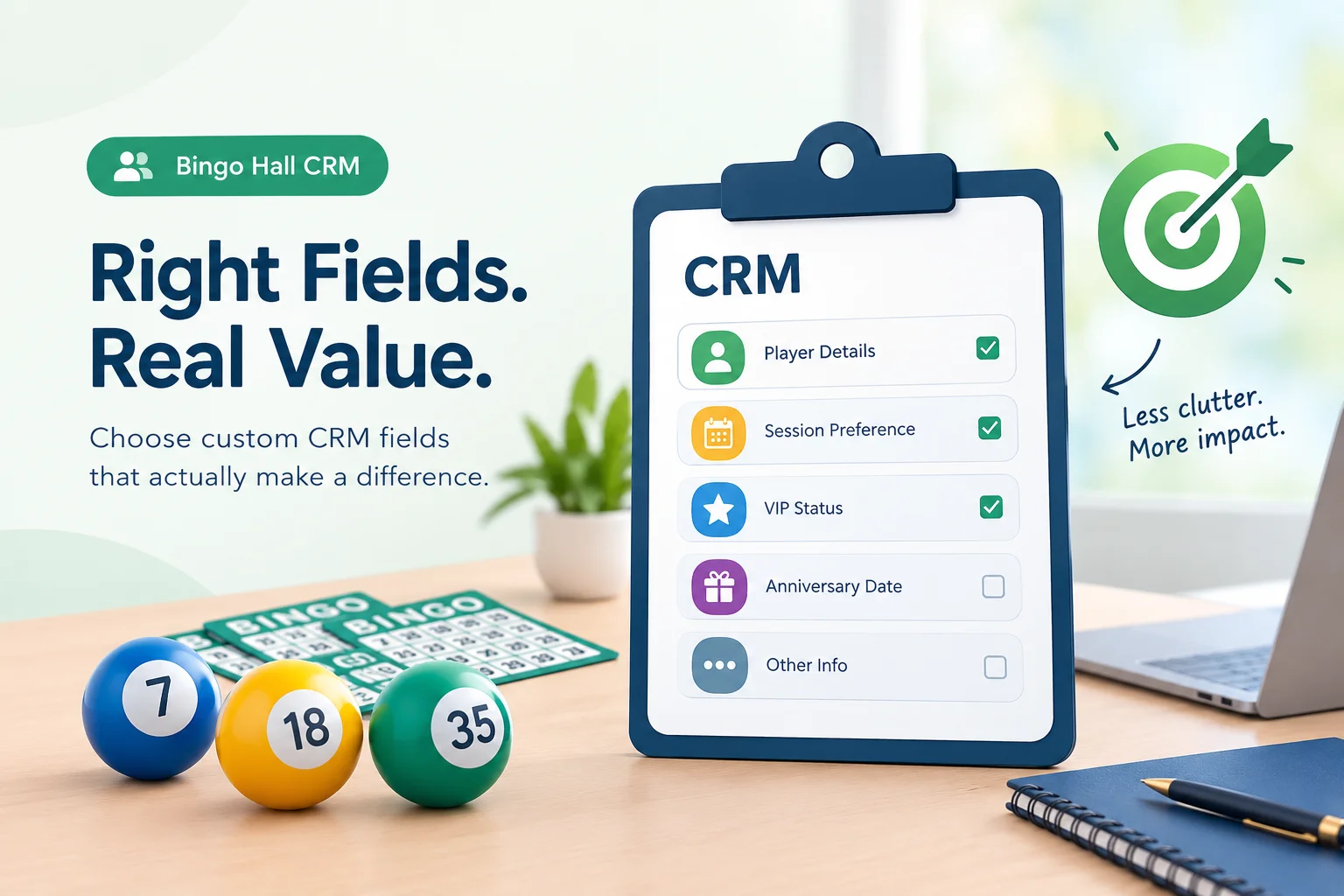
Its Player Profiles & CRM brings player information together, including visit history, contact details, and loyalty status. This provides a more useful starting point for understanding the relationship between a player and the hall than a contact list alone.
Operators can use these capabilities to organise their campaign audiences and make more deliberate decisions about who should receive each communication. Where dynamic segmentation is supported and correctly configured, audience membership can reflect changes in player activity.
The value comes from connecting the data to a clear marketing decision. Technology cannot guarantee that a player will attend, redeem a reward, or respond to a message. It can, however, help a hall organise its audience and measure whether its communication strategy is producing the intended outcomes.
Frequently Asked Questions
Why should bingo halls market differently to new players and regulars?
New players may need introductory information and encouragement to visit again, while regulars already understand the hall and may benefit more from relevant session reminders, event announcements, or loyalty updates. Different communication priorities help avoid sending unnecessary information.
How should a bingo hall define a VIP player?
A hall should use clear, documented criteria based on its own membership or loyalty programme. These could include a qualifying tier, attendance requirements, or programme participation. The definition should be consistent, accurate, and aligned with the benefits actually offered.
When should a player be considered lapsed?
There is no single timeframe suitable for every venue. Operators should consider how frequently the player normally attends and define inactivity thresholds accordingly. Someone who usually visits weekly may need to be assessed differently from an occasional event attendee.
Should lapsed players receive discounts to encourage them to return?
Not necessarily. A relevant event invitation or a simple reminder may be sufficient for some players. Incentives can be tested where appropriate, but they should have clear eligibility rules and terms. Measure whether they contribute to meaningful return visits rather than assuming every incentive is worthwhile.
Can one player belong to more than one segment?
Yes. A player could be a VIP member and a regular attendee at the same time. The hall should decide which campaign is most relevant, coordinate overlapping communications, and apply frequency limits so the player does not receive unnecessary messages.
How often should a bingo hall update its player segments?
It depends on how quickly the underlying information changes. Visit-based segments may need frequent updates, while membership categories may change less often. Review the rules regularly and use dynamic updates where the CRM supports them.
How can a bingo hall measure whether segmentation is working?
Measure each campaign against its objective. Welcome campaigns can be assessed through repeat visits, event promotions through attendance, VIP campaigns through relevant programme engagement, and re-engagement campaigns through return visits. Delivery, clicks, and redemptions can provide additional context, but they should not replace the outcome that matters.
Build Campaigns Around the Player Relationship
New players, regulars, VIPs, and lapsed members are not simply four lists to select before sending a message. They represent different relationships with your hall, and each relationship calls for a different marketing priority.
Welcome new players with useful information. Give regulars relevant reasons to stay engaged. Recognise VIPs through genuine programme benefits. Approach lapsed members with thoughtful invitations and realistic expectations.
Start with clear segment definitions, keep the underlying data accurate, and measure outcomes consistently. Over time, those habits can help your hall move from sending more messages to making each campaign more purposeful.
Explore JustKonnect Customer Segmentation to see how player groups can support more relevant bingo hall marketing and a more organised approach to player engagement.