A special bingo night is approaching, and the hall wants to promote it.
The marketing team has a list of 2,000 players. Some attend several times a week. Others visit only for major jackpots. A group joined recently but has not yet established a routine. Another group used to attend frequently but has barely appeared in recent weeks.
One promotion. Four very different relationships with the hall.
Sending the same message to every player might seem efficient, but it overlooks an important question: who has the strongest reason to respond to this particular campaign?
Player segmentation helps bingo operators answer that question. Instead of treating the entire database as one audience, the hall groups players according to relevant information and adapts its communication accordingly.
The result is a more deliberate approach to campaign planning. Messages have a clearer audience, incentives can be allocated more thoughtfully, and operators can assess which groups actually respond.
A Campaign Should Begin With an Audience Decision
Many promotional campaigns start with an offer.
The hall decides to announce a jackpot, introduce a special session, or promote a loyalty reward. Someone writes the message, chooses a sending time, and distributes it to the available contact list.
Segmentation changes the order of those decisions.
Before writing the message, ask three questions:
- What do we want players to do?
- Which players are most relevant to that objective?
- What information supports our decision to contact them?
Suppose the objective is to improve attendance at a quieter Wednesday session. Sending an announcement to every player might reach people who already attend every Wednesday, people who never attend midweek, and people who have not visited for months.
Those audiences may need different approaches.
Regular Wednesday attendees might need a simple reminder. Players who attend other weekdays could receive information about what makes Wednesday's session worth considering. Previously active players who have become less frequent visitors might be suitable for a carefully designed re-engagement campaign.
The offer does not necessarily need to change for every group. Sometimes changing the message or timing is enough.
The important part is that the audience is chosen deliberately rather than inherited from the master database.
Build Your First Segments Around Five Useful Signals
A segmentation strategy does not need dozens of audience groups to be effective. Start with information that tells you something meaningful about a player's relationship with the hall.
1. Visit frequency: Who attends regularly?
Visit frequency helps distinguish frequent attendees from occasional visitors.
A hall might use this information to recognise its regular audience, plan appropriate reminders, or understand which players already have an established attendance routine.
For example, a player who visits three times most weeks may not need the same introductory message as someone who attends once every few months.
The objective is to acknowledge differences in behaviour without assuming that frequent attendance automatically means someone wants more promotional messages.
2. Last visit: Who may need a reason to return?
The date of a player's most recent visit can help identify changes in attendance.
Consider two players who were previously regular attendees. One visited last week; the other has not visited for six weeks.
They should not necessarily receive the same re-engagement message.
The first player may simply need information about an upcoming session. The second may warrant a different approach, depending on their previous attendance pattern and the hall's campaign rules.
Set inactivity thresholds that make sense for your venue rather than choosing an arbitrary number of days. A weekly player and someone who attends only for monthly events have different normal routines.
JustKonnect's Player Profiles CRM supports player information such as visit history, attendance frequency, and last-seen date, giving operators useful signals for organising these audiences.
3. Loyalty status: Who participates in your rewards programme?
Loyalty information can help the hall distinguish between players at different stages of programme participation.
For example, a hall might have:
- Players who have recently joined the loyalty programme.
- Members who regularly earn or redeem points.
- Eligible members approaching a reward.
- Players who have not engaged with the programme recently.
Each group presents a different communication opportunity.
A new participant may benefit from an explanation of how rewards work. An eligible member might appreciate a reminder about a reward they can claim. Someone who has not engaged recently may need clearer information about the programme's benefits.
The right message depends on the actual loyalty rules and the information available in the player's record.
Avoid assuming that every loyalty member wants a discount or that every player with unused points has forgotten about them.
4. Campaign engagement: Who responds to your communications?
A player's interaction with previous campaigns can help inform future decisions.
Depending on the data available, a hall might review message delivery, clicks, replies, offer redemptions, or other recorded interactions.
For instance, if a player responds to event announcements but rarely redeems discount offers, the operator could test a campaign focused on event details rather than another incentive.
One response should not define a player's preferences permanently. Campaign engagement can be influenced by timing, message quality, the offer, and whether the player was available to attend.
Use engagement data as a signal to test, not as a fixed label.
5. Event or offer relevance: Who is this promotion actually for?
Some campaigns are tied to a particular occasion, session, or benefit.
A jackpot event may appeal to a different audience from a membership anniversary campaign. A loyalty reward reminder may be relevant only to players who qualify for that reward.
Where reliable data is available, use it to identify eligible audiences instead of sending every promotion to the entire database.
This also helps reduce unnecessary messaging. A player who is not eligible for an offer should not receive a message that creates confusion or disappointment.
One Promotion, Four Different Campaign Decisions
Consider a fictional hall planning a special Saturday jackpot session. The operator wants to increase awareness and encourage attendance, but does not want to send an identical message to every player.
Here is how segmentation could shape the campaign.
| Player segment | Campaign objective | Possible message approach |
| Regular Saturday attendees | Help existing attendees plan their visit | Clear event details and a reminder of the session time |
| Players who attend other sessions | Introduce a relevant alternative session | Explain the Saturday event and what makes it different |
| New members | Help them understand how to attend | Provide a welcoming invitation and practical session information |
| Previously active but recently absent players | Encourage a return visit | Share the event information and, where appropriate, a relevant incentive |
These are example strategies, not guaranteed response patterns. A hall should use its own attendance records and campaign results to determine which groups are most promising.
Notice that the same event can support four different messages without requiring four completely different promotions.
The first group may already know the hall well. New members may need basic information. A lapsed player may need a more compelling reason to consider returning.
Segmentation helps the operator decide which details deserve emphasis.
The Difference Between a Useful Segment and an Arbitrary List
A segment is not valuable simply because it contains a distinct group of names.
It should be possible to explain why the group exists and what the hall intends to do with it.
Compare these two examples.
Arbitrary segment: Players whose surnames begin with A through F.
Unless the hall has a specific operational reason for this grouping, it offers little guidance about campaign relevance.
Purposeful segment: Players who attended regularly during a previous period but have not visited within a defined recent period.
This group has a clear relationship to an operational question: which previously active players might benefit from an appropriate re-engagement message?
Even then, the segment is only a starting point. Some players may have changed their routines, moved away, or chosen not to receive marketing communications. Eligibility, contact preferences, and available evidence should guide the final audience.
A useful test is to ask: If this segment did not exist, what decision would become harder?
If the answer is unclear, the segment may not be worth maintaining.
How Many Segments Does a Bingo Hall Really Need?
There is no universal number. The right amount depends on the size of the database, the campaigns the hall runs, the quality of its data, and the time available to manage communications.
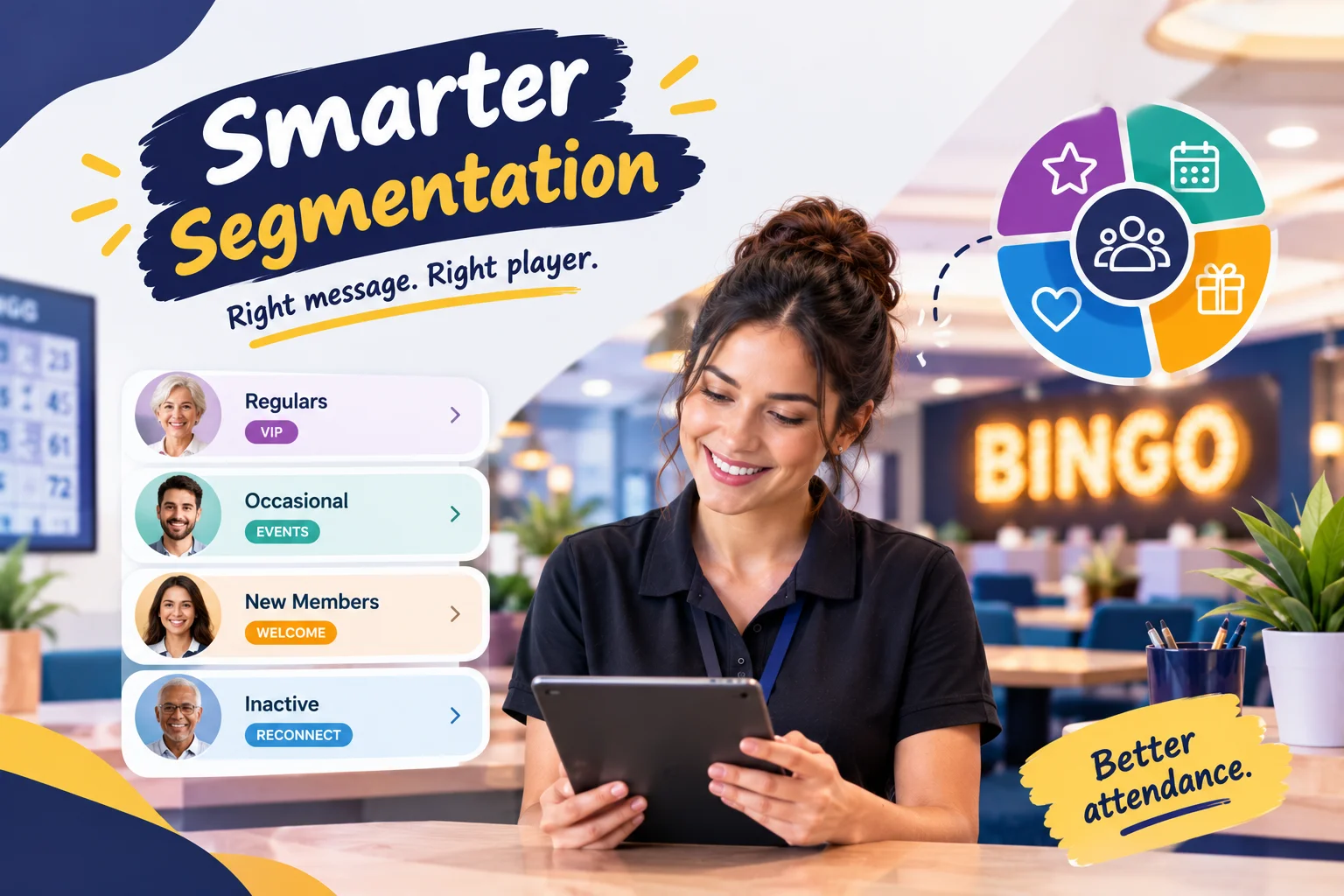
A smaller hall might begin with four practical groups:
- New members.
- Frequent attendees.
- Occasional attendees.
- Previously active players who have become less active.
These groups provide a foundation for welcome messages, relevant session reminders, and re-engagement campaigns.
As the hall gathers reliable data, it can introduce additional segments for loyalty participation, event relevance, or campaign engagement.
The key is to avoid creating more groups than the team can use meaningfully.
A database with 30 segments is not automatically more sophisticated than one with six. If several segments receive the same message and serve the same purpose, they may be unnecessarily complicated.
Start small, evaluate the results, and add complexity only when it improves a real campaign decision.
Turning Segmentation Into a Repeatable Campaign Workflow
The challenge is not creating the first segment. It is using segmentation consistently without turning every campaign into a manual data exercise.
A repeatable workflow can help.
Step 1: Define one campaign objective
Choose a specific goal, such as promoting a special session, encouraging eligible players to redeem a reward, or reconnecting with previously active attendees.
Avoid trying to improve every attendance and loyalty metric through a single message.
Step 2: Identify the required player data
Decide which information is necessary to build the audience.
For a re-engagement campaign, this might include last-visit date and previous attendance frequency. For a reward reminder, it might include current loyalty status and reward eligibility.
Use reliable existing records wherever possible instead of creating unnecessary custom fields.
Step 3: Establish eligibility rules
Determine who should be included and excluded.
Check communication permissions, opt-out status, offer eligibility, and any relevant campaign restrictions. Remove players for whom the message is not appropriate.
Step 4: Match the message to the segment
Write the message around the audience's likely needs.
A new member may need an explanation. A regular may need a concise reminder. A lapsed player may need a relevant reason to return.
Keep the communication accurate and avoid making unsupported assumptions about why someone has or has not attended.
Step 5: Send through the appropriate channel
Choose SMS, email, push notifications, or another suitable channel based on the campaign's purpose, player permissions, and the contact information available.
A targeted audience does not remove the need to follow the relevant channel-specific requirements.
Step 6: Review the outcome
Look beyond the number of messages sent.
Where the necessary tracking is available, review delivery, responses, clicks, redemptions, and attendance during the relevant period. Compare the results with previous campaigns or an appropriate comparison group.
This final step helps the hall determine whether the segment was useful and whether the message or offer needs to change.
Why Static Segments Can Become Outdated
A player who was considered a regular last month may become less active. Someone who recently joined may develop a consistent attendance routine. A player who previously ignored campaigns may respond to a new type of event.
Player relationships change, so segmentation needs to account for changing information.
Where the CRM supports dynamic segments, membership can update as player activity changes. This reduces the need to rebuild lists manually every time a campaign is prepared.
JustKonnect's Customer Segmentation feature is designed to organise players using relevant behaviour and engagement criteria, including visits, recency, loyalty engagement, and campaign response.
Before relying on a dynamic segment, confirm how its rules are configured, when membership refreshes, and whether exclusions remain in place. Automated updates are only useful when the underlying data and rules are accurate.
For halls that currently use spreadsheets, begin by documenting the segment criteria and reviewing how often the list needs updating. Even a simple, consistently maintained process is better than a complicated segmentation model built on outdated information.
How to Know Whether a Segment Is Actually Working
A campaign can produce a high number of responses without achieving its underlying objective. Players might click a message but never attend the event. They might redeem an offer they would have used anyway. Alternatively, a campaign could generate modest engagement while bringing back a meaningful number of previously inactive attendees.
That is why segment performance should be evaluated against the campaign's original purpose.
| Campaign objective | Useful measures |
| Promote an upcoming session | Attendance during the relevant session, campaign response, and delivery |
| Re-engage inactive players | Return visits during a defined period and cost per reactivated player where measurable |
| Increase loyalty participation | Programme participation, reward redemption, and repeat attendance where available |
| Welcome new members | Second-visit rate within a defined period and engagement with welcome communications |
| Improve campaign relevance | Response rates by segment, opt-outs, and attendance outcomes |
For example, a hall might compare a targeted re-engagement campaign with a similar previous campaign. It should account for differences in timing, offers, session schedules, and audience composition before concluding that segmentation caused an improvement.
Where practical, a small holdout group that does not receive the campaign can help the operator estimate whether the communication made a difference beyond what might have happened naturally. Use this approach only when it is operationally appropriate and consistent with communication preferences and applicable requirements.
JustKonnect's Analytics capabilities are designed to help operators review campaign performance, visit-frequency trends, engagement, and reward activity. These measures can inform future segmentation decisions rather than leaving the team to rely on intuition alone.
Mistakes That Weaken Player Segmentation
Even a well-designed CRM can produce poor campaign results when the segmentation process is not maintained carefully.
Creating segments that are too broad. A group containing almost every player may not offer much targeting value. Define the audience around the campaign objective.
Making segments too narrow. If every small difference creates a new audience, campaign management becomes unnecessarily complicated. Combine groups when they genuinely need the same communication.
Using outdated data. Old attendance records or inaccurate loyalty information can place players in the wrong segment. Review data quality before sending.
Treating behaviour as certainty. Past attendance or campaign engagement can inform decisions, but neither guarantees future behaviour. Leave room for changing circumstances.
Ignoring message frequency. A player can qualify for several segments at once. Without campaign coordination, they may receive too many messages in a short period. Use appropriate frequency controls and exclusions.
Measuring opens or clicks alone. Engagement metrics are useful, but they may not reflect actual attendance. Choose measures that align with the intended outcome.
Forgetting communication preferences. Segmentation should improve relevance, not bypass consent or opt-out requirements. Maintain eligibility rules across the entire campaign workflow.
Frequently Asked Questions
What is player segmentation in a bingo hall?
Player segmentation is the process of grouping members using relevant information such as visit frequency, last visit, loyalty status, or campaign engagement. Operators use these groups to make communications, offers, and service decisions more relevant to each audience.
Which player segments should a bingo hall create first?
A practical starting point is new members, frequent attendees, occasional visitors, and previously active players who have become less active. The best starting groups are those that support campaigns the hall already runs and can maintain with reliable data.
Does player segmentation increase bingo hall attendance?
Segmentation can help operators deliver more relevant messages and identify appropriate audiences for attendance campaigns. However, results depend on the offer, timing, message quality, player circumstances, and other factors. Halls should measure attendance outcomes rather than assume segmentation automatically increases visits.
How often should player segments be updated?
Update frequency should reflect how quickly the underlying data changes and how the segment will be used. Segments based on recent attendance may need frequent updates, while a membership category may change less often. Dynamic segmentation can help when the CRM supports it.
Can bingo halls segment players by loyalty points?
Yes, where the CRM makes loyalty information available for supported searches or segment rules. This can help operators identify eligible members for reward-related communications, provided the loyalty data is accurate and the campaign follows the programme's rules.
Should every segment receive a different offer?
No. Sometimes the same offer is appropriate for several groups, but the message, timing, or explanation may differ. The objective is to make the communication relevant, not to create a unique promotion for every audience.
What is the difference between player segmentation and customer behaviour analytics?
Segmentation groups players according to selected criteria so operators can act on those groups. Behaviour analytics examines patterns and outcomes to help operators understand what players do and which strategies may be effective. The two approaches complement each other.
Stop Treating Your Player Database as One Audience
A bingo hall's database contains people with different attendance routines, loyalty relationships, and reasons for visiting. A single campaign cannot always address those differences equally well.
Player segmentation gives operators a practical way to choose who should receive a message, why it is relevant, and what outcome the hall hopes to achieve.
Start with a small number of useful groups. Keep the underlying records accurate. Match each campaign to a clear objective, and review the results before repeating it.
If your team is ready to move beyond sending every promotion to the same contact list, explore JustKonnect Customer Segmentation.
See how behaviour-based player groups can help your hall organise more relevant promotions, manage campaign audiences, and make better-informed decisions about attendance and retention.