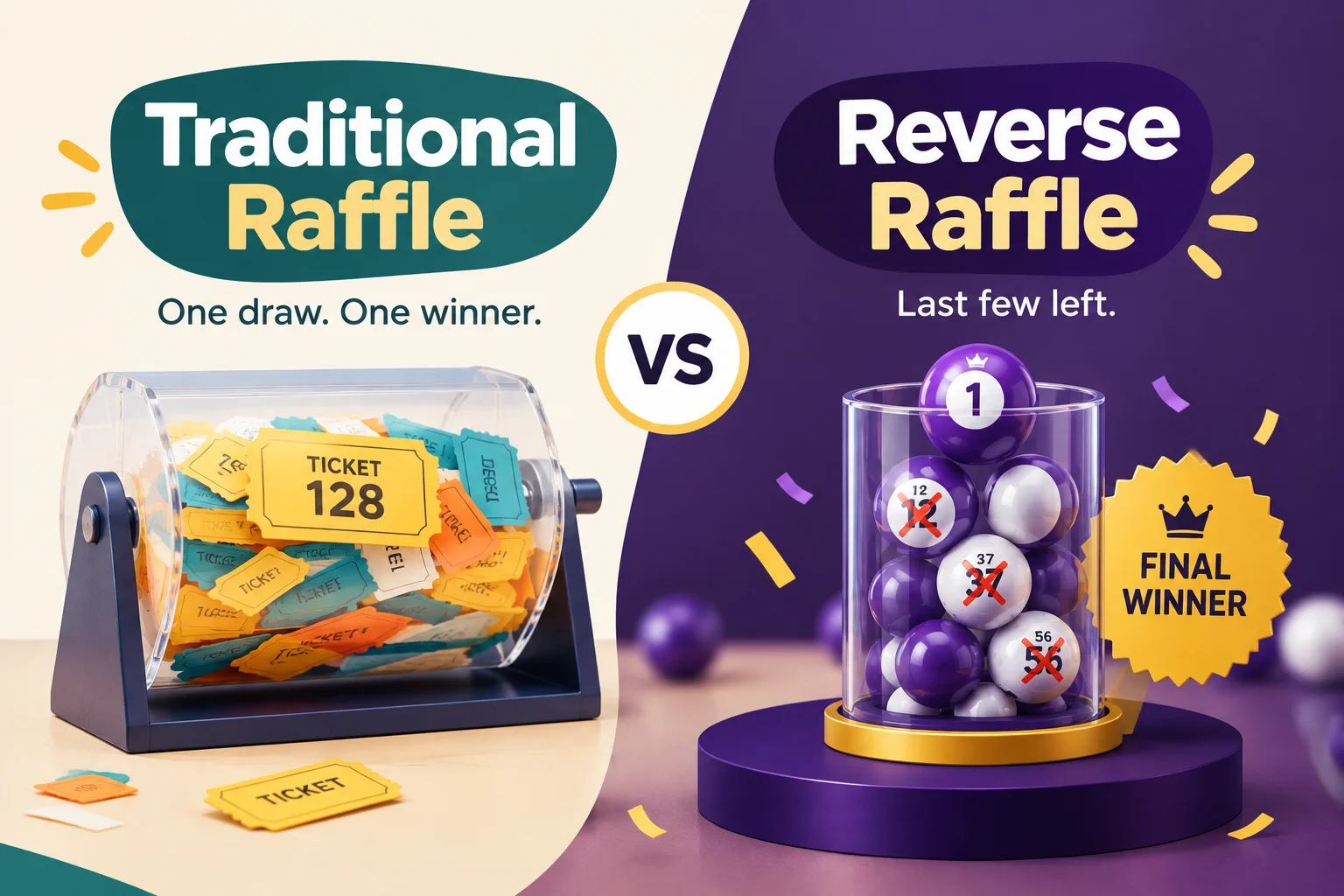
A reverse raffle has something most fundraising formats would love to have built into the rules:
The longer the draw continues, the more important each remaining ticket becomes.
At the beginning, there might be hundreds of tickets in play.
Then there are 200.
Then 100.
Then 50.
Then 10.
Suddenly, everyone is paying attention.
But there is an important distinction between having suspense built into a reverse raffle and actually keeping an audience engaged throughout the entire event.
A poorly managed draw can still feel slow.
Numbers can be announced without context. Participants may not know how many tickets remain. Long gaps between draws can drain the atmosphere. And once someone is eliminated, they may feel that their involvement has ended.
A well-planned reverse raffle does something different.
It treats the draw as a live event rather than simply a process for selecting a winner.
The objective is not to make every second exciting.
It is to give players a reason to keep watching, listening, and participating as the field gets smaller.
Start Creating Engagement Before the First Number Is Drawn
Engagement should begin before the reverse raffle starts.
If participants arrive without knowing how the event works, the first part of the evening may be spent explaining rules instead of building anticipation.
Give players the basic information in advance.
Tell them:
- How many tickets are in the draw
- What the grand prize is
- How elimination works
- Whether there are additional prizes
- When the draw begins
- How eliminated numbers will be announced
- How the final winner will be determined
The clearer the format is, the easier it becomes for people to follow the action.
A player who understands the rules can immediately appreciate what it means when 300 tickets become 200, or 20 become 10.
The shrinking number becomes part of the story.
Make the Number of Remaining Tickets Visible
One of the simplest ways to maintain attention is to show the audience what is happening.
Don't just announce:
“Ticket 184 is eliminated.”
Give the audience the larger context:
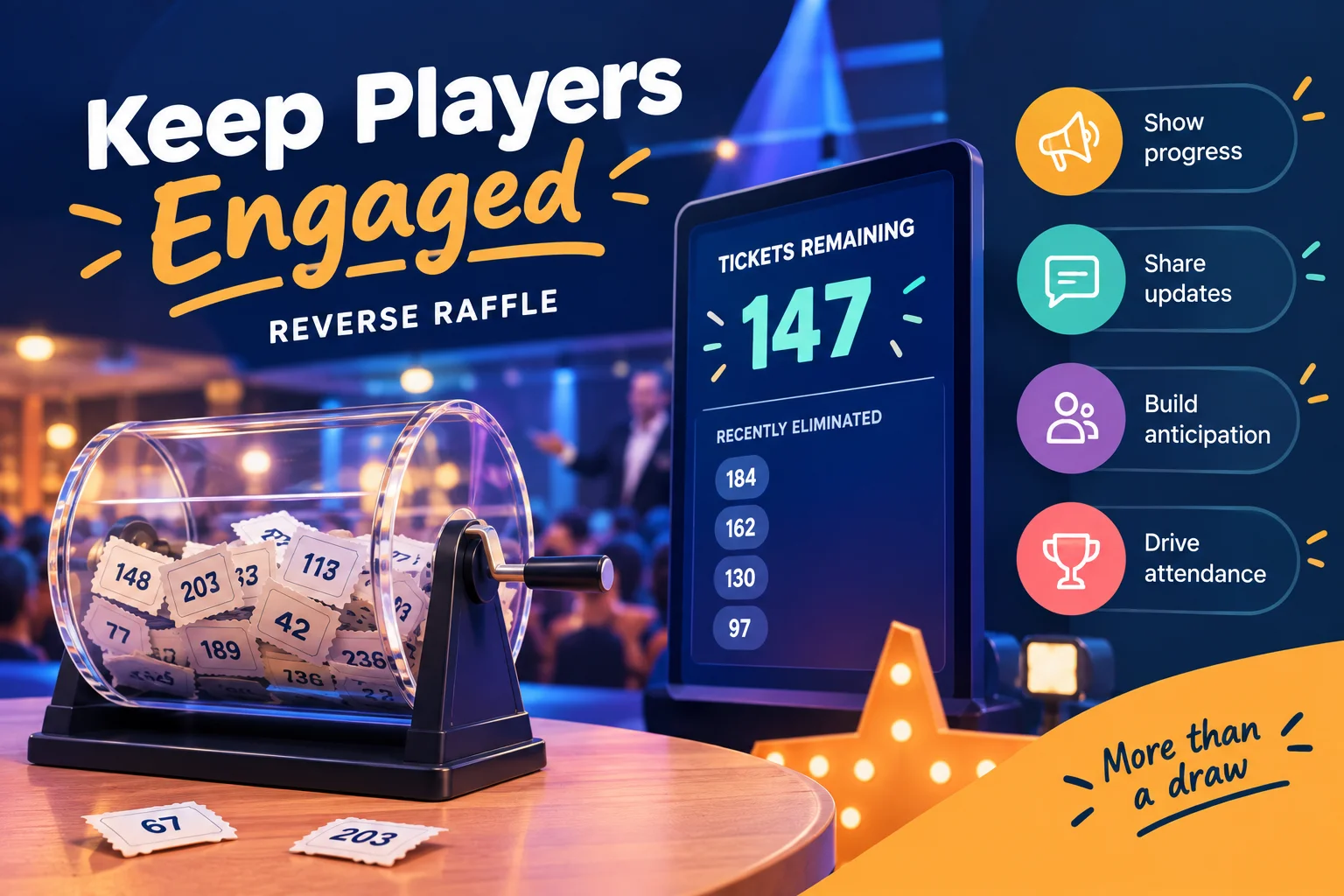
“Ticket 184 is out. We now have 147 tickets remaining.”
That second statement gives the elimination meaning.
The audience can see progress.
As the number drops, anticipation naturally changes.
300 remaining
The event is just beginning.
100 remaining
The field is getting smaller.
25 remaining
Every draw matters.
10 remaining
The atmosphere changes.
3 remaining
Everyone knows the final moment is close.
JustKonnect's reverse raffle software includes a live display showing eliminated numbers and updating the remaining entries in real time, giving participants a visible representation of the draw's progress.
Don't Treat Every Stage of the Draw the Same Way
A common mistake is maintaining the same pace from the first elimination to the final three tickets.
That can make the event feel flat.
Instead, think of the draw in stages.
The Opening Stage: Keep Things Moving
When there are many tickets remaining, the audience does not need a dramatic pause after every number.
This is the time to establish momentum.
Announce numbers clearly.
Keep the explanations short.
Show the remaining count.
Move to the next draw.
The objective is to establish the rhythm of the event.
The Middle Stage: Start Adding Context
Once the field becomes smaller, the numbers begin to matter more.
This is a good time for the host to remind the audience:
“We're down to 75 tickets now.”
Or:
“Only 25% of the original entries remain.”
These statements help participants understand how close they are getting.
The Final Stage: Slow It Down
When only a handful of tickets remain, rushing is unnecessary.
This is where pauses become useful.
Read the number.
Give the audience a moment.
Confirm the result.
Update the remaining count.
Then continue.
The closer the event gets to the final ticket, the more valuable each moment becomes.
Give the Host Something to Work With
A reverse raffle host has an important job.
They are not simply reading numbers.
They are helping the audience understand what those numbers mean.
The host can explain the progress of the draw, acknowledge sponsors, remind participants about prizes and build anticipation around major milestones.
For example:
“We started tonight with 300 entries. We're now down to just 50.”
Then later:
“There are only 10 tickets left. If your number is still on the board, you're getting very close.”
The host does not need to constantly shout or manufacture excitement.
Simple commentary can be enough when the underlying game already provides genuine suspense.
Use Milestones Instead of Constant Hype
Not every draw needs an announcement worthy of a grand finale.
Instead, create specific milestones.
For example:
250 tickets remaining
Acknowledge the first major reduction.
100 tickets remaining
Remind the audience that the field has been significantly reduced.
50 tickets remaining
Shift the pace.
25 tickets remaining
Start highlighting the remaining participants.
10 tickets remaining
Make the final stage more deliberate.
5 tickets remaining
Explain exactly what happens next.
Final ticket
Celebrate the winner.
This approach creates structure without exhausting the audience with nonstop commentary.
Keep Eliminated Players Involved Where Possible
One of the biggest challenges with a reverse raffle is obvious:
When someone's number is drawn, they are out.
So what reason do they have to continue watching?
This is where additional prizes and event activities can help.
Depending on the rules and prize structure, organisers can introduce:
- Runner-up prizes
- Consolation prizes
- Bonus drawings
- Sponsor prizes
- Small milestone giveaways
- Food or drink promotions
- Additional fundraising activities
- Audience games
JustKonnect's reverse raffle feature supports multiple prize tiers, including grand prizes, runner-up prizes and consolation prizes.
The specific structure should always be established clearly before tickets are sold.
The important idea is simple:
Elimination from the grand prize does not necessarily have to mean the end of the participant's experience.
Use SMS to Keep Players Connected to the Draw
Not everyone will be standing directly in front of the display throughout the event.
Someone might be getting a drink.
Someone might be speaking with another guest.
Someone might be outside for a few minutes.
SMS can provide another layer of communication.
For example, participants could receive updates about:
- Draw progress
- Eliminated numbers
- Remaining entries
- Important event announcements
- Winner notifications
JustKonnect's reverse raffle workflow includes SMS notifications alongside live draw updates, allowing participants to receive information about the draw without relying entirely on the physical display or verbal announcements.
This is particularly useful when the event has a large audience.
The technology should support the event, however—not overwhelm it.
The live experience should remain the centre of attention.
Give Players a Reason to Watch the Screen
A live display should answer one question immediately:
“What is happening right now?”
At a minimum, participants should be able to understand:
- The latest number drawn
- Whether that number has been eliminated
- How many entries remain
- Which stage of the draw they are in
As the field gets smaller, the display becomes increasingly important.
When there are only five tickets remaining, people should not have to ask a staff member whether their number is still active.
They should be able to see it.
This also makes the event easier to follow for participants who cannot hear every announcement.
Build a Rhythm Between the Draws
A reverse raffle does not need to be one continuous sequence of numbers.
You can create a rhythm.
For example:
Draw
↓
Announce number
↓
Update display
↓
Confirm remaining entries
↓
Brief host commentary
↓
Next draw
During longer events, the host can also use appropriate pauses for sponsor recognition, prize reminders or other planned event activities.
The key is to avoid unexplained dead time.
A pause can create anticipation.
A delay with no explanation can create confusion.
There is a difference.
Make Sponsors Part of the Experience
Sponsors can become another source of engagement.
Instead of placing a sponsor logo on a poster and forgetting about it, consider incorporating sponsor recognition into the event programme.
For example:
“This round is supported by [Sponsor].”
Or:
“Our next prize has been donated by [Sponsor].”
The organiser can also recognise sponsors at specific milestones.
This gives sponsors visibility while giving the host another structured element to work into the event.
Any sponsor arrangement and prize promotion should, of course, match the event's published rules and applicable requirements.
Create Small Moments Around the Big Moment
The final winner is important.
But you do not have to wait until the final number to create memorable moments.
Suppose the event reaches:
100 remaining
The host acknowledges the milestone.
At:
50 remaining
A sponsor prize is announced.
At:
25 remaining
The host reminds everyone of the final prize.
At:
10 remaining
The remaining numbers are displayed prominently.
At:
5 remaining
The pace slows.
At:
2 remaining
The audience knows the next draw could determine the outcome.
At:
1 remaining
The winner is announced.
The event has now created a series of moments rather than one announcement at the end.
Don't Make the Draw Too Complicated
Engagement does not mean adding endless rules.
In fact, too many mechanics can have the opposite effect.
If participants have to remember several bonus rounds, complicated eligibility conditions, and multiple changing prize structures, the central game can become difficult to follow.
The reverse raffle itself is already easy to explain:
If your number is drawn, you're eliminated. The last remaining number wins.
Build around that simplicity.
Additional prizes and activities should enhance the experience rather than obscure it.
Use the Prize Structure to Shape the Event
Prize structure can influence how participants experience the final stages.
For example, an event might have:
- Grand prize for the final ticket
- Runner-up prize for the second-to-last ticket
- Third-place prize
- Additional consolation prizes
This means the audience has more than one reason to care about the final stages.
It also creates natural milestones.
The host can explain:
“We now have 10 tickets remaining. The final three will receive prizes, with the last ticket taking the grand prize.”
That one sentence can change how the audience perceives the next several draws.
They now know exactly what is at stake.
Make the Rules Visible Before the Event
A player should never reach the final five and suddenly discover that the prize structure works differently from what they expected.
Publish the rules before the draw.
Make clear:
- What happens when a number is drawn
- Whether eliminated tickets can win other prizes
- How many prizes are available
- How winners are notified
- What happens if a winner is absent
- How ties or unusual situations are handled
- How the final ticket is determined
Clear rules create confidence.
Confidence makes it easier for participants to focus on the experience rather than questioning the process.
Don't Forget the People Who Cannot Stay Until the End
Some participants may have to leave early.
Others may be unable to watch every draw.
This is another reason communication matters.
If the system can notify participants when their number is drawn, the organiser does not have to rely entirely on someone hearing an announcement from across the room.
JustKonnect's reverse raffle workflow includes automatic SMS/email winner notifications and a dashboard for staff to view winner information.
That helps separate the live entertainment experience from the administrative responsibility of tracking outcomes.
Turn the Final Ten Into a Different Experience
The final ten deserve more attention than the first ten.
This is where the event can deliberately change pace.
Display all remaining numbers.
Remind the audience of the prize.
Ask the host to clearly announce each elimination.
Allow a brief pause after each number.
Keep the remaining count visible.
If appropriate, acknowledge the participants still in the running.
The objective is to make the audience feel that the event has reached a new stage.
By the time only two tickets remain, everyone should understand what is about to happen.
What About Players Watching Remotely?
A reverse raffle does not necessarily have to be limited to people physically watching the draw.
Depending on the event setup, organisers may use digital communication or live streaming to extend participation beyond the room.
JustKonnect lists live-streaming the drawing as one promotional idea for reverse raffle events, while its platform can also use SMS to communicate with participants.
If an organisation chooses to offer remote participation, it should make the rules, eligibility, and communication process clear before the event.
Measure Engagement After the Event
Once the winner has been announced, there is still useful information to examine.
Ask:
How many tickets were sold?
How many participants attended?
How many people interacted with event messages?
Which promotional messages generated ticket interest?
How many participants returned for another event?
Which stage of the event created the most interaction?
The goal is not to turn a fun fundraising event into a spreadsheet exercise.
It is to identify what should be repeated next time.
If the event generated strong ticket sales but weak attendance, the reminder strategy may need work.
If attendance was strong but ticket sales were slow, earlier promotion may be worth testing.
If participants responded strongly to countdown messages, that tactic could become part of the next event.
Where JustKonnect Fits
Keeping people engaged during a reverse raffle requires more than a random draw.
The event needs a reliable way to manage tickets, show what is happening, communicate with participants, and keep the draw moving.
JustKonnect's Reverse Raffle Software brings those pieces into one workflow. The platform supports digital and in-person ticket sales, real-time tracking, automated drawing, live display, SMS notifications, winner management, multiple prize tiers, and reporting.
That means the operator can focus more attention on the event experience while the system handles much of the tracking happening behind it.
And that distinction matters.
Technology should not become the attraction.
It should make it easier for the people running the event to create one.
A Sample Engagement Flow
Here is what a simple reverse raffle evening could look like.
Before the Event
Send a reminder to registered participants.
Confirm the event time.
Explain the basic rules.
Share any important arrival information.
Opening
Welcome participants.
Explain the rules again briefly.
Introduce the prize structure.
Show the starting number of entries.
Early Draw
Keep the pace moving.
Announce each eliminated number clearly.
Display the remaining count.
Middle Draw
Introduce milestone updates.
Recognise sponsors where appropriate.
Remind participants about the prize structure.
Use SMS for relevant event updates.
Final 25
Slow the pace slightly.
Keep all remaining numbers visible.
Explain what happens during the final stage.
Final 10
Give every draw more attention.
Pause between announcements.
Keep the prize information visible.
Final 3
Make the final stage unmistakable.
Confirm the remaining numbers.
Announce each elimination carefully.
Winner
Celebrate the final result.
Confirm the winning number.
Notify the winner.
Record the result.
Thank the audience and supporters.
That is how a reverse raffle becomes more than a sequence of random numbers.
It becomes a structured experience.
Frequently Asked Questions
How do you keep people interested during a reverse raffle?
Use visible draw progress, clear announcements, milestone updates, appropriate pacing, additional prizes, and participant communication. The closer the event gets to the final numbers, the more deliberately the pace can change.
Should a reverse raffle have multiple prizes?
It can. Runner-up and consolation prizes can give participants additional reasons to remain interested during the final stages. The prize structure should be clearly communicated before tickets are sold.
How can SMS help during a reverse raffle?
SMS can provide reminders, draw updates, and winner notifications. It is particularly useful for participants who are temporarily away from the main event area or cannot follow every announcement. JustKonnect supports SMS notifications as part of its reverse raffle workflow.
How many tickets should a reverse raffle have?
There is no universal number. The appropriate ticket quantity depends on the prize structure, audience, venue, fundraising target and event format. The rules and ticket limit should be established before sales begin.
Should the reverse raffle draw be shown on a screen?
A live display can make the event easier to follow by showing eliminated numbers and the remaining entries. It also gives participants a visible reference as the field becomes smaller.
Can eliminated players still participate in the event?
Yes, depending on how the event is structured. Additional prizes, entertainment, sponsor activities, and other fundraising elements can give eliminated participants reasons to remain involved.
The Final Number Should Feel Like the Final Number
A reverse raffle already contains the ingredients for suspense.
The challenge is making sure the event does not waste them.
If the audience cannot see how many entries remain, the progress feels abstract.
If the host rushes through the final numbers, the most exciting part can disappear.
If eliminated players have nothing else to engage with, participation can drop before the event reaches its conclusion.
But when the draw has a clear rhythm, visible progress, well-timed communication, and a prize structure people understand, every elimination contributes to the experience.
The goal is simple:
Make the audience feel the field getting smaller.
Because when there are 300 tickets, the winner feels distant.
When there are 10, the room starts watching.
When there are 2, nobody wants to look away.
And when there is 1, everyone knows exactly why that final number matters.
Explore JustKonnect's Reverse Raffle Software to see how digital ticket tracking, live draw updates, SMS notifications and winner management can support the event from setup through the final number.