A bingo hall may have a perfectly good SMS campaign ready to go.
The message is written.
The player list is prepared.
The promotion starts tonight.
Then someone asks a question that is easy to overlook:
What number will actually send these messages?
For many operators, the answer is simply whatever number the SMS provider gives them.
But the type of number behind the platform can affect how messages are sent, how quickly large campaigns can be delivered, how the sender is identified, and how the communication system fits into the hall's wider operation.
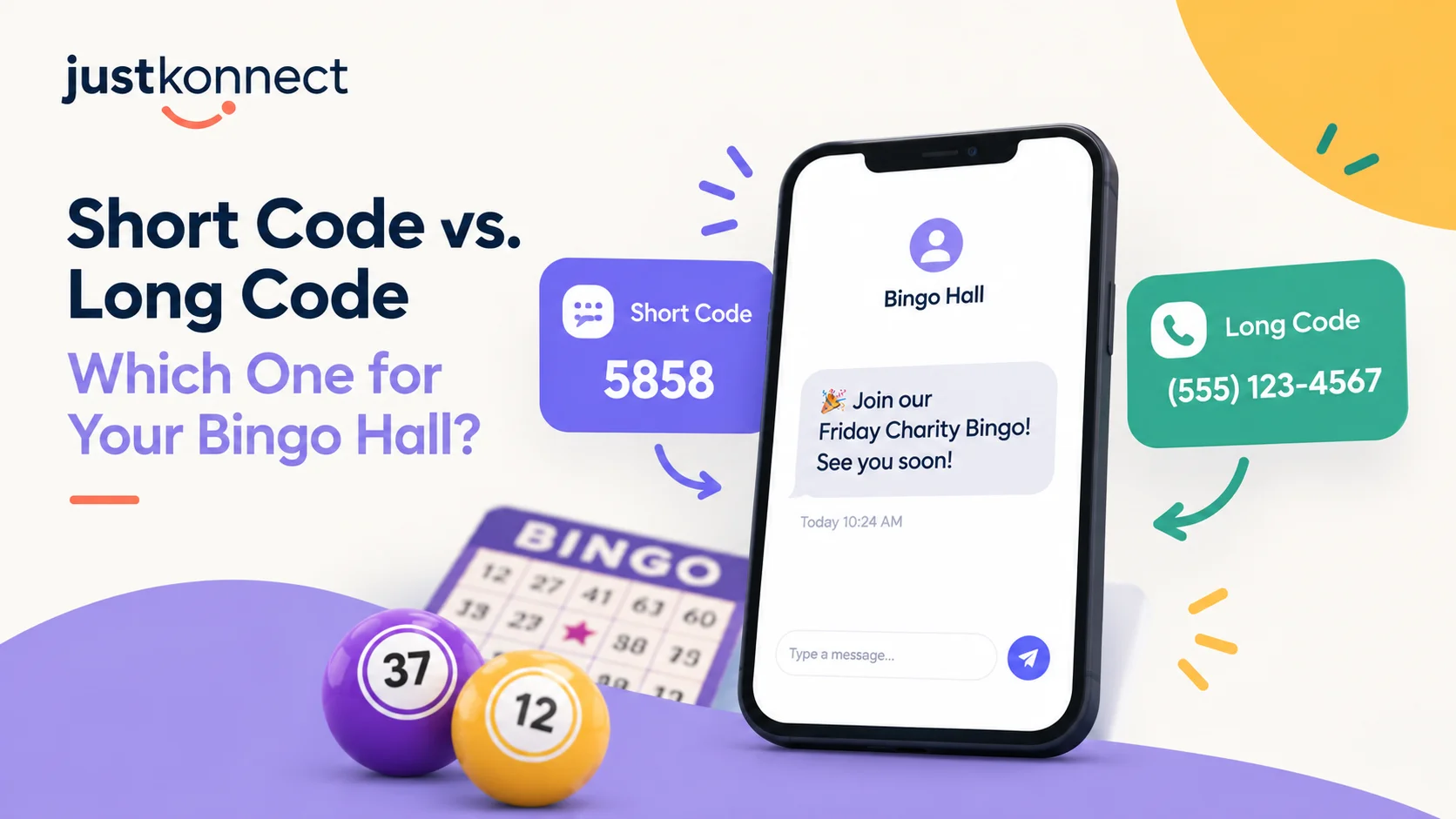
The two terms you will hear most often are short code and long code.
They both send SMS.
They are not designed for the same job.
For a bingo hall sending reminders, promotions, event announcements, and other player communications, understanding that distinction is worth doing before choosing an SMS platform.
First, What Is a Short Code?
A short code is a dedicated, abbreviated number used for business messaging.
Instead of seeing a conventional phone number, players may see something resembling a five- or six-digit number, depending on the country and messaging system.
Short codes were designed for application-to-person messaging at scale. They are particularly suited to situations where an organisation needs to send a large number of messages within a relatively short period.
That makes the concept easy to understand from a bingo operator's perspective.
Imagine your hall has a major Friday charity event.
Thousands of eligible players need the announcement.
You do not want the campaign sitting in a queue for an unnecessarily long time.
You want the communication infrastructure to be designed for that type of traffic.
That is where short codes become relevant.
And What Is a Long Code?
A long code looks much more like a conventional telephone number.
In the United States, A2P 10DLC numbers are standard ten-digit numbers registered for application-to-person business messaging. Long-code numbers can support two-way communication and can provide a more familiar telephone-number format.
That makes long codes useful for certain conversational or lower-volume messaging scenarios.
For example, a business might use a long-code number when customers need to communicate back and forth with the organisation.
The important distinction is that the number format is only one part of the decision.
You also need to consider:
- Message volume
- Sending speed
- Campaign type
- Two-way communication
- Carrier requirements
- Registration
- Deliverability
- Compliance
- Geographic coverage
- How the number fits the rest of your SMS platform
For a bingo hall, these considerations can become particularly important during large campaigns.
The Difference Becomes Clear on a Busy Game Night
Consider two scenarios.
Scenario A: A Small Player Conversation
A player texts the hall with a question about Friday's event.
A staff member responds.
The player asks a follow-up question.
The conversation ends.
This is a relatively small, conversational interaction.
Scenario B: A Major Campaign
The hall has a charity event coming up.
The operator wants to send an announcement to a large portion of the player database at around the same time.
Now the requirement is different.
The system needs to handle a large outbound campaign efficiently.
This is one reason short codes are commonly used for high-volume A2P messaging. Carrier-approved short codes are designed for higher-throughput messaging and can be particularly suitable for large, time-sensitive campaigns.
The question is therefore not:
“Is short code better than long code?”
A more useful question is:
“What type of messaging does our bingo hall actually need to handle?”
Think About the Traffic, Not Just the Number
This is where some SMS platform comparisons become misleading.
A platform may advertise a phone number as a feature.
But the number itself is not the whole product.
Think about what happens around it.
A bingo hall may have:
Regular reminders
“Tonight's bingo starts at 7 PM.”
Event announcements
“Our charity fundraiser is this Friday.”
Last-minute updates
“Tonight's session has an updated start time.”
Loyalty communication
“You've reached a new loyalty reward.”
Re-engagement
“We haven't seen you recently. Here's what's happening this week.”
Player replies
“Can I still attend tonight?”
These are different communication situations.
A useful SMS platform needs to handle the appropriate traffic without forcing the operator to think about the underlying infrastructure every time a campaign is created.
Why Short Codes Make Sense for Large Bingo Campaigns
Short codes are particularly relevant when communication happens at scale.
Suppose your hall has several thousand opted-in players.
A special event is approaching.
You want to send one campaign to a broad audience.
The campaign could include:
- Event announcements
- Game reminders
- Charity fundraiser information
- Jackpot alerts
- Schedule updates
- Promotional campaigns
- Loyalty communications
Short codes are built for this kind of high-volume application-to-person messaging. Providers commonly position them for marketing, alerts, notifications, and other large-scale communication use cases.
The practical advantage is not that the number is shorter because it looks nicer.
It is that the underlying messaging infrastructure is designed around high-volume business communication.
Throughput Matters More Than Most Operators Realise
Imagine sending 3,000 messages.
The important question isn't only whether your platform can technically send 3,000 messages.
You also want to know how efficiently the messages can be delivered.
Messaging throughput is measured in message segments per second, and available throughput varies by sender type, country, registration status, and provider. In the US, short codes generally support substantially higher throughput than registered long-code messaging.
Why does that matter to a bingo hall?
Because timing can be part of the campaign.
A reminder sent the day before an event has one purpose.
A message sent shortly before a session has another.
A last-minute announcement may have a very narrow useful window.
If your communication strategy depends on reaching a large audience quickly, sender infrastructure becomes an operational consideration rather than a technical detail.
But Don't Assume Long Codes Are Useless
They aren't.
Long codes have an important role in business messaging.
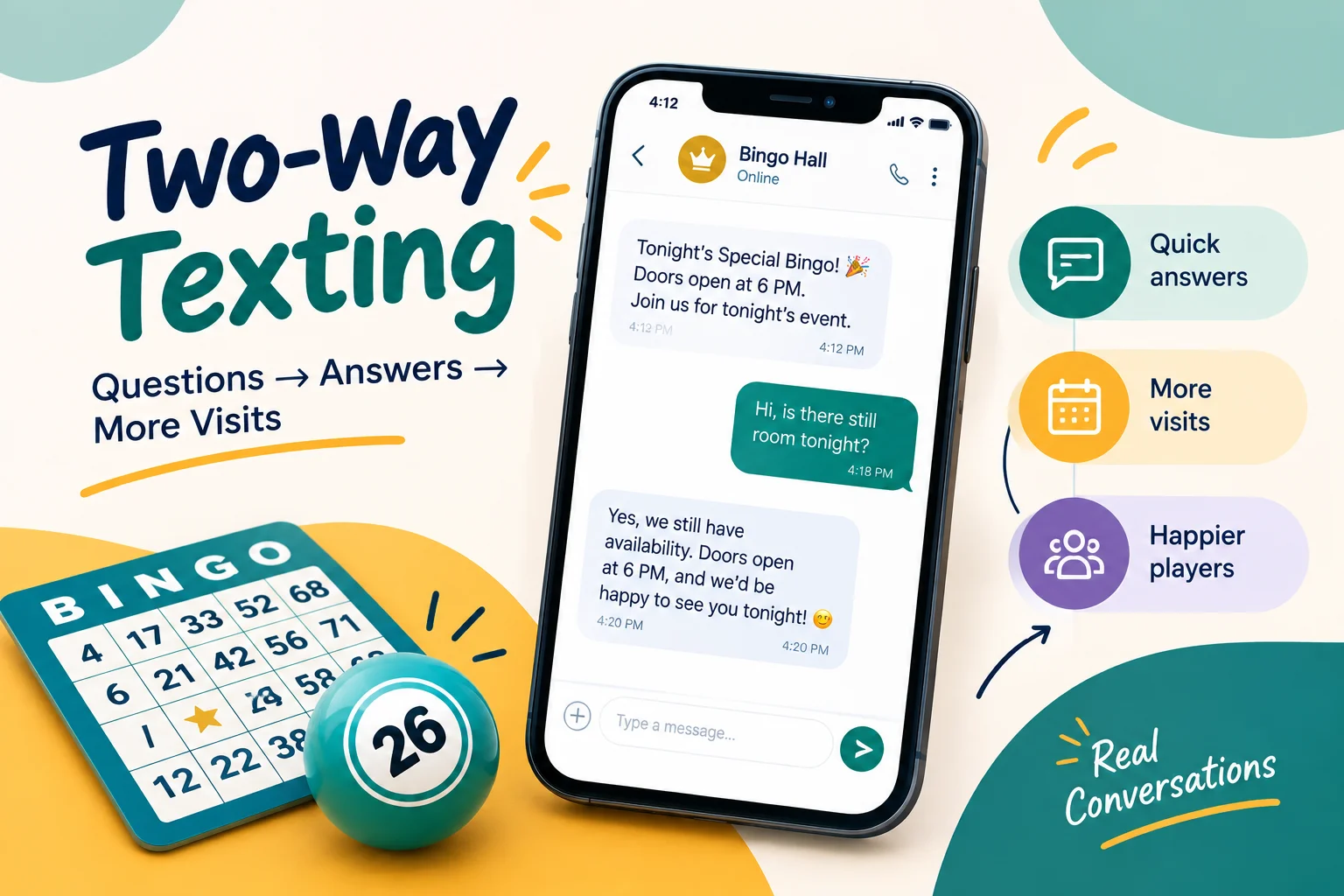
Their conventional phone-number format can work well for conversational communication, and long-code messaging can support two-way SMS.
Think about a player who replies:
“What time do doors open?”
Or:
“Can I still book for tonight?”
Or:
“Is the charity event still happening?”
These conversations are different from sending a large promotional campaign.
The right platform should therefore be evaluated according to the communication workflow, not simply by asking which number type sounds more advanced.
The Bigger Question: What Are You Sending?
Before choosing a texting platform, list the actual messages your hall expects to send.
You might discover that you have four broad categories.
1. Broadcast Messages
Large campaigns sent to many players.
Examples:
- Special bingo nights
- Charity events
- Major promotions
- Holiday sessions
- Important announcements
2. Automated Messages
Messages triggered by an action or player status.
Examples:
- Welcome messages
- Reminder sequences
- Re-engagement messages
- Loyalty notifications
3. Conversational Messages
Messages where players reply, and staff continue the interaction.
Examples:
- Event questions
- Attendance questions
- General enquiries
- Follow-up questions
4. Operational Messages
Communication that keeps players informed.
Examples:
- Schedule changes
- Session reminders
- Venue updates
- Event information
Once you understand the mix, choosing the messaging infrastructure becomes much easier.
Short Code vs. Long Code: A Practical Comparison
| Consideration | Short Code | Long Code |
| Number format | Usually a short numeric code | Conventional telephone number |
| High-volume messaging | Strong fit | More limited depending on registration and provider |
| Large campaigns | Well suited | Can be suitable at appropriate volumes |
| Two-way messaging | Supported in many implementations | Supported |
| Conversational use | Possible | Common use case |
| Voice calling | Generally not supported | Can support voice depending on number/provider |
| Carrier approval | Short codes typically go through an approval process | Business messaging generally requires applicable registration/verification |
| Best fit | Large-scale A2P campaigns | Conversational and lower-volume business messaging |
| Setup | Usually more involved | Generally simpler than short-code provisioning |
| Cost | Typically higher | Generally lower |
The exact capabilities, throughput, and registration requirements vary by country and provider, so operators should verify the current requirements for the markets they serve.
What About Deliverability?
This is where the infrastructure behind the number becomes particularly important.
Carriers use filtering systems to identify unwanted or non-compliant messaging.
Short codes undergo carrier approval for their intended use, which is one reason they are commonly used for high-volume A2P messaging.
That does not mean a short code automatically guarantees delivery.
Message content, consent, sender reputation, registration, carrier rules, and compliance practices still matter.
A good SMS platform should therefore make it easier to operate within the applicable messaging requirements rather than treating compliance as an afterthought.
Compliance Should Be Part of the Platform Conversation
When evaluating SMS software, don't stop at:
“How many messages can it send?”
Ask:
- How is player consent recorded?
- How are opt-outs handled?
- Can players reply STOP?
- Are delivery records available?
- Is campaign activity logged?
- Who owns the sender identity?
- What happens when a player opts out?
- Does the platform support the requirements of the countries being messaged?
For example, JustKonnect's published SMS policy describes STOP/START handling, HELP support, opt-out records, and carrier-approved short-code messaging for its broadcast SMS communications.
Those operational details matter just as much as raw sending speed.
Be Careful With the Phrase “Best SMS Number”
There is no universally best sender type for every business.
A small organisation with mostly one-to-one conversations has different requirements from a national organisation sending millions of alerts.
A bingo hall sits somewhere interesting because it can combine both.
You may need:
High-volume campaigns
and
Player conversations
in the same overall communication strategy.
That means the platform matters.
You don't necessarily want to choose a number type in isolation and then discover that your campaigns, replies, reporting, and player records live in completely different systems.
The Number Should Fit the Rest of Your SMS Workflow
Consider a typical bingo campaign.
The operator selects a player segment.
The campaign is scheduled.
The SMS is sent.
Players receive it.
Some players attend.
Some reply.
Some don't engage.
Some may become eligible for another campaign later.
Now imagine trying to understand that journey when the SMS system is completely disconnected from the player database.
You may know that 2,000 messages were sent.
But you may not know which player segments responded, which players returned, or how the campaign fits into their wider engagement history.
That is where an integrated platform can make a difference.
Where JustKonnect Fits
JustKonnect positions its SMS system around the way bingo halls actually communicate with players.
Its platform includes short-code SMS for game reminders, jackpot alerts, payout announcements, and event promotions, with campaigns available to full player lists or targeted segments. It also connects SMS with CRM, segmentation, loyalty, and analytics rather than treating messaging as a standalone tool.
For an operator considering a texting platform, that creates a broader evaluation question:
Can this system simply send messages, or can it support the way our hall manages player communication?
That distinction matters.
A short code can provide the messaging infrastructure.
But the operator still needs the tools around it to select audiences, create campaigns, manage player relationships, and understand what happened after the message went out.
You can explore JustKonnect's Short Code SMS feature to see how short-code messaging fits into its wider bingo-focused platform.
Five Questions to Ask Before Choosing Your SMS Platform
Before signing up for a texting solution, ask the provider these questions.
1. Which sender type will we actually use?
Don't accept a vague answer such as “business SMS.”
Ask whether the platform uses short codes, long codes, toll-free numbers, or another sender type and why.
2. What happens when we send a large campaign?
Ask about throughput.
If your hall has thousands of opted-in players, you need to understand how the platform handles a large campaign sent within a short period.
3. Can players reply?
If your strategy includes two-way communication, confirm that replies are supported and find out where those replies appear.
4. How are opt-outs and consent handled?
This should be part of the platform's core workflow, not a spreadsheet maintained by staff.
5. What happens after the SMS is delivered?
Can you see campaign performance?
Can you connect communication with player activity?
Can you segment future campaigns based on engagement?
The answers to these questions may tell you more about the platform than the number printed at the top of the text message.
The Real Choice Is Bigger Than Short Code vs. Long Code
Short code and long code are useful concepts, but they are only one part of choosing an SMS platform.
For a bingo hall, the real decision is about the entire communication system.
You need to consider the size of your player database.
The type of campaigns you run.
How quickly messages need to reach players.
Whether players need to reply.
How consent and opt-outs are managed.
How campaign activity is recorded.
And whether SMS connects with the CRM and player engagement tools your team already needs.
A number can deliver a message.
A well-designed platform should help you manage everything that happens before, during and after that message.
Frequently Asked Questions
What is the main difference between short code and long code SMS?
A short code is a shorter numeric sender designed primarily for business messaging at scale, while a long code resembles a conventional telephone number and is commonly used for conversational or lower-volume business messaging. Exact capabilities vary by country and provider.
Are short codes better for bingo halls?
Short codes can be particularly suitable for bingo halls that send high-volume campaigns, such as major event announcements, game reminders and promotions. Whether they are appropriate depends on the hall's messaging volume, use cases, geography and platform requirements.
Can players reply to short-code SMS?
Short codes can support two-way messaging, although the exact functionality depends on the provider and implementation. Operators should confirm how inbound replies are handled before choosing a platform.
Are long codes cheaper than short codes?
Long-code messaging generally has a lower infrastructure cost than dedicated short codes, while short codes typically involve additional setup or leasing costs. Pricing varies considerably by provider and country, so operators should compare the complete cost rather than just the number rental.
Does using a short code guarantee SMS delivery?
No. Short codes benefit from carrier approval and high-throughput infrastructure, but delivery still depends on factors such as consent, message content, registration, carrier policies and other filtering considerations.
Should a bingo hall choose its SMS platform based only on sender type?
No. Sender type is important, but the platform should also be evaluated for campaign management, player segmentation, two-way communication, compliance, reporting, automation and integration with the hall's wider customer engagement workflow.
Choose the Infrastructure Before You Choose the Interface
The SMS dashboard is the part operators see.
The infrastructure behind it is the part doing the heavy lifting.
For a bingo hall, that infrastructure becomes especially important when a campaign needs to reach a large player audience quickly, when players need to respond, or when SMS becomes a regular part of attendance and retention activity.
Short codes and long codes can both have legitimate roles.
The important thing is matching the sender type—and the platform built around it—to the way your hall actually communicates.
Because the question isn't simply “Which number should we use?”
It is:
“What do we need our messaging system to handle when the next big campaign goes live?”
Explore JustKonnect's Short Code SMS solution and see how short-code messaging can fit into a broader bingo hall communication workflow.