A raffle sounds simple.
Sell tickets. Put the entries into a draw. Select a winner.
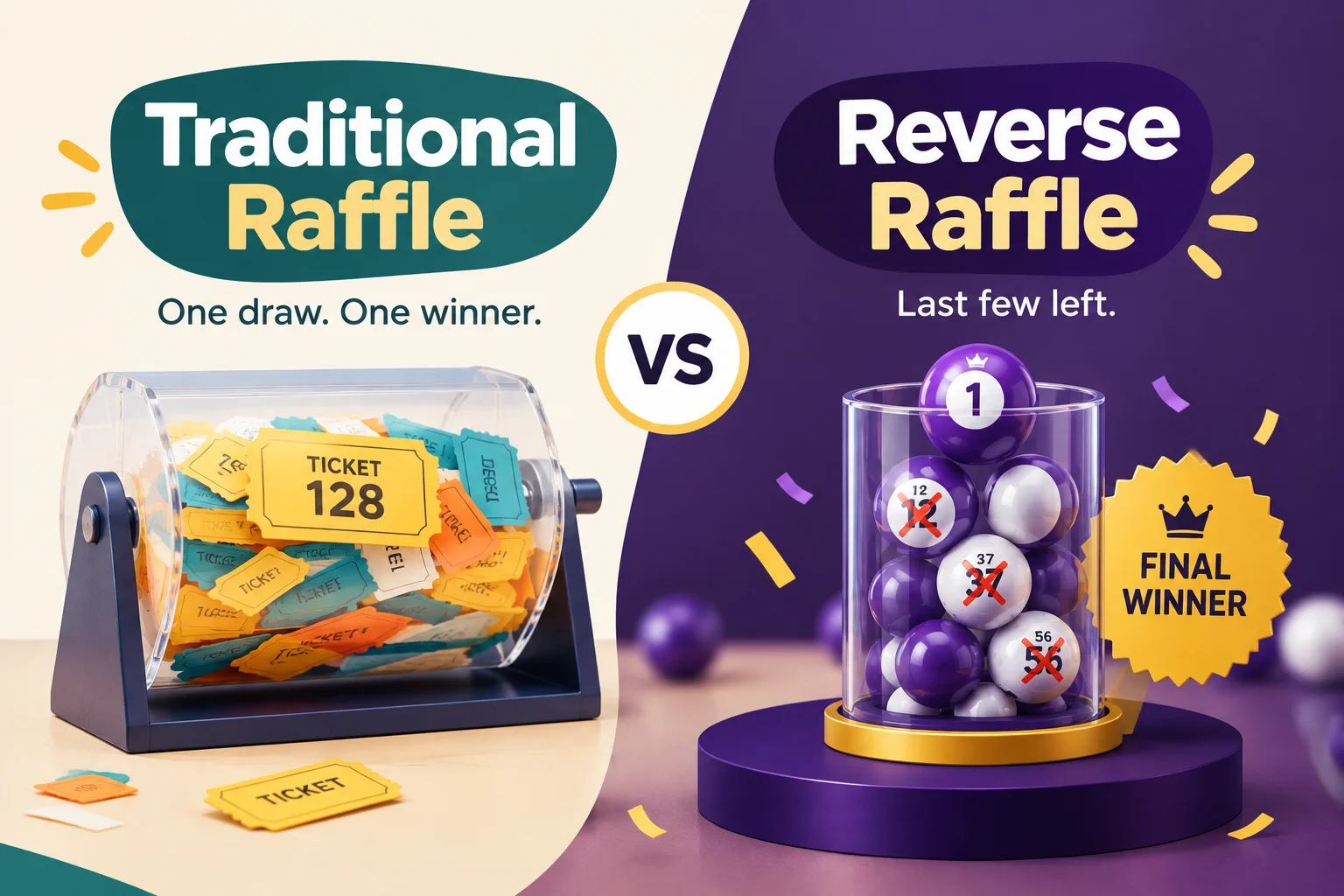
That is the basic idea behind a traditional raffle.
A reverse raffle starts with the same basic ingredient, numbered entries, but changes what happens during the draw.
Instead of selecting a winning ticket early and ending the event, a reverse raffle typically removes tickets from consideration one by one until only a final entry, or a defined set of entries, remains.
That small change creates a very different event experience.
For charities, bingo halls, fundraising organisations and entertainment venues, understanding the difference matters because the format affects how the event unfolds, how long participants remain engaged, how prizes are presented and how the audience experiences the draw.
Here is how the two formats compare.
Traditional Raffle: A Straightforward Path to the Winner
In a traditional raffle, participants purchase tickets or entries.
Each ticket represents a chance to win.
At the scheduled draw, one or more tickets are selected.
If ticket number 428 is drawn, the holder of ticket 428 wins the relevant prize.
The process is relatively direct:
Sell tickets → Draw a ticket → Identify the winner → Award the prize
A traditional raffle can work well when the primary objective is to raise funds through ticket sales while keeping the draw itself relatively simple.
It can also support multiple prizes.
For example:
- £100 cash prize
- Gift voucher
- Weekend package
- Sponsored prize
- Grand prize
The organiser can draw winners one after another according to the event rules.
The audience may watch the draw, but the mechanics do not necessarily require them to remain involved throughout the entire process.
Reverse Raffle Turns the Draw Into the Event
A reverse raffle changes the structure.
Instead of starting with a pool of tickets and selecting winners, the organiser begins with the eligible entries and progressively eliminates them.
Imagine 100 tickets are sold.
The first number is drawn.
That player is eliminated from winning the grand prize.
Then another number is drawn.
Another player is eliminated.
The process continues.
The remaining players become increasingly important because they are still in contention.
Eventually, only a small number of entries remain.
The tension increases as the final draw approaches.
That gives the event a different rhythm:
Sell entries → Begin eliminations → Narrow the field → Build anticipation → Reach the final draw
The raffle is no longer simply the moment when a winner is announced.
The draw itself becomes part of the entertainment.
The Biggest Difference Is What Happens to the Participants
This is the easiest way to understand the two formats.
In a traditional raffle, most participants discover relatively quickly whether their ticket has won.
If it has not, their involvement in the draw may effectively end.
In a reverse raffle, participants can remain involved because their ticket is still alive until it is eliminated.
That creates a different psychological experience.
At the beginning:
“I have a chance.”
Later:
“My number is still in.”
Near the end:
“There are only a few tickets left.”
And eventually:
“Could I be the last one standing?”
The mechanics create a natural progression without requiring the organiser to manufacture excitement artificially.
A Simple Example
Suppose a charity runs a reverse raffle with 200 entries.
The grand prize is £5,000.
The draw begins.
Ticket 137 is eliminated.
Then ticket 42.
Then ticket 186.
Then ticket 91.
Each eliminated participant knows their ticket is no longer eligible for the grand prize.
But everyone whose number remains has another reason to keep watching.
After 150 eliminations, only 50 tickets remain.
After another 40, only 10 remain.
Now the atmosphere is different.
The remaining participants are paying close attention.
The audience is waiting for the next number.
The final few draws carry significantly more weight than the first few.
That progression is one of the defining characteristics of a reverse raffle.
Traditional Raffle vs. Reverse Raffle at a Glance
| Feature | Traditional Raffle | Reverse Raffle |
| Basic mechanic | Select winning entries | Eliminate entries until the final winner |
| Participant involvement | Often concentrated around the winner announcement | Can continue throughout the elimination process |
| Event duration | Can be relatively short | Often structured as a longer live event |
| Suspense | Usually concentrated around the draw | Builds progressively |
| Audience engagement | Depends heavily on event presentation | Naturally increases as entries are eliminated |
| Multiple prizes | Easy to incorporate | Can be incorporated through defined rules |
| Main focus | Selecting winners | Creating an unfolding draw experience |
| Ticket tracking | Required | Especially important as entries are eliminated |
The difference is therefore not simply a matter of terminology.
It is a difference in event design.
Why Reverse Raffles Can Create More Moments During the Event
A traditional raffle can have one major moment:
“And the winning ticket is…”
A reverse raffle can create dozens or even hundreds of smaller moments.
Every elimination changes the remaining pool.
Every remaining participant has a reason to pay attention.
Every reduction in the number of entries makes the outcome feel closer.
For an organiser, that creates opportunities to structure the event around those moments.
For example:
Early Stage
The draw moves relatively quickly.
The audience is introduced to the rules, and the first eliminations take place.
Middle Stage
The number of remaining entries becomes smaller.
The organiser can slow the pace and create more anticipation.
Final Stage
Only a handful of entries remain.
The final eliminations become the main event.
This pacing can turn what might otherwise be a simple administrative draw into a programmed fundraising experience.
But a Reverse Raffle Requires Clear Rules
The more involved the format becomes, the more important clarity becomes.
Participants should understand:
- How entries are allocated
- How tickets are selected
- What happens when a ticket is eliminated
- How many prizes are available
- Whether eliminated tickets can win another prize
- What happens if a participant is not present
- How the final winner is determined
- What happens in the event of a disputed or invalid entry
Rules should be established before tickets are sold.
The organiser should also make the rules easy for participants to understand.
A complicated format can create confusion if the audience does not know what each draw means.
The Draw Process Should Be Visible
A reverse raffle depends heavily on trust.
Participants need to believe that the elimination process is fair and accurately managed.
That makes transparency important.
The organiser should have a clear process for:
- Recording all eligible entries
- Confirming the starting pool
- Selecting entries according to the published rules
- Recording eliminated entries
- Tracking remaining entries
- Announcing the final result
- Documenting the outcome
For larger events, managing this information manually can become increasingly difficult.
A spreadsheet may be sufficient for a small event.
But once the number of entries grows, the number of eliminations increases, and multiple staff members become involved, manual tracking creates more opportunities for mistakes.
Why Ticket Management Becomes More Important in a Reverse Raffle
Imagine a traditional raffle with 500 tickets.
You need to know which tickets are valid and which ticket wins.
Now imagine a reverse raffle with 500 tickets.
You need to know:
- Which tickets were entered
- Which tickets have been eliminated
- Which tickets remain
- Which entries are still eligible for each prize
- What has already been announced
- Who the final winner is
The information changes continuously throughout the event.
That makes accurate tracking a central part of the experience.
The audience may only see a number being announced.
Behind the scenes, the organiser needs to know exactly what that announcement means.
Reverse Raffles Also Create More Opportunities for Engagement
Because the draw takes place over time, organisers can build additional experiences around it.
For a bingo hall or charity event, this could include:
- Music between eliminations
- Host commentary
- Sponsor mentions
- Prize announcements
- Audience interaction
- Food and beverage promotions
- Loyalty rewards
- Additional fundraising opportunities
- SMS reminders before the event
- Updates during the event
The reverse raffle becomes one component of a larger event rather than an isolated prize draw.
This can be particularly useful for organisations that already have an audience gathered in one venue.
What About Fundraising?
Both traditional and reverse raffles can be used for fundraising.
The difference is primarily in how the draw itself is structured.
A traditional raffle can provide a straightforward fundraising mechanism:
Sell entries → Draw winners → Award prizes
A reverse raffle can make the fundraising event more experiential:
Sell entries → Host a live elimination process → Keep the audience engaged → Build toward the final prize
For charities, the latter format can create more opportunities to engage the audience around the event.
However, the fundraising outcome still depends on factors such as ticket pricing, audience size, promotion, prize structure, costs and the organisation's overall event strategy.
The format alone does not determine fundraising performance.
When a Traditional Raffle May Fit the Event
A traditional raffle may make sense when simplicity is the priority.
For example, an organisation might want to:
- Sell tickets over several weeks
- Keep administration straightforward
- Draw winners at a particular time
- Offer several prizes
- Announce winners without running a long live event
The format can work particularly well when the draw is one part of a broader fundraiser.
There is no need to turn every raffle into an extended entertainment experience.
Sometimes the straightforward format is exactly what the organiser wants.
When a Reverse Raffle Fits a Different Kind of Event
A reverse raffle can make more sense when the draw itself is intended to be a major part of the event.
For example:
- A charity wants a live fundraising evening
- A bingo hall wants to create an additional entertainment format
- A venue wants a structured event around a major prize
- An organisation wants participants to remain engaged throughout the draw
- Sponsors are involved in the event
- The organiser wants several stages of anticipation rather than one final announcement
The format naturally provides a beginning, middle and end.
That makes it easier to build a programme around the draw.
The Marketing Strategy Changes Too
A traditional raffle can often be marketed around the prize.
“Buy a ticket for your chance to win £5,000.”
A reverse raffle can promote both the prize and the experience.
For example:
“Join us for our £5,000 Reverse Raffle and stay to see whose ticket survives to the final draw.”
That gives the organiser more than one marketing angle.
The event can be positioned around:
- The prize
- The suspense
- The live experience
- The charity or cause
- The venue
- The date
- Additional entertainment
SMS marketing can also support the event through reminders, ticket-sale campaigns, and last-minute attendance messages.
Reverse Raffle Software Can Remove Some of the Administrative Burden
The more entries an event has, the more important it becomes to manage them accurately.
This is where dedicated reverse raffle software can help.
Instead of relying entirely on paper lists or manually updated spreadsheets, an organiser can use software designed around the event's ticket and draw workflow.
The technology should help answer practical questions such as:
How many entries are active?
Which numbers have already been eliminated?
What happens next in the draw?
Who is the final winner?
The goal is not to add technology for its own sake.
It is to reduce the administrative work that sits behind a live event.
Where JustKonnect Fits
JustKonnect's Reverse Raffle Software is designed to help organisations manage reverse raffle events as part of a broader engagement and fundraising workflow.
For an operator, the value is not simply having a digital version of a raffle ticket.
The bigger opportunity is connecting the reverse raffle with the activities surrounding it: promotion, player or participant engagement, communication and event management.
That can be particularly useful for bingo halls and charity organisations that already manage an audience and want to add a structured reverse raffle experience without building the process entirely around spreadsheets and manual administration.
A Useful Way to Choose Between the Two Formats
Instead of asking:
“Which raffle is better?”
Start with the event you are trying to create.
Ask:
Do you want the draw to be quick?
A traditional raffle may provide a simpler structure.
Do you want the audience watching throughout the draw?
A reverse raffle can naturally create ongoing suspense as entries are eliminated.
Is the prize draw one small part of a larger fundraiser?
A traditional raffle may be easier to integrate.
Is the draw itself intended to be the centrepiece?
A reverse raffle provides a structure around which the event can be built.
Do you have a large number of entries to manage?
Whichever format you choose, consider how entries will be tracked and how the draw will be documented.
The right format depends on the experience, administration and fundraising model you are trying to build.
Frequently Asked Questions
What is the main difference between a reverse raffle and a traditional raffle?
A traditional raffle generally selects winning tickets from a pool of entries. A reverse raffle progressively eliminates entries until the final eligible ticket or participant remains, depending on the event's rules.
Is a reverse raffle the same as a normal raffle?
No. Both use numbered entries or tickets, but the draw mechanics are different. A traditional raffle focuses on selecting winners, while a reverse raffle focuses on progressively narrowing the field.
Can a reverse raffle have multiple prizes?
Yes. An organiser can structure multiple prizes into the event rules. The exact prize and elimination structure should be clearly explained to participants before the event.
Are reverse raffles suitable for charity fundraising?
They can be used as part of charity fundraising events, particularly when the organisation wants the draw itself to become a live audience experience. Fundraising results will depend on the wider event strategy, including ticket sales, pricing, promotion, prizes and costs.
Do reverse raffles require software?
Not necessarily. Small events can potentially be managed manually. As the number of entries and draw stages increases, however, dedicated software can make tracking, administration and event management easier.
Can bingo halls use reverse raffles?
Yes. A reverse raffle can be incorporated into a bingo hall's wider entertainment or fundraising programme, subject to the applicable rules and regulations in the relevant jurisdiction.
A Different Kind of Raffle Experience
The difference between a traditional raffle and a reverse raffle comes down to what happens after the tickets are sold.
A traditional raffle can move quickly toward a winner.
A reverse raffle stretches the outcome across a sequence of eliminations.
One is built around selecting.
The other is built around narrowing.
That difference affects the pace, audience involvement, event structure and administrative requirements.
For an organisation deciding which format to use, the useful question is not simply which one sounds more exciting.
It is:
What do you want people to experience between the first ticket and the final prize?
If the answer involves anticipation, live participation, and a draw that becomes an event in its own right, a reverse raffle provides a very different framework from the traditional model.
Explore JustKonnect Reverse Raffle Software to see how the process can be supported with dedicated software rather than relying entirely on manual ticket tracking.