For many bingo halls, the customer relationship is still built around one central moment: game night.
Players arrive, buy their cards, settle in, enjoy the atmosphere, and play. Once the session ends, the interaction often stops until the next visit.
That creates a significant gap.
A player might have enjoyed the previous session and fully intend to return, but several days can pass without meaningful interaction with the venue. During that time, there may be little reminding them about upcoming events, loyalty progress, rewards, or reasons to stay connected.
This is where in-app mini game modules can change the role of a venue's digital experience.
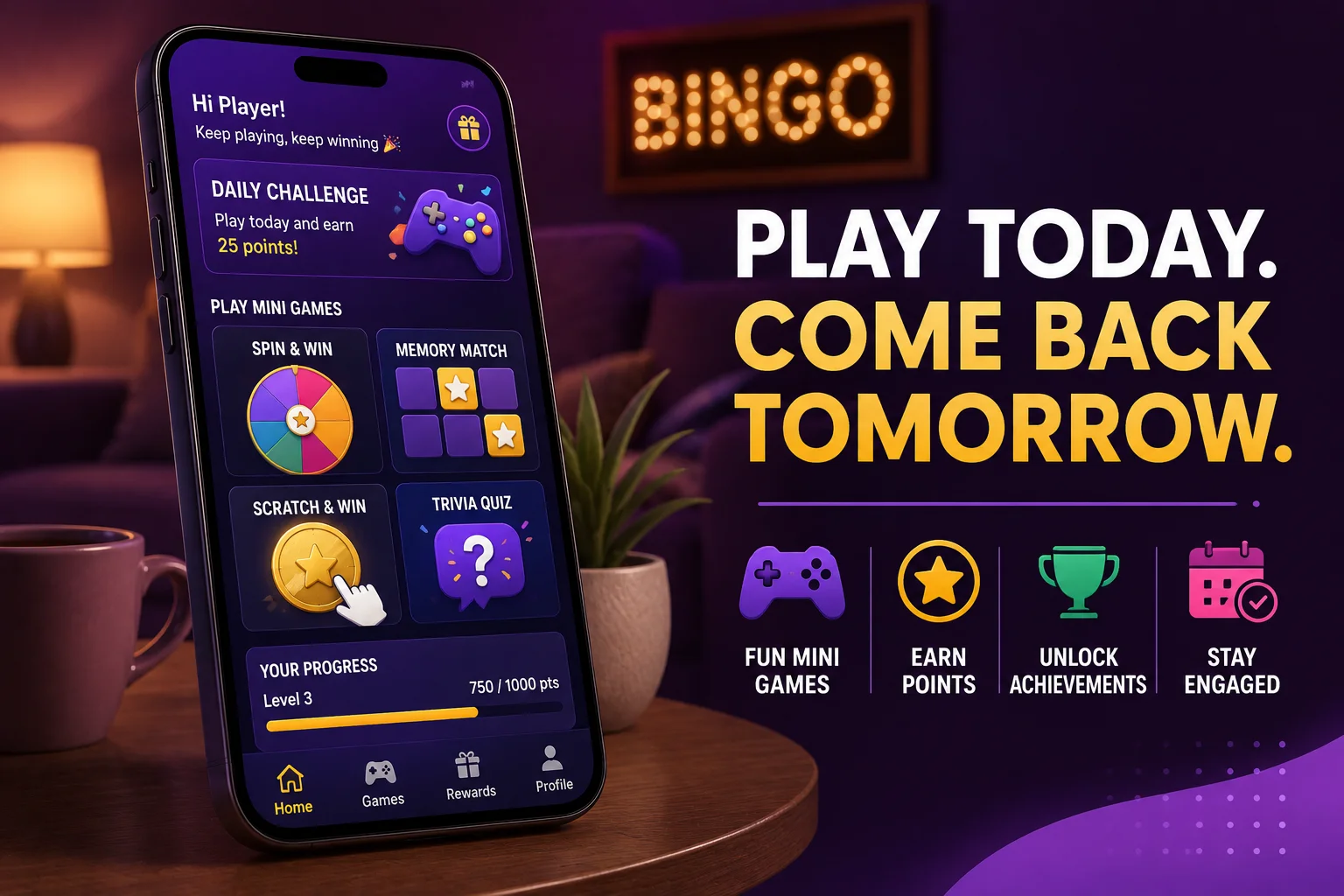
Rather than treating an app as simply a place to display rewards or send announcements, operators can use short interactive experiences to give players something to do between sessions.
The bingo card remains at the centre of the physical experience.
The mini games help keep the relationship moving when there is no card in front of the player.
The Gap Between One Bingo Session and the Next
Consider a typical customer journey.
A player visits on Friday night.
They enjoy the session and leave.
Saturday passes.
Sunday passes.
Monday passes.
By Tuesday, the venue may have disappeared from their attention.
On Wednesday, another business competes for their attention.
By Friday, the player receives a promotional message reminding them about bingo.
This approach depends heavily on the next marketing message to restart engagement.
A connected digital experience can work differently:
Friday: Attend bingo
Saturday: Check loyalty progress
Sunday: Complete a mini game
Monday: Earn points or progress toward an achievement
Tuesday: See a new challenge
Wednesday: Discover an upcoming event
Thursday: Receive a relevant reminder
Friday: Return
The customer hasn't physically visited every day.
But the relationship hasn't disappeared either.
What Mini Game Modules Actually Add
Mini games don't need to be sophisticated.
Their value comes from creating small, repeatable interactions.
Depending on the venue and programme, examples might include:
- Daily challenges
- Trivia games
- Memory games
- Digital scratch-style experiences
- Short puzzles
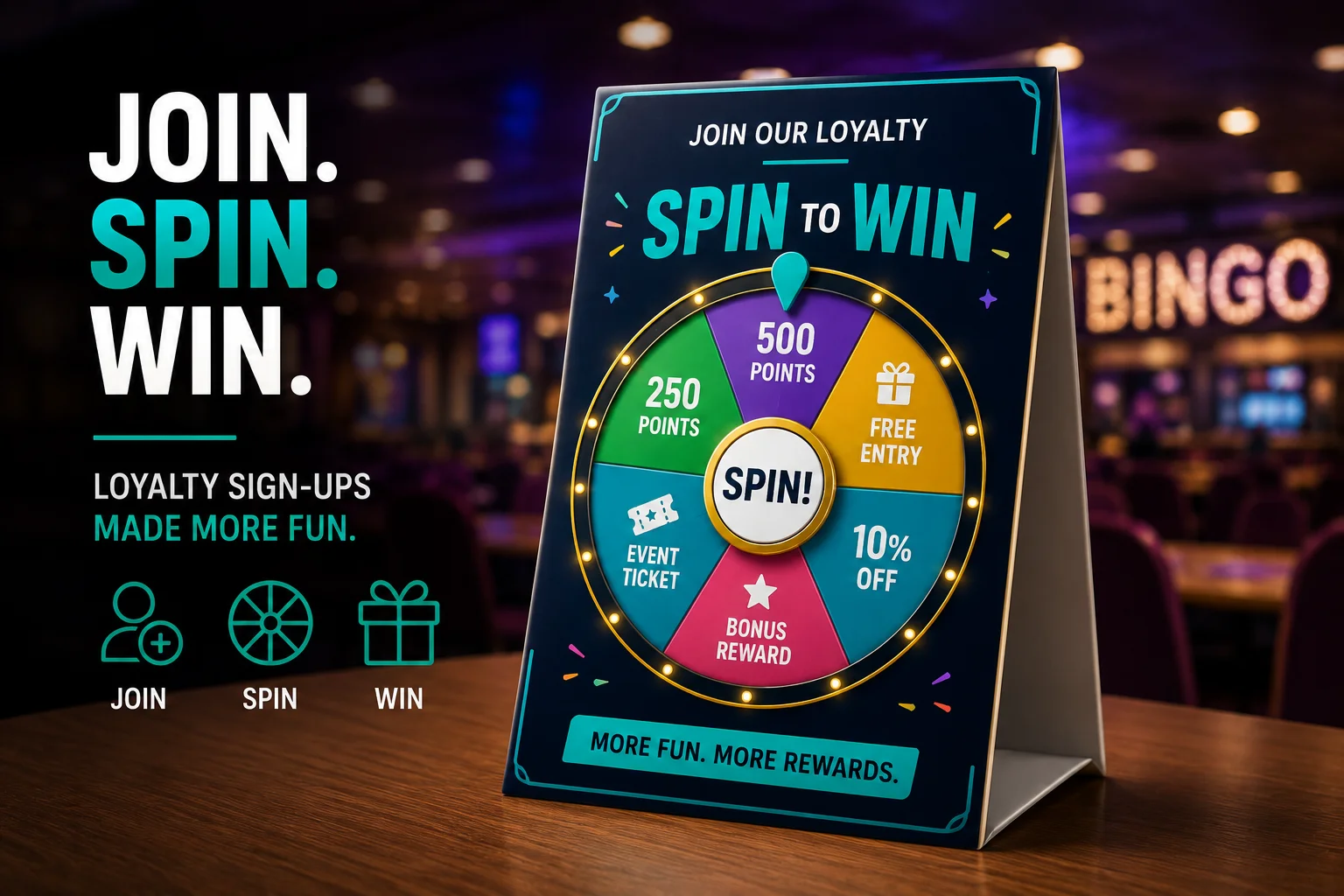
- Prize wheels
- Achievement challenges
- Collection mechanics
- Event-themed games
The important consideration is whether the module supports a meaningful customer objective.
A game that exists purely for entertainment may create activity.
A game connected to loyalty, rewards, events, or attendance can create purposeful engagement.
The Goal Isn't to Replace Bingo
This distinction matters.
A bingo hall doesn't need to turn its app into another gaming platform.
The mini game should complement the core venue experience.
Think of it as a bridge between visits.
The physical bingo session provides the main entertainment.
The digital experience provides additional touchpoints.
Together, they can create:
Physical experience → Digital engagement → Physical return
That makes the app part of the customer journey rather than a separate marketing channel.
Give Players Something to Do Between Sessions
One of the simplest uses for mini games is maintaining engagement.
A player might receive a notification:
"Your new weekly challenge is ready."
They open the app.
They complete a short game.
They earn points.
They check their loyalty balance.
They see that they're one visit away from their next achievement.
What started as a two-minute game has created several additional interactions.
The player has now been reminded of the venue without receiving another conventional sales message.
Turn Idle Time Into Loyalty Activity
Customers have spare moments throughout the week.
They may be:
- Waiting for an appointment
- Commuting
- Relaxing at home
- Taking a lunch break
- Waiting for friends
- Looking for something to do on their phone
A mini game allows the venue to occupy a small part of that time.
The experience doesn't need to last long.
In fact, keeping it short can be an advantage.
A five-minute interaction that happens repeatedly may be more useful for retention than an elaborate game that customers try once.
Create Progress That Carries Across Visits
Traditional bingo sessions tend to have a clear beginning and end.
Gamification can introduce something that continues.
For example:
3 of 5 weekly challenges completed
or:
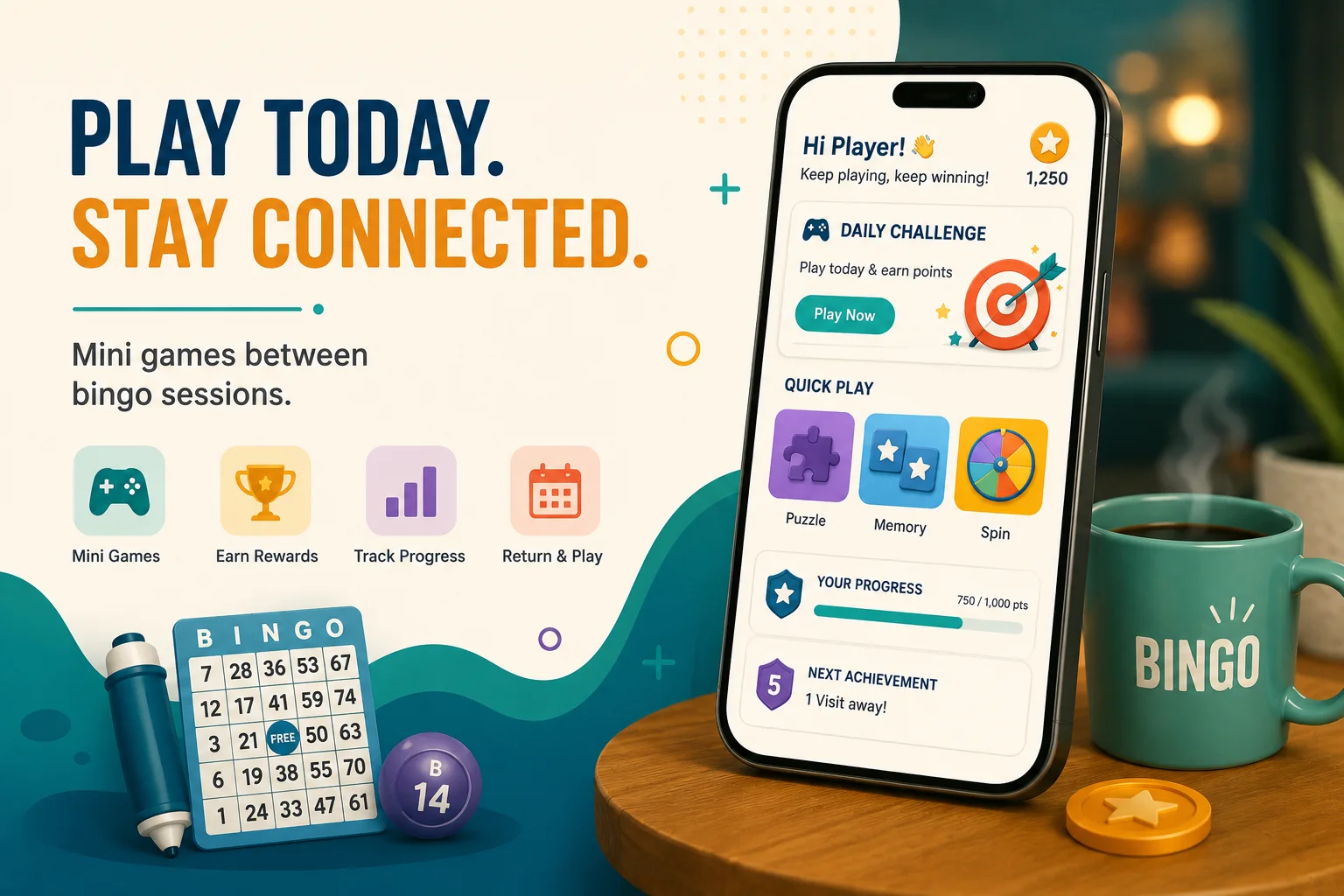
750 of 1,000 loyalty points earned
or:
One visit remaining to unlock your next achievement
The player leaves the venue, but their progress stays with them.
That continuity can encourage them to think about the next action.
Connect Mini Games With Loyalty Points
Points can provide a tangible connection between digital engagement and the wider loyalty programme.
For example:
Complete today's mini game → Earn 25 points
Complete five challenges → Earn a bonus
Reach your monthly target → Unlock an achievement
This gives the customer a reason to return to the app.
It also makes the loyalty programme more active than a simple points balance that customers occasionally check.
Use Mini Games to Support Attendance
Digital engagement is useful.
Physical attendance is often the bigger business objective.
The two can be connected.
Imagine a player completes a weekly challenge and receives:
"You've unlocked a reward available during Thursday's bingo session."
The mini game has now created a reason to visit.
The journey becomes:
Play digitally → Unlock → Visit physically
That connection is important for physical venues.
The digital experience should ultimately help strengthen the real-world customer relationship.
Make Quiet Nights Part of the Challenge
Not every session needs additional promotion.
Sometimes one particular night needs it.
Suppose Friday and Saturday are consistently busy while Tuesday attendance is weaker.
An operator could create:
Tuesday Challenge
Attend three Tuesday sessions this month and complete the associated mini-game challenges to unlock a special achievement or loyalty reward.
Now the digital mechanic supports a specific operational objective.
Instead of broadly discounting every session, the operator can focus engagement around the night where additional attendance matters.
Use Event-Themed Mini Games
Mini games can also become part of event promotion.
Suppose a venue is preparing for:
- A charity fundraiser
- Anniversary night
- Holiday event
- Special jackpot session
- Themed bingo night
- Member appreciation event
The app can feature a related mini game or challenge before the event.
For example:
"Complete the Event Challenge before Friday."
The customer interacts with the game and then sees:
"Your event reward is waiting at Friday's session."
The event has now become part of the customer's digital experience before they arrive.
Make the Experience More Personal
A major advantage of a connected digital platform is the ability to create different experiences for different customers.
A new member might see:
Welcome Challenge
An active player might see:
Weekly Attendance Challenge
A VIP might see:
Exclusive Member Challenge
An inactive customer might see:
Welcome-Back Challenge
The mechanic can remain simple.
The context changes.
This makes the experience more relevant without requiring every customer to receive the same campaign.
Mini Games Can Help Reactivate Lapsed Players
Consider a player who hasn't visited for two months.
Sending the same promotional message they received when they were active may not be effective.
A different approach could be:
"It's been a while. Your new challenge is waiting."
The player opens the app.
They complete the mini game.
They discover a reward or progress opportunity.
Then they see an upcoming event.
The mini game isn't necessarily the reason they return to the venue immediately.
It is the first step back into the relationship.
Don't Make Every Interaction a Sales Message
This is one of the most important differences between engagement and promotion.
If every app interaction says:
"Come to the venue and spend money."
customers may eventually tune out.
Mini games provide a non-sales interaction.
The player can simply participate.
Then, once they're inside the app, relevant information about rewards, events, loyalty progress, or upcoming sessions can be presented naturally.
The relationship becomes broader than constant promotion.
Build a Weekly Digital Rhythm
Operators can use a predictable structure without making the experience repetitive.
For example:
Monday
New weekly mini game.
Tuesday
Progress reminder.
Wednesday
Midweek challenge.
Thursday
Event or session reminder.
Friday
Bingo night.
Weekend
Achievement or reward update.
The exact schedule will depend on the venue.
The principle is to give customers a reason to interact throughout the week rather than concentrating every communication around game night.
Connect Mini Games With Achievements
A mini game can contribute to a larger achievement system.
For example:
5 completed mini games → Digital Explorer badge
10 completed challenges → Challenge Champion badge
Attend three sessions + complete five mini games → Connected Player achievement
This makes digital participation feel like part of a broader journey.
The customer isn't simply playing isolated games.
They're building progress.
Add VIP Progression
For customers who enjoy status and recognition, mini games can also support VIP progression.
A player might earn points through:
- Venue attendance
- Loyalty activity
- Event participation
- Qualifying mini-game engagement
That progress can contribute toward a VIP tier.
Now the digital experience has a clear connection to long-term loyalty.
The player can see:
Current status → Progress → Next tier → Benefits
This creates another reason to remain engaged.
Avoid Turning Engagement Into a Chore
Gamification stops being effective when it starts feeling like work.
Players shouldn't have to complete ten complicated steps just to receive a small reward.
A strong mini game should be:
- Easy to understand
- Fast to complete
- Mobile-friendly
- Accessible
- Clear about the outcome
- Connected to a meaningful benefit
The experience should feel like an optional piece of entertainment, not another task on a customer's to-do list.
Variety Keeps the Experience Fresh
One mini game can become familiar quickly.
Rotating formats can help maintain interest.
For example:
Week 1: Trivia
Week 2: Puzzle
Week 3: Spin-to-win
Week 4: Achievement challenge
The overall loyalty structure remains familiar while the individual experience changes.
Seasonal and event-based themes can add another layer of variety.
Don't Confuse Engagement With Retention
A customer playing a mini game is an engagement metric.
It isn't automatically proof of retention.
Operators should look at what happens afterward.
Do players who use mini games:
- Visit more frequently?
- Attend more events?
- Redeem more rewards?
- Remain active longer?
- Engage with loyalty programmes more often?
- Return after periods of inactivity?
These are the outcomes that matter.
Measure the Digital-to-Physical Connection
A useful reporting structure might compare:
Digital Engagement
Mini-game participation and completion.
Loyalty Engagement
Points earned, rewards viewed, achievements unlocked.
Physical Engagement
Visits, event attendance, and session frequency.
Retention
Repeat visits and continued activity over time.
This helps operators understand whether mini games are contributing to a broader customer journey.
A Realistic Example for a Bingo Hall
Imagine a venue introduces a weekly mini-game programme.
Every Monday, loyalty members receive a new challenge.
A player completes it and receives points.
Their dashboard then shows:
600 points
400 points until next reward
3 of 5 challenges completed
1 visit until next achievement
Later in the week, the player receives a relevant reminder about Thursday's session.
They attend.
Their visit contributes toward the next milestone.
After the session, their loyalty progress updates.
The following Monday, another challenge appears.
Nothing about the core bingo game has changed.
But the relationship around it has become continuous.
What Happens When the Mini Game Is Connected to the Rest of the Platform?
This is where the strategy becomes more powerful.
Imagine the following customer journey:
Player attends bingo
↓
Loyalty activity is recorded
↓
Player leaves the venue
↓
New mini game becomes available
↓
Player completes it
↓
Points are awarded
↓
Achievement progress increases
↓
SMS reminds player about upcoming event
↓
Player attends
↓
Referral opportunity appears
↓
Player invites a friend
This is no longer simply a mini game.
It's a connected engagement system.
Common Mistakes Operators Should Avoid
Building a Game With No Business Objective
The mechanic should support engagement, loyalty, attendance, or another measurable goal.
Making the Game Too Long
Customers should be able to participate quickly.
Separating Digital and Physical Activity
Connect digital progress with real-world visits and events where appropriate.
Rewarding Every Click
Not every interaction needs a monetary reward. Progress and recognition can also motivate.
Overusing Notifications
Relevant messages are more useful than constant reminders.
Measuring Only Game Plays
Look at repeat visits, retention, loyalty engagement, and event participation as well.
Making the Experience Complicated
The simpler the mechanic, the easier it is for customers to understand and repeat.
How JustKonnect Helps Extend Engagement Beyond Game Night
For a physical bingo venue, the challenge isn't simply finding another way to entertain customers.
It's creating a reason for them to remain connected when they're not physically in the hall.
JustKonnect In-App Mini Games provides a way to introduce interactive experiences into the wider customer and loyalty journey. Mini games can work alongside loyalty points, achievements, rewards, challenges, VIP tiers, and customer communications to create more frequent digital touchpoints.
Instead of treating the app as a place customers visit only when they need to check their rewards, operators can give them another reason to open it.
A short game can lead to a loyalty interaction.
That interaction can lead to progress.
Progress can lead to an achievement.
And the achievement can become another reason to return to the venue.
Frequently Asked Questions
What are mini game modules in a bingo hall app?
Mini game modules are short interactive experiences available within a venue's digital or loyalty platform. They can include challenges, trivia, puzzles, spin experiences, and other simple game mechanics.
Why should bingo halls engage players between sessions?
Keeping customers connected between physical visits can create additional opportunities for loyalty engagement, event promotion, rewards, and reminders that encourage future attendance.
Can mini games increase bingo hall attendance?
Mini games can support attendance when they are connected to venue-based rewards, challenges, events, or milestones. Operators should measure whether digital engagement results in additional physical visits.
Do mini games need to provide cash or large discounts?
No. Points, achievements, progress, recognition, and other loyalty benefits can provide motivation without making every interaction dependent on a large financial incentive.
How can operators measure the success of mini games?
Track game participation and completion alongside loyalty activity, reward redemption, visit frequency, event attendance, reactivation, and retention. The goal is to understand whether digital engagement contributes to meaningful customer behavior.
The Bingo Session Ends. The Customer Journey Doesn't Have To.
A bingo card has a beginning and an end.
The customer relationship shouldn't.
The strongest venue loyalty strategies create continuity between physical visits, giving players reasons to remain connected even when they're sitting at home rather than sitting in the bingo hall.
Mini game modules can provide that missing connection.
They give players something quick to do.
They create opportunities for progress.
They can support loyalty points and achievements.
They can promote events and quieter sessions.
And, when connected properly, they can turn digital engagement into another path back to the venue.
The goal isn't to distract customers from bingo.
It's to extend the experience beyond the bingo card.
With the right combination of mini games, loyalty, rewards, CRM, and communication, game night can become one part of a much larger customer journey.
Explore JustKonnect In-App Mini Games to see how your venue can use interactive digital experiences to keep players engaged between sessions and create stronger reasons to return.