A bingo player's relationship with a venue shouldn't have to end when the last number is called.
Yet that's exactly what happens with many traditional loyalty programmes.
A customer attends a session, plays their cards, collects any winnings, and goes home. If the next visit is several days away, there may be little interaction between the player and the venue.
That creates a gap.
The venue may have a customer who genuinely enjoys playing, but there is nothing keeping the brand or community in front of them between visits.
In-app mini games can help close that gap.
Simple games, challenges, and interactive experiences can give players something to do between bingo sessions while creating additional opportunities for loyalty engagement, rewards, and communication.
The objective isn't to replace bingo.
It's to make the relationship with the venue continue between bingo sessions.
The Retention Problem Doesn't Always Start at the Venue
When a player doesn't return, operators often look at the experience inside the hall.
Was the event good?
Were the prizes attractive?
Was the atmosphere right?
Those questions matter.
But retention can also be influenced by what happens after the customer leaves.
Imagine a player visits on Friday.
Their next planned visit might be the following Friday.
That's seven days where the venue isn't part of their daily experience.
Now imagine that during the week they can:
- Complete a mini-game
- Earn loyalty points
- Work toward an achievement
- Check their progress
- Unlock a small reward
- Participate in a challenge
- See an upcoming event
The customer has another reason to open the app.
And another reason to think about the venue.
What Are In-App Mini Games?
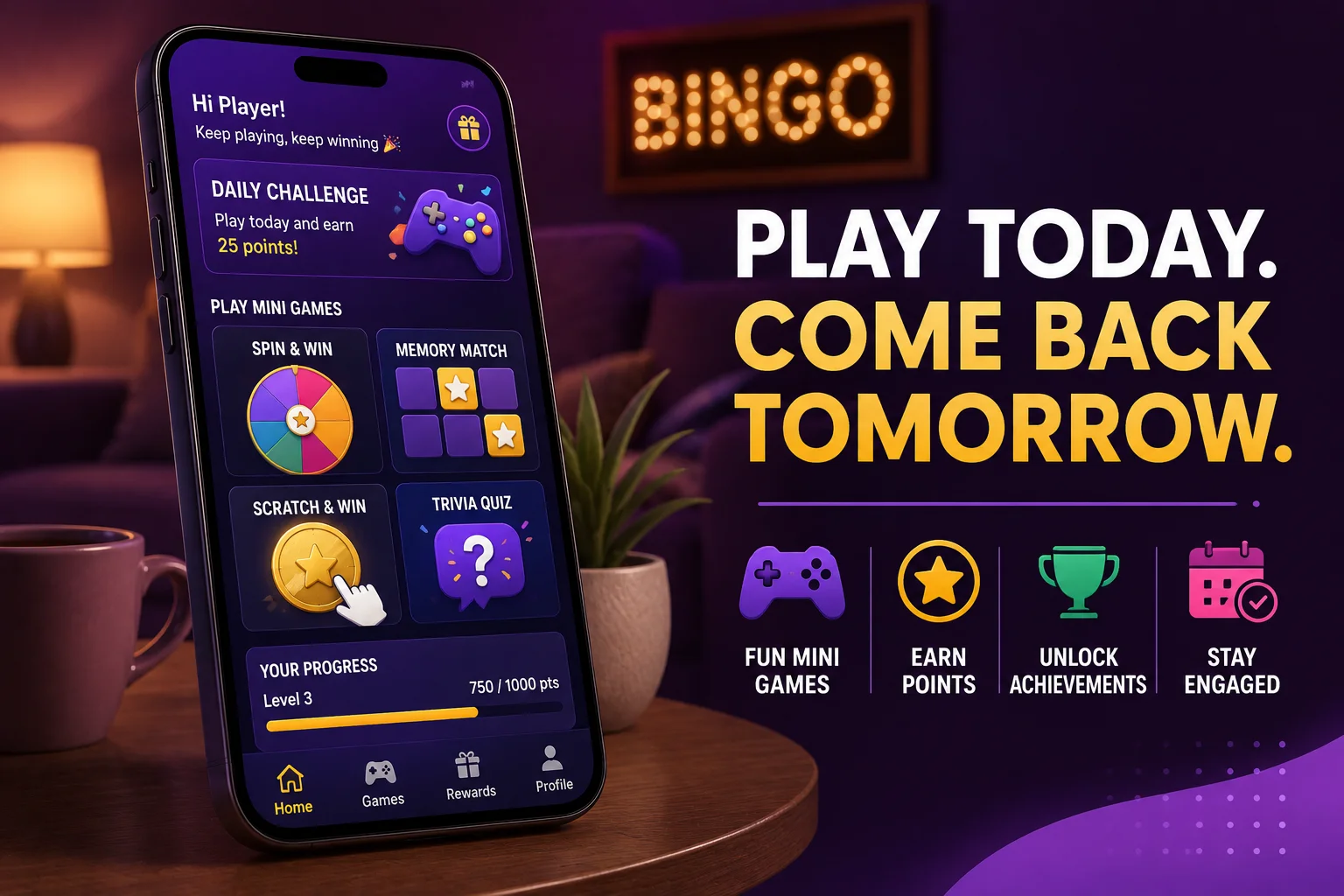
In-app mini games are short, accessible games built into a venue's digital experience.
They don't need to be complicated.
The best mini games are often simple enough to understand immediately.
Examples could include:
- Daily challenges
- Trivia
- Scratch-style experiences
- Memory games
- Digital puzzles
- Prize wheels
- Prediction-style challenges
- Achievement challenges
- Collection mechanics
For a bingo venue, the game should support the wider loyalty and engagement strategy rather than distract from the core bingo experience.
Why Between-Session Engagement Matters
Retention isn't only about what happens during a visit.
It's also about whether the customer continues to interact with the brand between visits.
Think about the difference between these two journeys.
Traditional Journey
Friday: Visit bingo hall
Saturday–Thursday: No interaction
Next Friday: Receive a promotional message
Connected Journey
Friday: Visit bingo hall
Saturday: Check loyalty progress
Sunday: Complete mini-game
Monday: Earn points
Tuesday: Unlock achievement progress
Wednesday: See upcoming event
Thursday: Receive relevant reminder
Friday: Return to the venue
The second journey creates more touchpoints without requiring another physical visit every day.
Mini Games Give Customers a Reason to Open the App
An app that only displays account information may have limited reasons for customers to open it frequently.
A player might check their points occasionally.
They might look at a reward.
Then they leave.
Mini games can create a recurring reason to return to the digital experience.
For example:
"Today's challenge is ready."
That simple message creates an opportunity for interaction.
Once the player opens the app, they may also see:
- Their loyalty balance
- Their next achievement
- Upcoming bingo sessions
- Available rewards
- VIP progress
- Event information
The mini game becomes an entry point into the wider loyalty ecosystem.
Daily Engagement Doesn't Mean Daily Discounts
This is one of the biggest advantages of mini games.
Operators don't need to offer a new discount every day simply to create engagement.
Instead, the player might receive:
10 points for completing today's challenge.
Or:
Complete five daily challenges to unlock an achievement.
The reward can be relatively modest while the interaction remains interesting.
That can help reduce the pressure to continually increase promotional value.
Give Players a Reason to Build a Streak
Streaks are another simple game mechanic.
For example:
Play the mini-game for three consecutive days.
Complete the challenge.
Continue the streak.
Unlock a milestone.
The customer now has a reason to maintain their progress.
However, streaks should be designed carefully.
If missing one day completely resets long-term progression, players may become frustrated and abandon the programme.
A more forgiving approach can allow occasional missed days while still rewarding consistency.
Connect Mini Games With Loyalty Points
The mini-game doesn't have to exist independently.
It can contribute to the customer's loyalty balance.
For example:
Complete today's game → Earn 25 loyalty points
Complete five games → Earn 150 bonus points
Complete the monthly challenge → Unlock a special reward
The customer receives a reason to engage with the app.
The operator gets another opportunity to encourage loyalty activity.
Use Mini Games to Build Toward Achievements
Points aren't the only progression mechanism.
Achievement badges can provide another objective.
Imagine a player sees:
Daily Player
Complete five mini-game challenges.
Then:
Challenge Champion
Complete 20 challenges.
And eventually:
Ultimate Member
Complete a combination of digital and physical venue activities.
The player isn't only accumulating points.
They're building a record of participation.
Make Digital Activity Connect With Physical Visits
This is where mini-games become particularly valuable for bingo halls.
The digital experience should ultimately support the physical venue rather than become completely separate from it.
For example:
Complete three mini-game challenges → Unlock a venue reward
Or:
Attend two bingo sessions + complete five app challenges → Earn an achievement
Now digital engagement and physical attendance reinforce each other.
The player has reasons to participate in both environments.
Use Mini Games to Encourage Return Visits
Suppose a player completes a mini-game on Tuesday.
The result says:
"You've unlocked a reward available during Thursday's bingo session."
The game has now created a reason to visit.
The sequence becomes:
Digital interaction → Reward → Physical visit
That's much more useful than simply entertaining customers inside the app.
Turn Upcoming Events Into Interactive Content
Mini games can also support event marketing.
Suppose the venue has a special themed bingo night coming up.
Instead of only displaying:
"Charity Night — Friday"
the app could feature a related challenge.
For example:
Complete the Charity Night Challenge before Friday.
The player interacts with the game and then receives information about the event.
The event becomes part of the customer's digital experience before they arrive.
Re-Engage Players Who Have Become Inactive
Mini games can also support reactivation.
Consider a customer who hasn't visited for six weeks.
A generic message might say:
"We'd love to see you again."
A more interactive approach could be:
"Your new weekly challenge is waiting. Open the app and see what you can unlock."
The objective is to create a low-friction first interaction.
Once the player returns to the app, they can be exposed to relevant information about upcoming sessions, rewards, or events.
The mini game opens the door.
The wider loyalty programme continues the conversation.
Personalise the Experience
Not every player needs to see the same content.
A frequent player might receive challenges related to:
- VIP progression
- Event participation
- Achievement milestones
A newer customer might receive:
- Welcome challenges
- Beginner achievements
- Loyalty education
- First-return incentives
An inactive customer might receive:
- Re-engagement challenges
- Return-visit rewards
- Limited-time experiences
Personalisation makes the mini game more relevant.
Keep Mini Games Short
The word mini matters.
Players aren't necessarily looking for a 30-minute gaming experience.
They're waiting for a bingo session.
They're commuting.
They're sitting at home.
They have a few minutes.
A good mini game should therefore be:
- Quick to understand
- Easy to access
- Simple to complete
- Mobile-friendly
- Connected to a clear outcome
If the experience requires lengthy instructions, complex navigation, or repeated forms, the engagement opportunity can quickly disappear.
Don't Let the Game Become the Main Attraction
The purpose of a bingo hall app isn't necessarily to compete with dedicated gaming platforms.
The mini game has a different job.
It should encourage:
Engagement → Loyalty → Attendance → Retention
If the player spends five minutes completing a challenge and then discovers the venue's next event, that's useful.
If the game becomes completely disconnected from the venue, its marketing value becomes harder to justify.
Give Players Something New to Discover
Repeating the same mini-game forever can reduce its novelty.
Operators can rotate experiences.
For example:
Monday
Weekly challenge.
Wednesday
Midweek mini-game.
Friday
Event-themed game.
Monthly
Special achievement challenge.
This creates variety while maintaining a familiar digital routine.
Measure Engagement, Not Just Downloads
If your venue offers an app, download numbers alone don't tell you much.
You need to understand what customers actually do.
Useful metrics include:
- Daily active users
- Mini-game participation
- Game completion rate
- Repeat game sessions
- Loyalty point activity
- Reward redemption
- Return visits
- Event attendance
- Inactive-player reactivation
- Visit frequency among engaged players
One particularly useful comparison is between players who regularly use the mini-games and those who don't.
Do the engaged players return more often?
Do they participate in more events?
Do they redeem more rewards?
Those comparisons can help determine whether the digital experience is contributing to retention.
A Practical Example
Imagine a bingo hall introduces a simple weekly mini-game.
Every Monday, loyalty members receive a new challenge.
A player completes it and earns 50 points.
Their account then shows:
450 points
50 points from next reward
2 of 5 challenges completed this month
1 visit away from your next achievement
The player now has several reasons to remain engaged.
Later in the week, they receive an appropriate reminder about the venue's Friday session.
They attend.
Their visit contributes to another milestone.
The digital and physical experiences reinforce one another.
That's much more powerful than treating the app and venue as separate channels.
What Traditional Loyalty Programmes Often Miss
A conventional loyalty programme might focus heavily on:
Spend → Earn points → Redeem
That's useful, but it can be limiting for bingo halls and other physical venues.
A broader engagement model can include:
Visit → Play → Engage → Earn → Progress → Achieve → Return
Mini games add another form of participation.
The customer doesn't need to be physically inside the venue to remain connected.
Common Mistakes When Introducing Mini Games
Making the Game Too Complicated
If players need a tutorial before they can participate, the mechanic is probably too complicated.
Rewarding Only Spending
If the objective is engagement, consider rewarding participation, attendance, challenges, and other meaningful actions.
Disconnecting Games From the Venue
The game should ultimately support loyalty, events, attendance, or another relevant business objective.
Sending Too Many Notifications
Frequent communication can become irritating. Use relevant triggers rather than constant messages.
Ignoring Inactive Players
Mini games can be useful for re-engagement, but inactive segments need different messaging from highly active players.
Measuring Entertainment Instead of Retention
A popular game isn't automatically a successful loyalty tool. Measure whether engagement translates into meaningful customer behaviour.
How JustKonnect Uses Mini Games to Extend Player Engagement
For bingo operators, the opportunity isn't simply to add another feature to an app.
It's to create a reason for customers to remain connected between physical visits.
JustKonnect's In-App Mini Games feature provides a way for venues to introduce interactive experiences into the digital customer journey. These experiences can work alongside loyalty programmes, rewards, achievements, challenges, and other engagement tools.
That creates a connected cycle:
Visit the venue → Earn loyalty progress → Leave → Play a mini game → Earn or unlock something → Receive relevant engagement → Return
Instead of waiting until the next bingo session to communicate with a customer, operators can give players useful and entertaining reasons to interact between visits.
Frequently Asked Questions
What are in-app mini games for bingo halls?
They are short interactive games built into a venue's digital or loyalty experience. They can be used to encourage engagement, support rewards, create challenges, and keep customers connected between physical visits.
Can mini games improve bingo player retention?
They can contribute to retention by creating additional interactions between visits and giving players reasons to remain engaged with the venue's loyalty ecosystem.
Do mini games need to offer large rewards?
No. Points, achievements, progress, recognition, and small incentives can all contribute to engagement. The right reward structure depends on the venue's goals.
Can mini games encourage players to visit the bingo hall?
Yes. Operators can connect digital challenges and rewards with physical attendance, events, or venue-based achievements.
How can operators measure whether mini games are working?
Track participation, completion, repeat engagement, loyalty activity, reward redemption, attendance, visit frequency, and reactivation. Comparing engaged and non-engaged customers can provide additional insight.
The Relationship Shouldn't End When the Session Does
A bingo session might last a few hours.
The relationship with the customer can last much longer.
That's why the period between visits matters.
A player who has nothing to do until the next session may gradually become less engaged. A player who can check progress, complete a challenge, earn points, unlock achievements, and discover upcoming events has more reasons to stay connected.
In-app mini games aren't a replacement for a great bingo experience.
They're an additional layer around it.
When connected with loyalty, rewards, CRM, messaging, and attendance strategies, a simple five-minute digital interaction can become part of a much larger retention journey.
The question isn't whether every player needs to play a mini game every day.
It's whether your venue is giving customers enough reasons to stay connected between the visits that matter most.
Explore JustKonnect In-App Mini Games and see how interactive digital experiences can help your venue keep players engaged between sessions and build stronger long-term loyalty.