A customer walks into a bingo hall, restaurant, entertainment venue, or other physical business.
You want them to join your loyalty programme.
The traditional approach is familiar:
"Join our loyalty programme and get 10% off."
It is simple. It can work.
But it also creates a problem.
Customers quickly learn that joining a loyalty programme usually means receiving another discount. If the offer isn't immediately useful, they may ignore the sign-up request altogether.
Now consider a different experience:
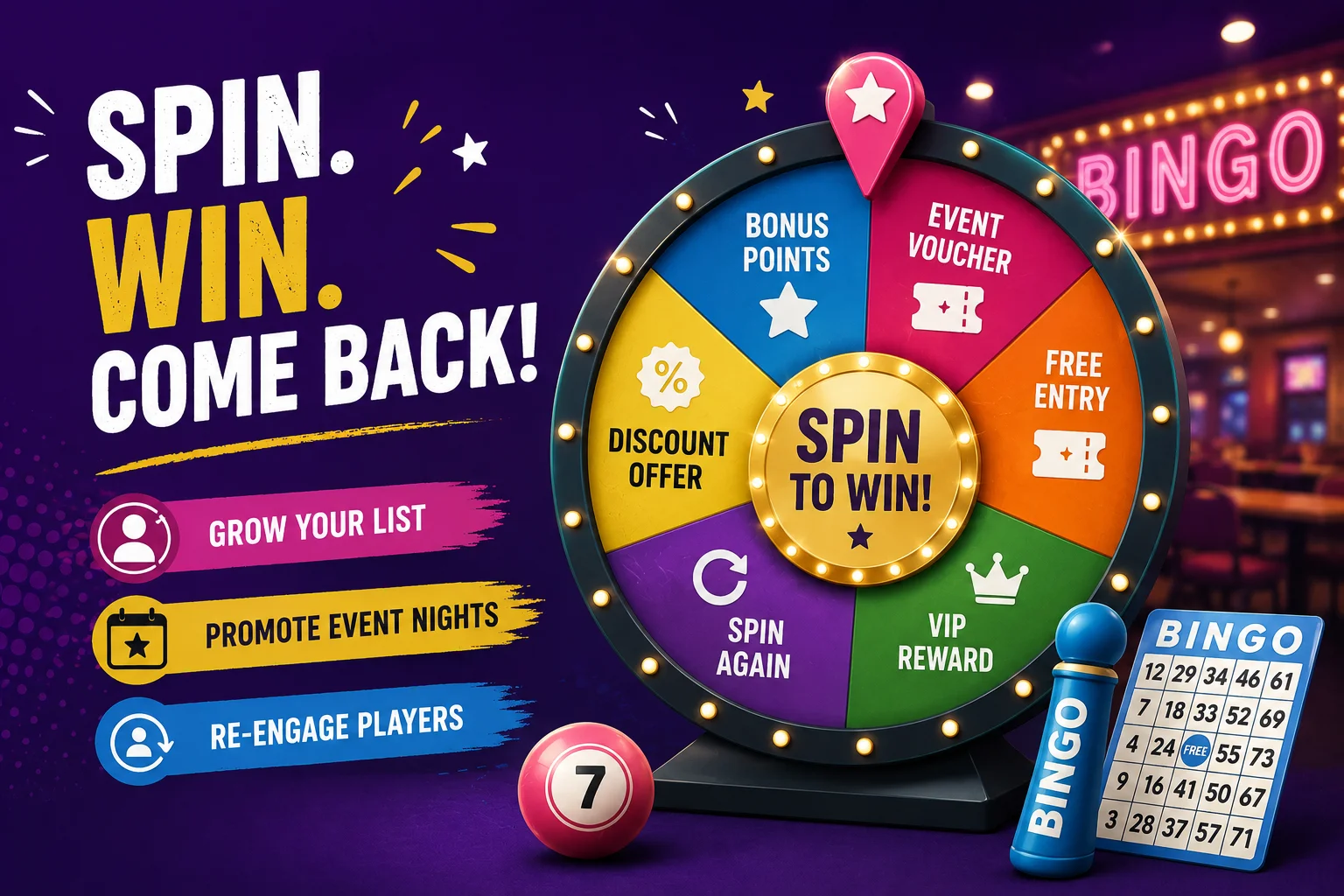
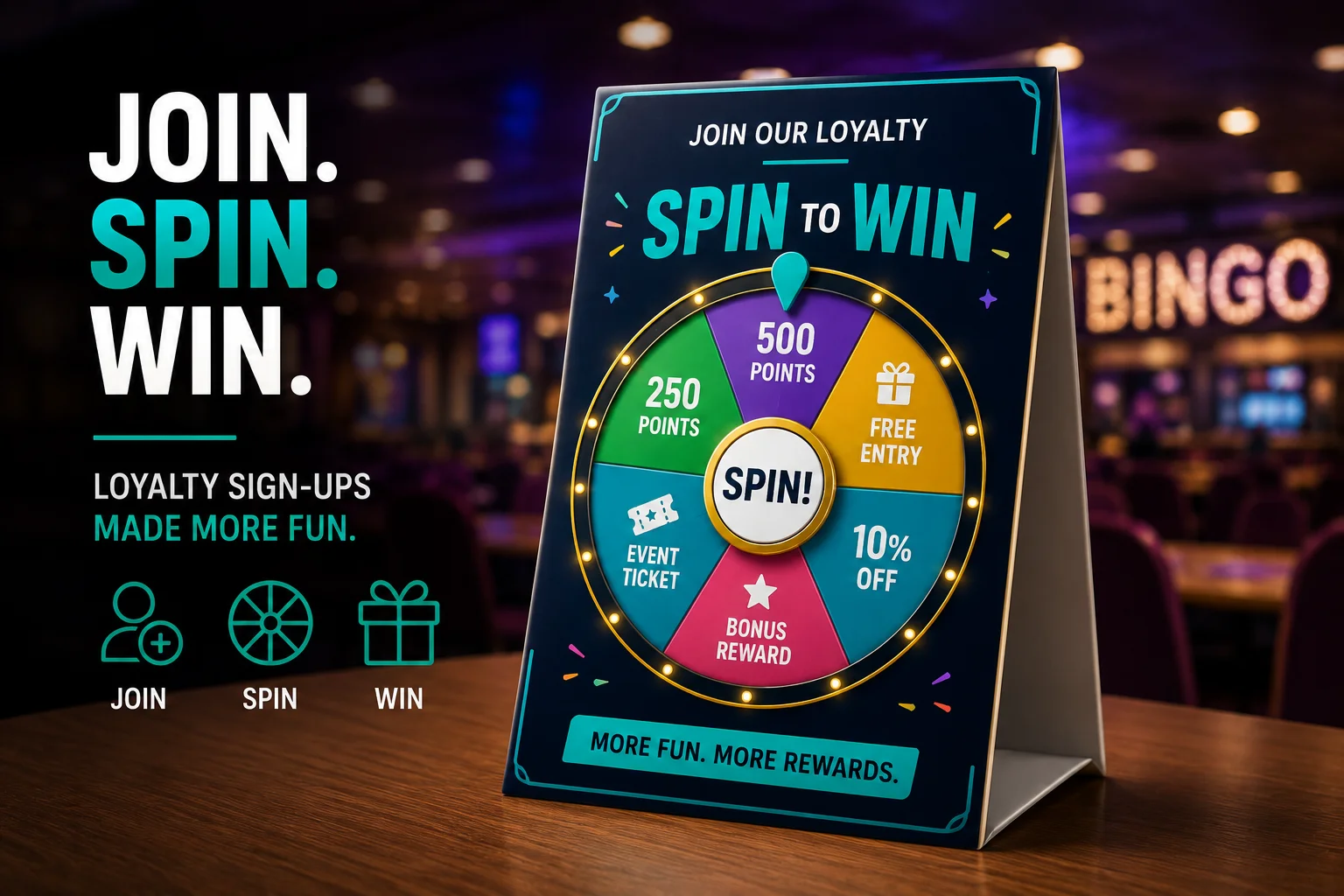
"Join our loyalty programme and spin to discover your reward."
The customer doesn't know exactly what they'll receive.
There is an element of curiosity.
They have something to do immediately.
And the act of signing up becomes part of an experience rather than an administrative step.
That is the opportunity behind spin-to-win marketing.
For physical venues, particularly bingo halls and entertainment businesses where engagement and repeat visits matter, an interactive reward mechanic can make the loyalty sign-up process more compelling than simply presenting another static discount.
Why Static Discounts Have Become Easy to Ignore
Discounts are everywhere.
Customers see them in:
- Emails
- SMS messages
- Loyalty programmes
- Apps
- Social media
- Digital advertising
- In-store promotions
- Event campaigns
That familiarity can reduce their impact.
A customer may look at a message offering 10% off and think:
"I'll use it later."
Then later never comes.
There's also a deeper problem.
A static discount gives the customer a predictable outcome.
They know what they're getting before they interact.
There is no discovery.
No progress.
No surprise.
No reason to explore the programme beyond the financial incentive.
Spin-to-Win Changes the First Interaction
A spin-to-win campaign introduces an action.
Instead of:
Sign up → Receive discount
the experience becomes:
Sign up → Spin → Discover reward
That additional interaction may seem small, but it changes the psychology of the experience.
The customer isn't simply receiving an offer.
They're participating in something.
The reward becomes an outcome of the interaction.
Curiosity Is a Powerful Hook
Imagine seeing:
Get 10% off when you join.
Now compare it with:
Join today and spin to discover your reward.
The second message creates an unanswered question:
"What will I get?"
That curiosity can encourage the customer to complete the sign-up.
Importantly, the campaign doesn't need to offer a huge reward.
The interaction itself creates interest.
The Customer Gets Immediate Feedback
One of the weaknesses of many loyalty sign-up campaigns is delayed value.
A customer registers.
Then they wait.
Perhaps they receive points later.
Perhaps they receive another email.
Perhaps they eventually use their discount.
Spin-to-win can create an immediate moment of gratification.
Register → Spin → Reward revealed
The customer knows instantly that joining the programme produced something tangible.
That can make the registration experience feel more rewarding.
Why This Matters for Physical Venues
Online businesses can use pop-ups, recommendation engines, automated emails, and digital checkout experiences to encourage loyalty registration.
Physical venues have a different challenge.
The customer is already there.
You may have only a few moments to capture their attention.
A static sign saying:
"Join our loyalty programme"
can easily blend into the environment.
A digital display saying:
"Join and Spin to Win"
creates a more active proposition.
It gives staff something easy to explain.
It gives customers something to interact with.
And it creates a clear reason to opt in.
Spin-to-Win Can Work Particularly Well at Bingo Halls
Bingo halls already have an audience comfortable with game mechanics.
Players understand:
- Taking a chance
- Waiting for an outcome
- Participating in a game
- Winning rewards
- Progressing toward a result
A spin-to-win experience therefore doesn't feel completely disconnected from the environment.
It adds another playful interaction around the core bingo experience.
The important thing is to keep the promotional mechanic clearly separate from the underlying gambling activity and operate it in accordance with applicable promotional and responsible gaming requirements.
Make the Loyalty Sign-Up the Gateway
A strong campaign can make registration the natural first step.
For example:
Join the loyalty programme
↓
Create your member profile
↓
Spin the wheel
↓
Reveal your reward
↓
Use or save your reward
Now the loyalty programme isn't being presented as a database registration.
It becomes the gateway to an experience.
You Don't Need to Give Everyone the Same Discount
Static discounts usually have a fixed value.
For example:
10% off for everyone.
Spin-to-win allows you to introduce a range of outcomes.
A wheel might include:
- Loyalty points
- Digital vouchers
- Event rewards
- Bonus benefits
- Exclusive offers
- Achievement progress
- Other venue-approved incentives
This gives the campaign more variety.
It also allows operators to control the overall promotional cost while keeping the customer experience engaging.
Use Smaller Rewards Without Making the Campaign Feel Small
One advantage of gamification is that the perceived experience can be larger than the monetary value of the reward.
A customer may be perfectly happy receiving a modest reward if the process of discovering it is enjoyable.
That's different from simply telling them:
"Here is a £2 voucher."
The spin makes the reward feel like something they have uncovered.
This doesn't mean operators should make rewards deliberately confusing.
The terms and conditions should remain clear.
But the experience can still be playful.
Create Different Spins for Different Audiences
One static discount often gets sent to everyone.
That's rarely ideal.
Your customer database probably includes:
- New visitors
- Regular players
- VIP members
- Infrequent visitors
- Lapsed customers
- Event attendees
Their motivations aren't identical.
New Visitors
Join and spin for a welcome reward.
Existing Members
Spin during our special event campaign.
Lapsed Customers
We've saved a spin for you—come back and discover your reward.
VIP Members
Exclusive VIP spin available this week.
The same mechanic can support different objectives.
Spin-to-Win Can Help Build a First-Party Database
For physical venues, customer data is valuable.
Without an opt-in, a venue may know that someone visited but have limited ability to communicate with them afterward.
A spin campaign can make the data capture proposition more attractive.
The customer receives something immediately in exchange for becoming part of the loyalty ecosystem.
This can help create a progression:
Anonymous visitor → Known customer → Engaged member → Repeat visitor
The important part is making sure data collection, consent, and communications comply with applicable privacy and marketing requirements.
Don't Collect Data Just for the Sake of It
A loyalty sign-up should have a clear purpose.
Ask only for information you genuinely need.
Then use it to improve the customer experience.
For example, if a customer opts in and later receives relevant information about:
- Upcoming events
- Loyalty progress
- Available rewards
- Challenges
- VIP benefits
the original sign-up becomes useful.
If the customer signs up and then receives irrelevant messages every day, the value disappears quickly.
Connect the Spin With the Next Action
The best campaigns don't stop after the reward is revealed.
Think about what you want the customer to do next.
If the goal is attendance:
Spin → Receive event reward → Attend event
If the goal is loyalty engagement:
Spin → Earn points → Track progress → Return
If the goal is referrals:
Spin → Unlock reward → Refer a friend → Earn additional benefit
The spin should be part of a journey.
Use Spin-to-Win to Promote Specific Nights
A static discount might say:
"10% off this week."
A gamified campaign can be more specific:
"Join our loyalty programme and spin for a Wednesday-night reward."
This gives the campaign a defined purpose.
For venues trying to improve attendance on quieter nights, the mechanic can be linked directly to those sessions.
The customer doesn't simply receive another discount.
They receive a reason to engage with a particular occasion.
Add a Time Limit
A reward that can be used indefinitely may not create urgency.
A clearly communicated expiry can encourage action.
For example:
"Your reward is available until Saturday."
Or:
"Spin before Friday's event."
This gives customers a defined window.
However, expiry rules should always be transparent. Don't use artificial urgency that customers cannot reasonably understand.
Use SMS to Bring Customers Back
Once a customer has opted in, the spin campaign can become the starting point for further communication.
For example:
Day 1: Join and spin.
Day 3: Reminder about the reward.
Day 7: Event invitation.
Day 14: Loyalty progress update.
The messages should be relevant and appropriately timed.
The objective is to move the customer from sign-up to ongoing engagement.
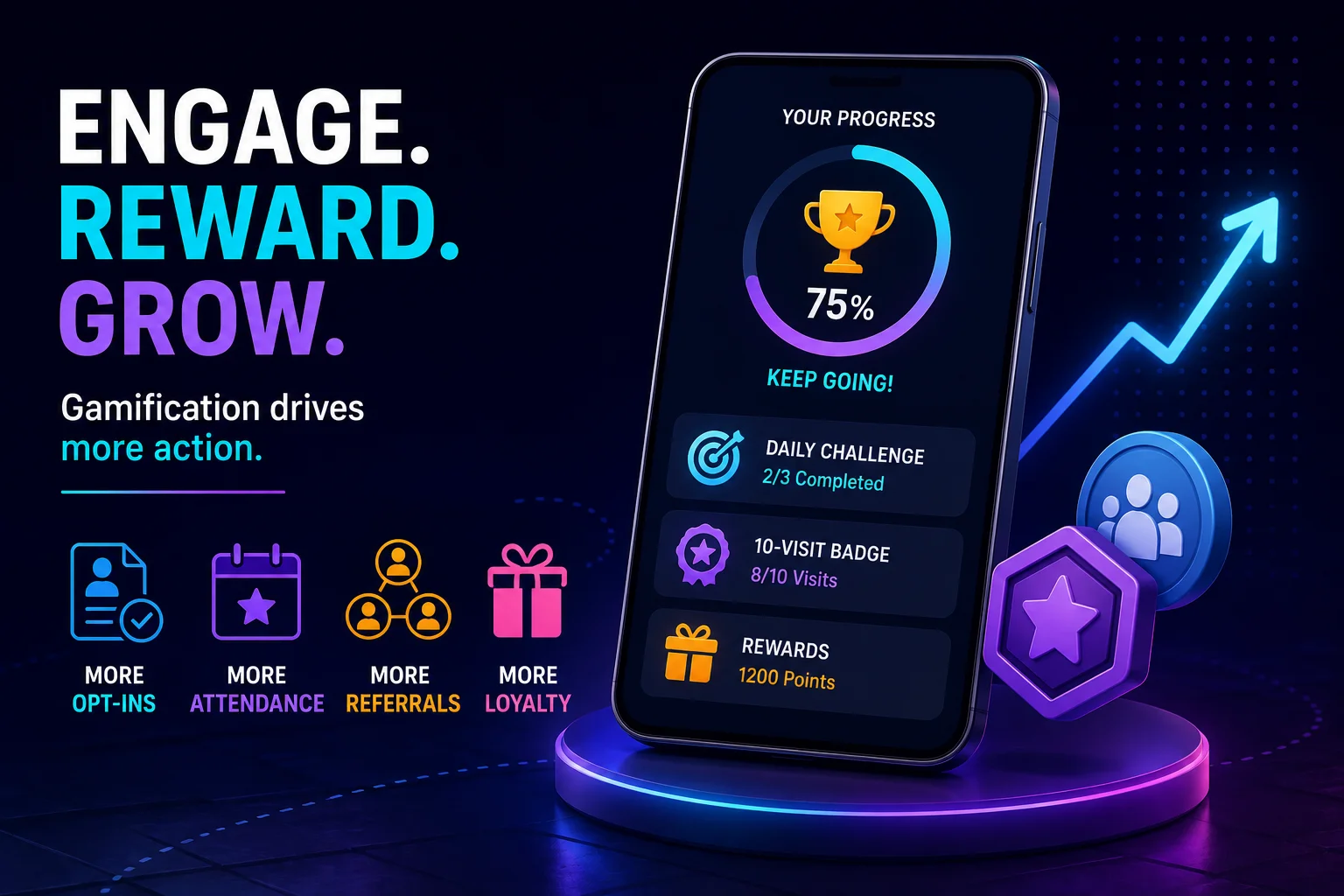
Combine Spin-to-Win With Other Gamification
Spin-to-win becomes even more interesting when it isn't the only game mechanic.
A customer could:
Join → Spin → Earn points → Unlock badge → Progress toward VIP tier
Each mechanic serves a different purpose.
The spin creates immediate interaction.
Points provide accumulated value.
Badges provide recognition.
VIP tiers provide longer-term status.
Together, they create a more complete loyalty journey.
A Practical Physical Venue Example
Imagine an entertainment venue wants to increase loyalty registrations.
It replaces its standard:
"Join our loyalty club and get 10% off"
message with:
Join & Spin
Register today and spin to reveal your member reward.
A customer signs up.
They spin.
They receive loyalty points.
Their account is created.
They then see:
"You're 300 points away from your first reward."
The original sign-up has now created another reason to return.
The customer isn't simply holding a discount.
They're inside a loyalty journey.
What Should Operators Measure?
Don't assume a campaign is successful because customers enjoy spinning.
The important question is whether the mechanic improves business outcomes.
Track:
Loyalty Sign-Up Rate
How many eligible visitors become members?
Spin Participation Rate
How many new members actually use the feature?
Reward Redemption
How many rewards are claimed or used?
First Repeat Visit
How many new members return?
Event Attendance
Does the campaign increase attendance for promoted events?
Customer Engagement
Do members continue interacting with the loyalty programme?
Cost Per New Member
How much does each acquired loyalty member effectively cost?
These numbers can be compared against traditional static offers.
When Static Discounts Still Make Sense
Spin-to-win isn't automatically better for every campaign.
A straightforward discount may be more appropriate when:
- The customer needs a clear price incentive
- The offer has a simple commercial objective
- The reward must be guaranteed
- The audience doesn't need additional gamification
- The promotion needs to communicate a fixed value immediately
The point isn't to eliminate static offers.
It's to recognise that not every customer action needs to be driven by a predictable discount.
Common Mistakes With Spin-to-Win Loyalty Campaigns
Making the Sign-Up Process Too Long
If customers have to complete a lengthy form before reaching the spin, the experience loses momentum.
Making Rewards Unclear
Customers should understand what they can win and how rewards can be used.
Using the Same Wheel Forever
Fresh campaigns and themes can help maintain interest.
Giving Everyone the Largest Reward
This can quickly make the campaign unnecessarily expensive.
Ignoring the Post-Spin Journey
The real opportunity begins after the customer has joined.
Measuring Spins Instead of Sign-Ups and Visits
Participation is useful, but business outcomes matter more.
How JustKonnect Uses Spin-to-Win as a Loyalty Engagement Tool
For physical venues, the real value of spin-to-win is not simply creating a digital wheel.
It is connecting an interactive mechanic to customer acquisition and engagement.
JustKonnect Spin-to-Win gives venues a way to build gamified campaigns around customer participation, rewards, and loyalty engagement. A bingo hall or other physical venue can use the mechanic to make loyalty registration more interactive and then connect the customer with broader engagement opportunities.
The feature can work alongside CRM, loyalty points, SMS marketing, achievement badges, VIP tiers, referrals, and analytics.
That means the journey doesn't have to end when the wheel stops.
A customer can join, spin, receive a reward, attend an event, earn loyalty progress, unlock an achievement, and eventually become a regular advocate for the venue.
Frequently Asked Questions
Why can spin-to-win be more engaging than a static discount?
A static discount provides a predictable outcome. Spin-to-win adds interaction and curiosity, giving the customer a reason to participate rather than simply receiving an offer.
Can spin-to-win help increase loyalty programme registrations?
Yes. Operators can make the spin part of the registration journey, giving customers an immediate interactive reason to join.
Does spin-to-win have to offer expensive rewards?
No. Operators can combine modest rewards, loyalty points, event benefits, and other incentives while keeping the experience engaging.
Can bingo halls use spin-to-win to promote events?
Yes. A spin can be built around specific event nights, helping create an interactive reason for players to engage with the event promotion.
How should operators measure a spin-to-win campaign?
Look beyond the number of spins. Track loyalty opt-ins, reward redemption, repeat visits, event attendance, customer engagement, and acquisition costs.
Make the Sign-Up Worth Completing
The hardest part of many loyalty programmes isn't creating the rewards.
It's getting customers to take the first step.
A static discount says:
"Join and receive this."
Spin-to-win says:
"Join, take part, and discover what happens."
That small difference can make the initial interaction more engaging.
For bingo halls and other physical venues, this creates an opportunity to turn a routine loyalty registration into the beginning of a customer journey.
The spin creates curiosity.
The reward creates immediate value.
The loyalty programme creates an ongoing relationship.
And the data from that relationship can help operators understand which customers are engaging, returning, attending events, and responding to future campaigns.
The objective isn't to replace every discount.
It's to stop relying on discounts as the only reason customers have to engage.
Explore JustKonnect Spin-to-Win to see how interactive gamification can help your physical venue make loyalty sign-ups more engaging and turn new members into repeat customers.