A bingo hall can have hundreds or thousands of players in its database, but that doesn't mean communicating with them is easy.
One player needs a reminder about Friday night. Another is eligible for a loyalty promotion. A regular customer should hear about a special event. Someone who hasn't visited in weeks may need a re-engagement message.
Then there are the operational messages, promotional campaigns, event announcements, and follow-ups happening at the same time.
When all of that is managed through disconnected tools, communication quickly becomes difficult to control.
Messages get duplicated.
Customer lists become inconsistent.
Staff members use different systems.
Campaigns are harder to track.
And the venue loses sight of the bigger picture.
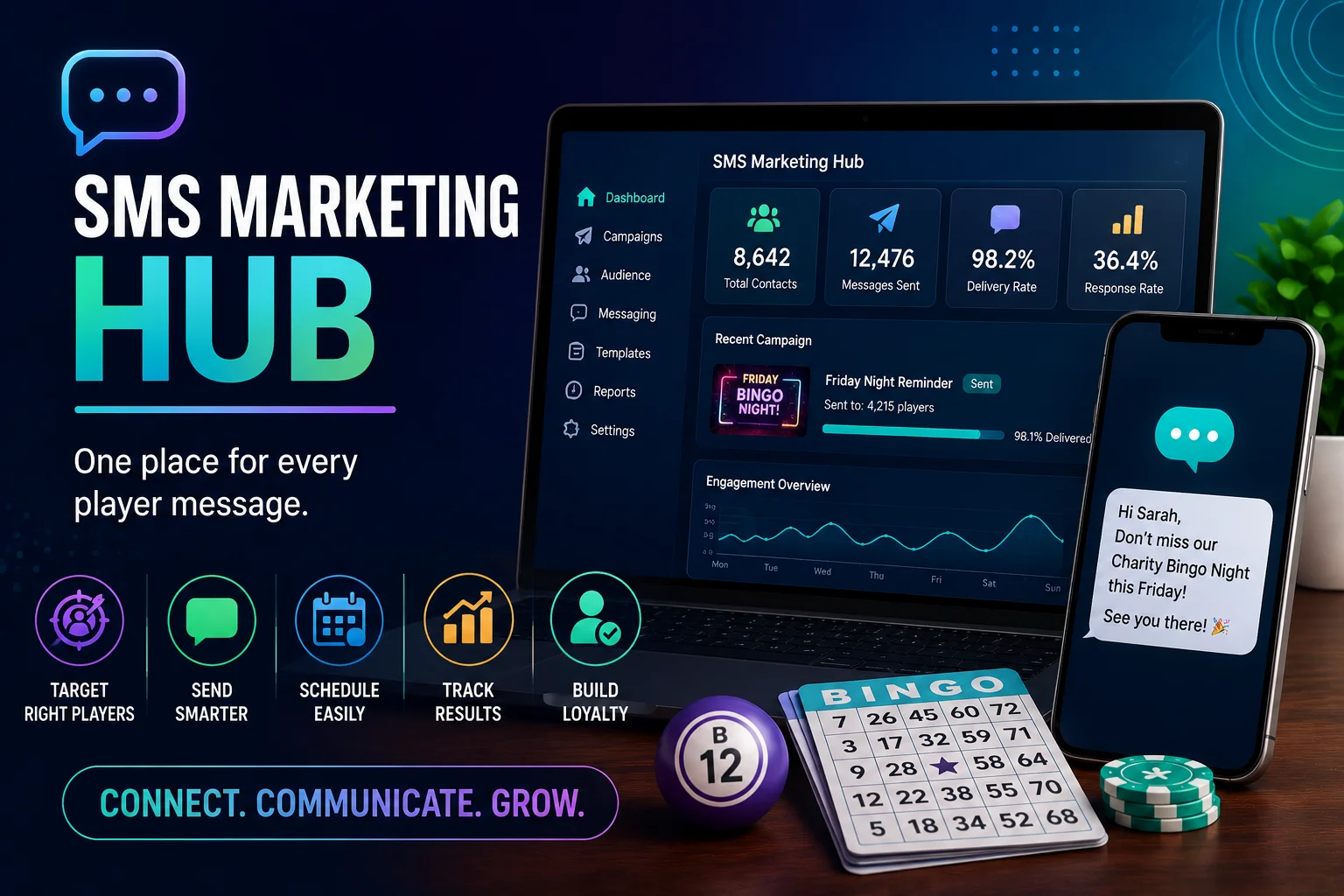
An SMS marketing hub brings these activities into one central place, making it easier for bingo operators to manage player communication, organise campaigns, segment audiences, and understand what happens after a message is sent.
The goal isn't simply to send more SMS messages.
It is to make the communication a coordinated part of the player experience.
The Problem With Sending Messages From Everywhere
Imagine a bingo hall using one tool for its customer database, another for loyalty, a spreadsheet for event lists, and a separate SMS service for marketing.
Each system might work perfectly on its own.
The problem appears when they need to work together.
A marketing employee might export a list of customers.
A loyalty manager might have a different list.
An events coordinator might maintain another spreadsheet.
Someone then uploads those contacts into an SMS platform.
Suddenly, there are several versions of the same customer information.
That creates unnecessary risk and unnecessary work.
A central SMS marketing hub changes the workflow from:
Find data → Export data → Upload contacts → Create campaign → Send → Check another system
to something closer to:
Select audience → Create campaign → Send → Monitor → Review results
That difference becomes increasingly important as the venue's customer base grows.
What Is an SMS Marketing Hub?
An SMS marketing hub is a central system for managing text-message communication with customers or members.
For a bingo hall, that can include activities such as:
- Creating SMS campaigns
- Managing player communication
- Segmenting audiences
- Scheduling messages
- Promoting events
- Sending loyalty-related communications
- Re-engaging inactive players
- Tracking campaign activity
- Managing communication from a central dashboard
Instead of treating SMS as a standalone marketing channel, the hub becomes part of the venue's broader customer engagement system.
Think of It as a Control Centre
A useful way to understand an SMS hub is to think about an airport control tower.
The control tower doesn't fly the aircraft.
It coordinates what is happening around them.
Similarly, an SMS marketing hub doesn't replace your loyalty programme, CRM, events, or promotions.
It helps bring communication into one organised workflow.
For example:
Player data
↓
Audience segment
↓
SMS campaign
↓
Player receives message
↓
Player takes action
↓
Engagement is recorded
↓
Next communication becomes more relevant
The value comes from connecting those steps.
Why Bingo Halls Have a Particular Communication Challenge
Bingo isn't simply an online transaction.
Customers visit at specific times.
Events happen on specific dates.
Attendance matters.
Community relationships matter.
Promotions often have a limited window.
That makes timing particularly important.
A message sent three days before an event may help someone plan their visit.
The same message sent three hours after the event has little value.
An SMS marketing hub can make it easier to organise campaigns around the timing of the venue's calendar.
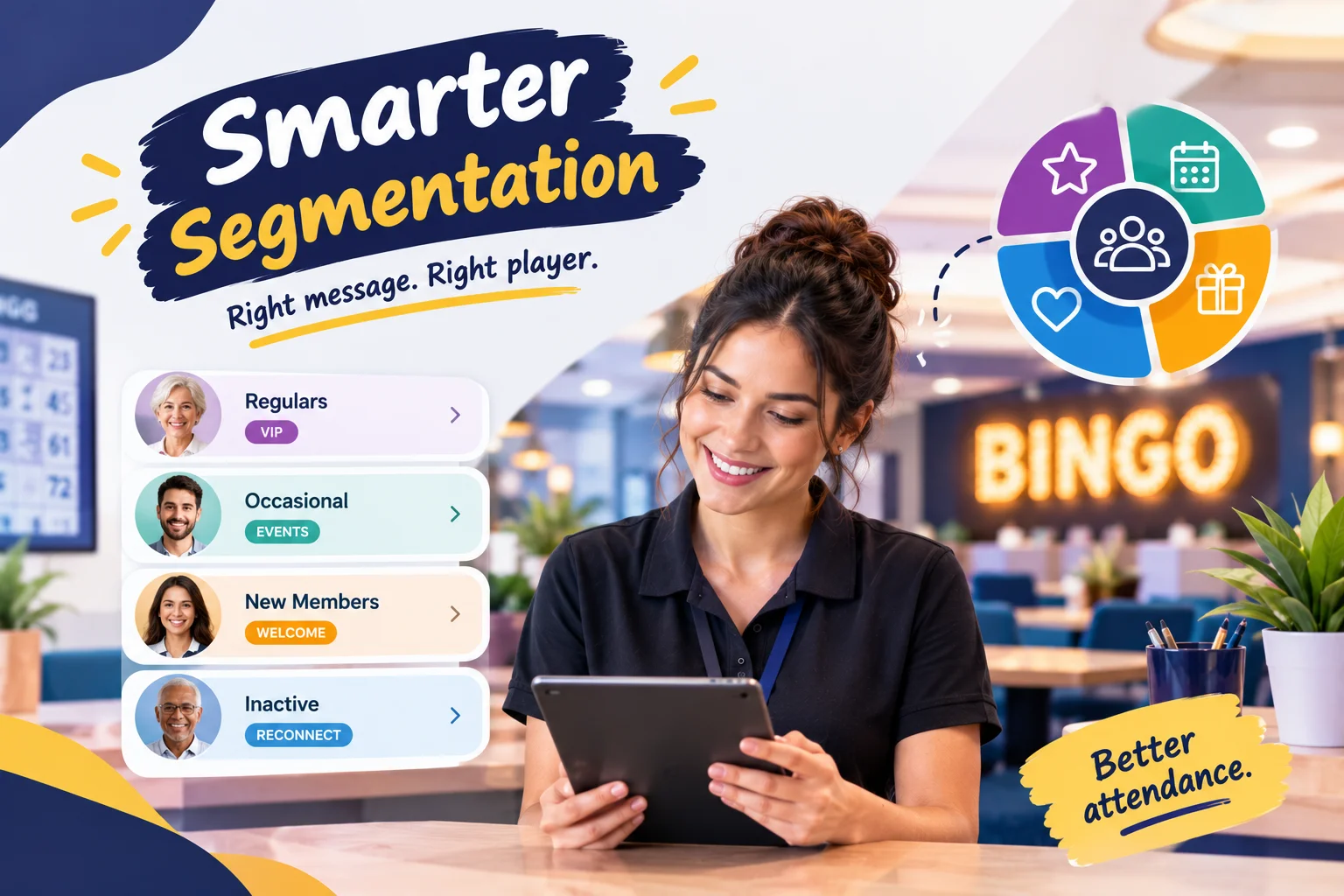
Not Every Player Should Receive the Same SMS
One of the most common mistakes in venue marketing is treating the entire database as one audience.
Your customer base may include:
- New members
- Regular players
- High-frequency visitors
- VIP customers
- Infrequent visitors
- Lapsed players
- Event attendees
- Loyalty members
- Customers interested in specific promotions
Sending everyone the same message can make communication less relevant.
Segmentation allows operators to ask a better question:
"Who should receive this message?"
rather than:
"How can we send this message to everyone?"
A Simple Example of Segmentation
Suppose a bingo hall is promoting a Thursday event.
Instead of sending one message to the entire database, the operator might create different campaigns.
Regular Thursday Players
A reminder about the upcoming session.
New Members
An introduction to the event and an invitation to attend.
Lapsed Players
A re-engagement message with an appropriate incentive.
VIP Members
A message focused on their relevant benefits or experience.
The event hasn't changed.
The communication has.
Timing Can Matter as Much as the Message
A good SMS sent at the wrong time can perform badly.
An SMS hub makes scheduling easier because operators can plan communications around their campaigns rather than sending everything manually.
For example:
Monday: Announce the event.
Wednesday: Send a reminder to relevant players.
Thursday morning: Final event reminder.
Friday: Follow-up or thank-you message.
The exact schedule should depend on the venue, audience, event type, and customer preferences.
The important thing is that communication becomes planned rather than reactive.
Use SMS as Part of a Larger Player Journey
SMS works best when it isn't treated as an isolated broadcast tool.
Consider a loyalty campaign.
A player receives:
"You've reached 750 points. You're only 250 points from your next reward."
That message has context.
It is not simply an advertisement.
It tells the player where they are and what they can do next.
Another customer might receive:
"Your event challenge is waiting. Complete it before Friday."
Again, the message is connected to an existing customer journey.
This is where a central communication hub becomes more useful than a basic bulk-texting service.
SMS Can Support Event Promotion Without Becoming Spam
Bingo halls often have a regular schedule of sessions and special events.
If every event produces multiple generic messages to the entire database, customers can quickly become overwhelmed.
A better approach is to decide:
Who needs to hear this?
Why would they care?
When should they receive it?
What should they do next?
For example, a customer who regularly attends Friday sessions may need a reminder about a special Friday event.
A customer who never attends Fridays may not.
Better targeting can improve relevance while reducing unnecessary communication.
Re-Engage Players Who Have Gone Quiet
One of the most useful applications of SMS marketing is re-engagement.
Suppose a player used to attend twice a month but hasn't visited recently.
A generic promotional blast may not give them much reason to return.
Instead, the venue could create a re-engagement campaign specifically for inactive players.
The message might introduce:
- A relevant upcoming event
- A loyalty opportunity
- A new challenge
- A limited-time reward
- A reason to reconnect with the venue
The exact offer should be based on the venue's strategy and customer data.
The principle is simple:
Different behaviour deserves different communication.
Connect SMS With Loyalty
SMS becomes significantly more useful when it can support loyalty activity.
For example:
Points milestone reached
Reward available
VIP tier progress
Achievement unlocked
Challenge ending soon
These aren't necessarily traditional marketing messages.
They're relationship messages.
The customer receives information that helps them understand their position within the loyalty programme.
That can encourage continued engagement.
Use SMS to Bring Digital Activity Back Into the Hall
Suppose your venue uses gamification.
A player completes an in-app challenge and earns progress toward a reward.
The next relevant message could encourage a physical visit.
The journey becomes:
Digital engagement → SMS reminder → Venue visit
Similarly:
Event registration → SMS reminder → Event attendance
Or:
Referral activity → SMS update → New player visit
This creates a connection between the digital side of the customer relationship and the physical venue.
Track What Happens After the Message
Sending an SMS is not the end of the campaign.
It's the beginning of measurement.
Operators should be interested in questions such as:
- How many customers received the message?
- How many engaged with it?
- How many took the desired action?
- Did event attendance increase?
- Did inactive customers return?
- Did loyalty engagement change?
- Which audience segments responded best?
The exact reporting available depends on the platform, but the principle remains important:
Measure the outcome, not just the send.
Why Spreadsheets Become Difficult to Manage
A spreadsheet can be useful when a venue has a small number of contacts.
As the programme grows, however, manual lists can become increasingly difficult to maintain.
Imagine preparing a campaign for 3,000 customers.
You need to:
- Export customer data.
- Identify eligible players.
- Remove people who shouldn't receive the message.
- Check for duplicates.
- Format phone numbers.
- Upload the list.
- Build the campaign.
- Send the SMS.
- Record what happened.
Now repeat that process several times a week.
The problem isn't simply that it takes time.
Manual processes also create more opportunities for mistakes.
A Central Hub Reduces Operational Friction
A central system can simplify the process by keeping campaign management closer to the customer information and engagement tools already being used by the venue.
That can reduce unnecessary movement between platforms.
Instead of repeatedly preparing separate lists, staff can work from organised customer segments and campaign workflows.
The result is a more repeatable process.
And repeatability matters when communication becomes a regular part of venue operations.
What About Compliance?
SMS marketing is not simply a matter of writing a message and pressing send.
Bingo operators need to consider applicable privacy, consent, marketing communication, and industry requirements.
A useful SMS marketing system should therefore support responsible communication practices rather than encouraging indiscriminate messaging.
Operators should have clear processes for:
- Customer consent
- Opt-outs
- Appropriate audience selection
- Communication preferences
- Record keeping
- Frequency management
- Promotional requirements
The exact legal obligations depend on the jurisdiction and the nature of the communication.
Technology can help organise these processes, but it does not replace the operator's responsibility to comply with applicable requirements.
Don't Measure Success by Message Volume
Sending 20,000 SMS messages isn't an achievement if they produce little useful activity.
A smaller, better-targeted campaign may deliver more value.
For example:
Campaign A
10,000 recipients
Large reach
Low response
Campaign B
2,500 relevant recipients
Smaller reach
Higher event attendance
The second campaign may be considerably more valuable.
This is why campaign reporting should be connected to the business objective.
The Metrics Worth Watching
Depending on the campaign, useful measures can include:
Delivery
Did the intended audience receive the message?
Engagement
Did customers interact with the communication?
Conversion
Did they take the desired action?
Attendance
Did the campaign contribute to physical visits?
Reactivation
Did previously inactive customers return?
Loyalty Activity
Did members engage more with rewards, points, or challenges?
Campaign Cost
What did the campaign cost relative to the outcome?
Tracking these measures over time helps operators understand which types of communication deserve more attention.
A Better Workflow for a Weekly Bingo Promotion
Consider a venue promoting a Saturday special event.
Instead of creating the campaign at the last minute, the operator could build a simple workflow.
Monday
Select the relevant audience.
Tuesday
Send the initial announcement.
Thursday
Review engagement and send a targeted reminder where appropriate.
Saturday
Send a final event message to eligible customers.
Sunday
Review campaign results and attendance.
The process is straightforward.
But because the communication is managed centrally, the operator can repeat and refine it for future events.
Where an SMS Marketing Hub Fits Into the Bigger Picture
SMS is only one part of modern venue engagement.
The real opportunity comes from connecting it with the other systems that influence the customer journey.
A player might:
Join the loyalty programme
↓
Receive a welcome SMS
↓
Earn points
↓
Complete a mini game
↓
Unlock an achievement
↓
Receive an event reminder
↓
Visit the bingo hall
↓
Progress toward a VIP tier
↓
Receive a relevant follow-up
Each interaction has a purpose.
The SMS is the communication layer that helps connect those moments.
How JustKonnect Approaches Centralised SMS Marketing
For bingo halls, communication becomes difficult when customer data, loyalty activity, promotions, and messaging live in separate places.
JustKonnect's SMS Marketing Hub is designed to give venues a central place to manage SMS communication as part of their wider player engagement strategy.
Rather than treating text messaging as an isolated broadcast tool, it can sit alongside the broader customer experience, including loyalty, promotions, gamification, rewards, and engagement activity.
That gives operators a more organised way to think about communication:
Who should we contact?
Why are we contacting them?
What should they do next?
What happened after we contacted them?
Those questions are more valuable than simply asking how many messages were sent.
Frequently Asked Questions
What is an SMS marketing hub?
An SMS marketing hub is a central platform for managing customer text-message communication, including campaigns, audience segmentation, scheduling, engagement, and reporting.
Why do bingo halls need an SMS marketing hub?
Bingo halls often communicate with customers about sessions, events, loyalty, promotions, and re-engagement. A central hub can make those communications easier to organise and manage.
Can an SMS hub work with a loyalty programme?
Yes. SMS can be used to communicate loyalty milestones, rewards, challenges, VIP progression, and other relevant customer activity when the systems are connected appropriately.
Should every player receive the same SMS?
Not necessarily. Segmenting customers based on relevant behaviour or programme status can make messages more useful and reduce unnecessary communication.
Can SMS marketing help increase bingo hall attendance?
It can support attendance by promoting relevant events and sessions to appropriate audiences, but operators should measure actual attendance and campaign outcomes rather than assuming that sending messages will automatically increase visits.
What should bingo operators measure in SMS campaigns?
Useful measures can include delivery, engagement, conversions, attendance, reactivation, loyalty activity, and campaign cost. The most important metrics depend on the purpose of the campaign.
Communication Works Better When It Has a Centre
The problem with SMS marketing isn't usually the text message itself.
It's everything around it.
Who receives it?
Where did the customer list come from?
Has that customer already received another message?
Is the offer relevant?
What happened afterward?
Can the operator easily see the results?
When those questions require several spreadsheets and disconnected systems, even a simple campaign becomes harder than it needs to be.
A central SMS marketing hub gives bingo operators a more organised way to manage those moving parts.
It creates one place to plan communication, work with customer segments, coordinate campaigns, and evaluate results.
And when SMS is connected with loyalty, CRM, rewards, gamification, and venue activity, it becomes more than a way to send promotions.
It becomes part of the ongoing relationship with the player.
For operators looking to move away from scattered customer communication and toward a more connected approach, JustKonnect's SMS Marketing Hub is a practical place to explore how centralised SMS marketing can fit into a broader player engagement strategy.