A bingo hall can have thousands of player names in its database and still struggle to answer a straightforward question: Who are our players, and what do we know about their relationship with the hall?
A spreadsheet might show a name and phone number. A generic customer relationship management (CRM) system might add email addresses, notes, and a record of previous communications. Both are useful starting points, but neither necessarily explains how a player interacts with a bingo hall.
Does the player attend every Friday? Have they stopped visiting recently? Do they have loyalty points waiting to be redeemed? Have they already received an offer this week?
These details matter because bingo hall relationships are built around attendance, sessions, loyalty, and ongoing engagement—not simply a sequence of sales transactions.
A well-designed player profile brings the relevant information together so operators can make better decisions without searching across spreadsheets, message histories, and disconnected systems. That is the difference between storing contact details and building a practical understanding of a player.
A Player Profile Is More Than a Digital Contact Card
Think about the information a hall manager might need before deciding whether to send a player a promotional message.
A contact record may confirm that the player is called Sarah and has a mobile number on file. It might not reveal whether Sarah attended yesterday, has not visited for a month, or is close to earning a loyalty reward.
Without that context, the operator must either investigate manually or send the same message to everyone.
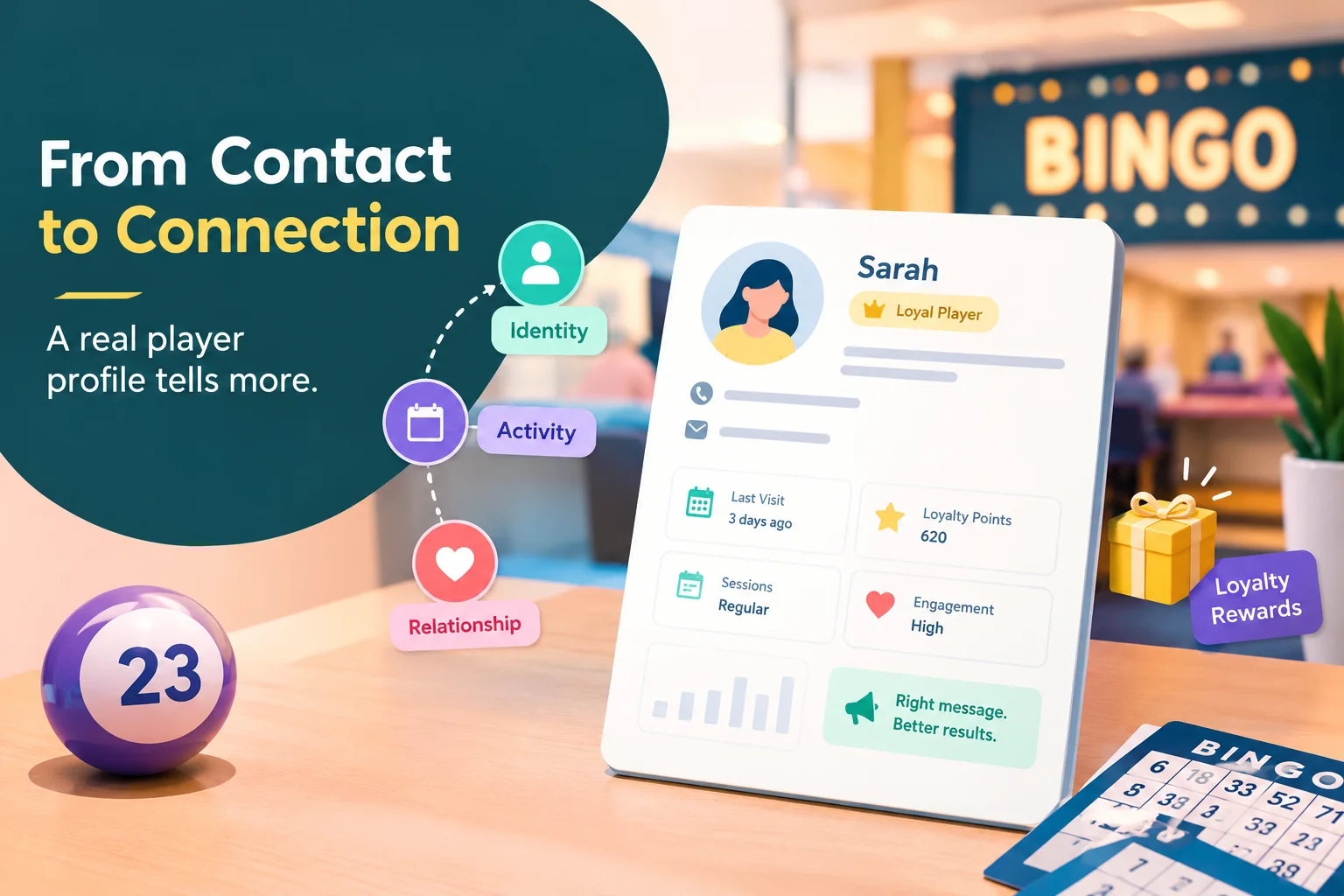
A player profile should connect three layers of information:
- Identity: Who is the player, and how can the hall contact them appropriately?
- Activity: How does the player engage with sessions, offers, rewards, and communications?
- Relationship status: Is the player new, regularly attending, becoming less active, or participating in the hall's loyalty programme?
The value comes from connecting these layers. Contact details make communication possible, activity records provide context, and relationship information helps determine what action makes sense.
JustKonnect's Player Profiles CRM is designed around this approach, bringing contact information, visit history, loyalty status, and engagement data into a player-focused system.
The Fields That Belong in a Useful Bingo Player Profile
Not every hall needs dozens of custom fields. The objective is to capture information that supports real operational decisions, rather than collecting data simply because a software platform allows it.
The following fields provide a practical starting point.
| Profile field | What it tells the operator | Why it matters |
| Player name and unique identifier | Which player the record belongs to | Helps staff find the correct record and avoid duplicates |
| Contact details | Which approved contact methods are available | Supports relevant, accurate communication |
| Communication consent and preferences | Whether a player is eligible for a particular type of message | Helps teams respect communication choices and maintain reliable records |
| First registration date | When the player joined the database | Helps distinguish newer contacts from established players |
| Visit and session history | Which sessions the player has attended | Provides context for attendance patterns |
| Last visit date | How recently the player attended | Helps identify changes in activity |
| Visit frequency | How often the player typically attends | Supports attendance-based segmentation |
| Loyalty points and tier | The player's current loyalty position | Makes reward-related communication more relevant |
| Reward redemption history | Which rewards have been claimed | Helps teams understand participation in the loyalty programme |
| Communication history | Which messages or follow-ups have been recorded | Reduces unnecessary repetition and provides context for future contact |
| Engagement indicators | How the player interacts with relevant campaigns or offers | Helps operators assess what may deserve further attention |
These fields do not all serve the same purpose. Some establish the player's identity, others record what has happened, and others help the team decide what to do next.
A useful profile makes those distinctions clear.
Why Attendance History Deserves Its Own Place
For a retail business, purchase history is often central to understanding customer behaviour. For a bingo hall, attendance history provides a different and particularly important perspective.
A player may attend regularly without making purchases that a conventional retail CRM can easily use to define their relationship with the venue. The hall needs to understand the sessions they attend and how their attendance changes over time.
Consider two fictional players:
Player A attends the Wednesday and Saturday sessions most weeks. Their latest visit was three days ago.
Player B previously attended several times a month but has not visited for five weeks.
A basic contact database may show almost identical information for both players. An attendance-focused profile tells a different story.
Player A may need a straightforward reminder about an upcoming session. Player B may be worth reviewing for a carefully timed re-engagement message, provided the player is eligible to receive it.
The point is not to assume that every absence signals lost interest. Holidays, personal circumstances, changing schedules, and other factors can affect attendance. Rather, the profile gives operators a reason to investigate a change instead of relying on guesswork.
A useful attendance record should therefore make it easy to understand:
- When the player last attended.
- How frequently they have visited over a defined period.
- Whether their attendance pattern has changed.
- Which player segments they currently belong to, where applicable.
Explore JustKonnect's Player Profiles CRM to see how player information and attendance-based segmentation can support more informed engagement.
Loyalty Data Should Connect to the Player, Not Sit in a Separate List
Loyalty programmes create another layer of information that can be difficult to manage when records are disconnected.
Imagine a player has accumulated enough points to be close to a reward. If the loyalty balance exists in one system and the player's contact details sit in another, staff may need to check both before sending a useful message.
When loyalty information is connected to the player profile, the relationship becomes easier to understand.
A profile can show the player's current points balance, loyalty tier where applicable, and relevant redemption history. This helps operators distinguish between someone who has never participated in the loyalty programme and someone who regularly earns and redeems rewards.
For example, a hall might send an eligible player a reminder about an available reward or explain how the loyalty programme works to a newer participant. The message should reflect the player's actual status rather than rely on a broad assumption about their interests.
The profile also helps the operator evaluate the programme. If many players accumulate points but few redeem them, the team may need to review reward visibility, redemption rules, or the perceived value of the available rewards.
JustKonnect connects player profiles with its Loyalty Points & Rewards functionality, helping operators bring player information and loyalty activity into a more connected workflow.
Communication Records Help Prevent Repetition
A player's profile should provide more than a way to send another message. It should also help the team understand what communication has already taken place.
Without a reliable communication history, different members of staff might contact the same player about the same promotion. A player could receive an offer they have already redeemed, or a follow-up might ignore a previous interaction.
A communication record can help answer practical questions:
- Has the player already been contacted about this event?
- Is there a recorded response or follow-up?
- Has the player opted out of a particular communication channel?
- Is the proposed message appropriate for the player's current status?
These details are particularly useful when a hall runs several campaigns at once, such as session reminders, special event promotions, loyalty offers, and re-engagement messages.
A connected profile can also give campaign tools the context needed to target eligible player groups rather than treating the entire database as one audience.
For instance, JustKonnect's SMS marketing tools work alongside its CRM and player data capabilities. This creates an opportunity to organise communications around player activity and engagement, rather than sending every message to every contact.
The underlying principle is simple: before sending a message, the hall should be able to understand who it is contacting and why that communication is relevant.
Generic CRM Fields Often Miss the Operational Questions
A generic CRM is not automatically a poor choice. Many platforms are effective at storing contacts, recording sales activity, managing leads, and organising business communications.
The difficulty arises when the system's standard structure does not match how a bingo hall operates.
A sales-focused CRM might prioritise deal stages, revenue forecasts, sales calls, and purchase records. Those fields can be useful in the right business, but they do not necessarily answer the questions a bingo operator asks every week.
| Operational question | What a contact-only record may lack | What a player-focused profile should provide |
| Who has stopped attending as often? | Reliable session history and visit recency | Attendance records and frequency indicators |
| Which players are becoming less active? | A meaningful baseline for player activity | Information that helps identify changing attendance patterns |
| Who is participating in the loyalty programme? | A connected view of rewards and player identity | Loyalty status and relevant redemption information |
| Has this player already received the promotion? | A complete, accessible communication history | Recorded campaign and interaction information |
| Which players should receive a particular offer? | Attendance-based segmentation | Player groups based on relevant activity and eligibility |
Custom fields can help a generic CRM capture some of this information. However, adding a field is not the same as building a complete workflow around it.
For example, a manually entered “Last Visit” field is only useful if someone updates it consistently. A purpose-built attendance workflow can reduce that administrative burden by connecting the player record with session activity.
The difference is not simply the number of fields available. It is whether the system can turn the information into a reliable, usable process.
Profile Quality Matters as Much as Profile Quantity
Building a database of 5,000 contacts does not automatically give a hall a strong understanding of its players.
Duplicate records, outdated phone numbers, missing consent information, and inconsistent attendance records can undermine even a sophisticated CRM.
A practical profile management process should address four areas.
1. Keep records identifiable
Use a consistent method for identifying players and reviewing possible duplicate profiles. If the same person appears under two records, their attendance and loyalty activity may become fragmented.
2. Capture information at the right point
Registration, session attendance, reward redemption, and communication interactions are natural opportunities to update relevant information. Make the process straightforward for staff and players.
3. Review incomplete or outdated details
Not every field needs to be completed immediately, but the team should know which missing details prevent a profile from being used effectively. Review contact accuracy and communication preferences regularly.
4. Make ownership clear
Decide who is responsible for correcting records, reviewing exceptions, and resolving duplicate profiles. Without clear ownership, data quality often deteriorates as the database grows.
These practices are important regardless of the software a hall chooses. The right platform should make them easier to follow, not create more administrative work.
A Player Profile Should Lead to a Decision
The strongest test of a CRM field is not whether it looks useful on a dashboard. It is whether it helps someone make a better decision.
Consider a hall reviewing its player database before a busy weekend.
A list of names and phone numbers does little to help the team prioritise its work. A more complete profile allows the operator to identify new registrants who may need an introduction to the hall, regular attendees who may appreciate a relevant session reminder, and previously active players whose attendance has declined.
The operator can then decide which action, if any, is appropriate.
This process should remain measured. A drop in attendance does not prove that a player is dissatisfied, and a message does not guarantee a return visit. The purpose of the profile is to provide useful context so that the hall can test thoughtful, relevant engagement strategies and evaluate the results.
Over time, this information can support more informed decisions about campaign targeting, loyalty participation, and player retention.
How to Evaluate a Player Profiles CRM Before Choosing One
When comparing CRM platforms, avoid judging them solely by contact limits, dashboard appearance, or the number of custom fields they advertise.
Ask the provider to demonstrate real operator tasks using a sample player record.
- Attendance visibility: Can you quickly see when a player last visited and review their attendance history?
- Useful segmentation: Can you organise players by visit frequency, last visit, loyalty status, or other relevant engagement criteria?
- Connected loyalty information: Can you view points and relevant reward activity alongside the player's record?
- Communication context: Can the system help your team understand previous interactions and recorded communication preferences?
- Practical reporting: Can you review player activity and campaign performance without manually combining multiple spreadsheets?
- Ease of maintenance: Can staff keep records accurate without adding unnecessary work to session operations?
Ask the provider to walk through a realistic scenario, such as finding players whose attendance has declined or reviewing a player's loyalty status before sending a campaign.
That demonstration will reveal more about the platform's practical value than a long list of features alone.
JustKonnect's Player Profiles CRM is built specifically around bingo hall attendance, player activity, contact details, and loyalty information. It is designed to help operators move beyond basic contact storage and connect player data with day-to-day engagement.
Frequently Asked Questions
What should a bingo hall player profile contain?
A useful profile should include identifying and contact information, relevant communication preferences and consent records, visit history, last visit date, attendance frequency, loyalty status, reward activity, and relevant engagement history. The exact fields depend on the hall's operational needs and data practices.
How is a player profile different from a CRM contact record?
A basic contact record primarily stores information about a person and their communications. A player profile connects that information with attendance, loyalty, and engagement activity, giving bingo hall operators more context for decisions about player retention and communication.
Can a generic CRM be used by a bingo hall?
Yes. A generic CRM may work if it can support the hall's required data and workflows. However, attendance tracking, session-based reporting, loyalty integration, and player-focused segmentation may require additional configuration or integrations. Operators should assess the total effort required, not just the initial feature list.
Why is last visit date important in a player profile?
The last visit date helps operators understand how recently a player attended. Combined with historical attendance, it can help identify changes in activity and inform appropriate re-engagement efforts. It should be treated as a useful indicator rather than proof of why a player has been absent.
How can player profiles improve marketing?
Profiles can help operators group eligible players by relevant factors such as attendance frequency, last visit, loyalty status, and engagement. This makes it easier to plan targeted messages and assess campaign results instead of sending every promotion to the entire contact list.
How often should player profiles be updated?
Relevant information should be updated as activities occur wherever possible, including registration, attendance, loyalty transactions, and recorded communications. Contact details and other information that can become outdated should also be reviewed periodically.
Give Your Player Database a Purpose
A player database becomes more valuable when it helps your team understand attendance, recognise loyalty, maintain communication context, and identify opportunities for meaningful engagement.
A name and phone number tell you how to contact someone. A complete player profile helps explain the relationship behind that contact.
If your team still relies on disconnected lists to understand who is attending, who is engaging with rewards, and who may need a different approach, explore JustKonnect's Player Profiles CRM.
See how a bingo-focused CRM can bring player information and attendance-based engagement into one connected workflow, helping your team spend less time searching through records and more time making informed decisions.