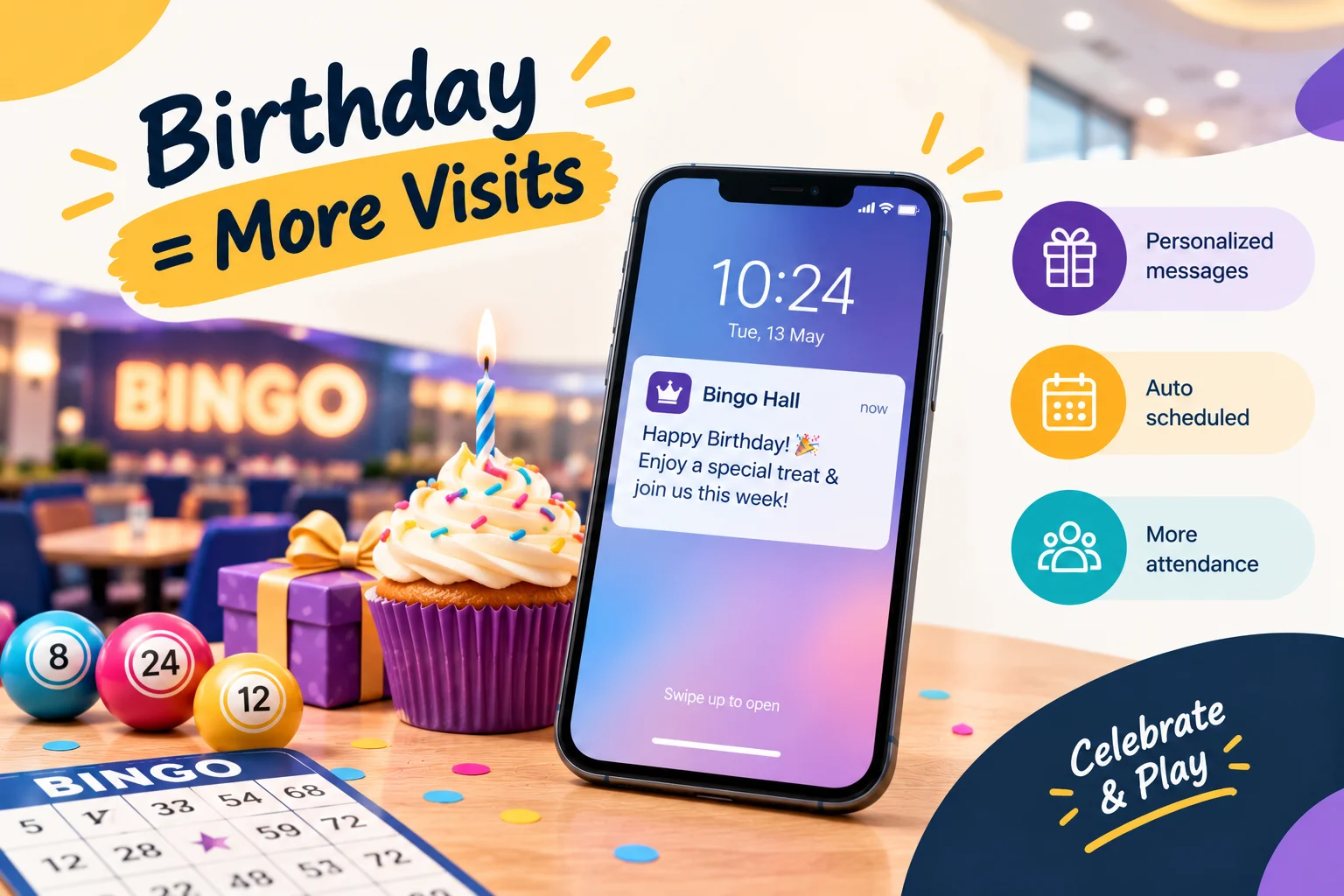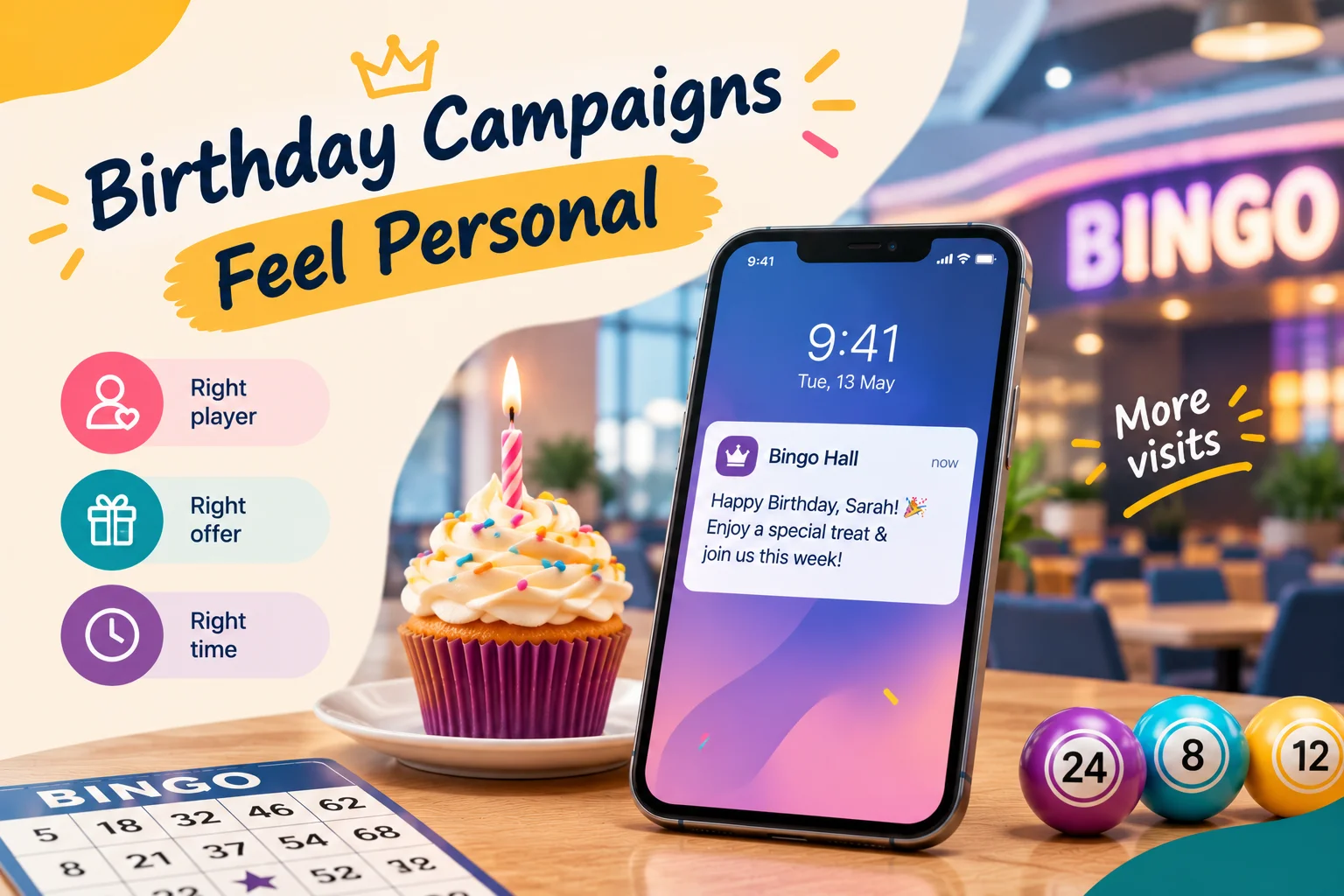
A player receives a birthday message from your bingo hall at 9 a.m.
It says, “Happy Birthday, Sarah! We hope you have a wonderful day. Come and celebrate with us this week.”
Sarah visits the hall regularly. She knows the staff, enjoys the atmosphere, and has been part of the loyalty programme for over a year. The message feels appropriate because it recognises a relationship that already exists.
Now imagine Sarah receives another message two hours later, followed by a generic weekly promotion that afternoon.
The birthday greeting suddenly feels less personal.
This is the challenge with birthday campaigns: automation can make messages arrive on time, but it cannot make them feel thoughtful by itself. That depends on the information behind the message, the offer being communicated, the language used, and how the campaign fits into the player's wider experience.
For bingo halls, the goal is not to create hundreds of individually written messages. It is to build a repeatable system that recognises each player without making the communication feel mechanical.
Whether you manage one local hall or several venues, the same principle applies: automate the routine work, but keep the player at the centre of the experience.
First, Decide What “Personal” Should Mean at Your Hall
Personalization is often reduced to inserting a first name into a message template.
That is a starting point, not a complete strategy.
A genuinely relevant birthday campaign recognises the occasion, gives the player accurate information, and offers something that makes sense for your venue and its audience.
Consider these two messages.
Message A
“Happy Birthday, [First Name]! Enjoy special offers at [Hall Name]. Visit us today!”
Message B
“Happy Birthday, [First Name]! Everyone at [Hall Name] hopes you have a brilliant day. If you're planning a bingo night this week, we'd love to celebrate with you. Your birthday offer is available until [Date].”
The second message feels more considered because it explains the invitation and gives the recipient useful information.
It does not need elaborate wording or excessive familiarity.
Before building a campaign, define the experience you want to create:
- Recognition that feels genuine
- An invitation that does not sound demanding
- A reward that is easy to understand, if one is offered
- A clear validity period
- A straightforward way to redeem the offer
- Communication that respects the player's preferences
Once these principles are clear, the automation becomes much easier to design.
Build the Campaign Around Four Decisions
A birthday campaign is easier to manage when you separate its moving parts instead of treating it as one large marketing task.
Decision 1: Who Is Eligible?
Start by defining which players should receive a birthday message.
Your rules might include players who have a recorded birthday, have an appropriate contact method, meet the campaign's eligibility requirements, and can legally receive the intended communication.
You may also need to exclude duplicate records, invalid contact details, or players who have opted out of the relevant marketing channel.
This step prevents a common automation problem: sending a perfectly written message to someone who should never have received it.
Decision 2: What Is the Message Supposed to Achieve?
Not every birthday message needs to generate an immediate visit.
Your campaign might aim to:
- Recognise the player without a promotional offer
- Encourage a visit during the birthday week
- Introduce a birthday reward
- Strengthen participation in a loyalty programme
- Acknowledge a membership anniversary
Choose one primary objective for each message. This makes the wording clearer and the results easier to evaluate.
Decision 3: What Makes the Invitation Worth Considering?
If you include an offer, decide what it is before writing the copy.
Possible options include bonus loyalty points, an eligible voucher, a complimentary game book, or an invitation to a special session. JustKonnect's Birthday Automation feature lists these types of personalized birthday incentives among its campaign options. Actual offers should reflect your venue's rules and what you can reliably provide.
A reward is not automatically better than a simple greeting. The right choice depends on the relationship you want to maintain and the outcome you want to encourage.
Decision 4: When Should the Message Arrive?
Decide whether the campaign should send the greeting on the birthday or a defined number of days beforehand.
If the offer is valid for a birthday week, sending the invitation early may give players more time to plan a visit. If the purpose is simply to recognise the occasion, the birthday itself may be more appropriate.
The timing should follow the campaign's purpose, not an arbitrary marketing schedule.
Make Personalization Work at Three Different Hall Sizes
A small independent hall does not need the same campaign structure as a group managing several locations.
The underlying principles are similar, but the level of coordination changes as the operation grows.
One Hall: Keep It Simple and Consistent
For a single-location venue, start with one reliable birthday workflow.
Set up a basic message, choose whether to include an offer, define the sending date, and establish a process for handling questions or redemptions.
For example:
“Happy Birthday, [First Name]! From everyone at [Hall Name], we hope you have a wonderful birthday. We'd love to welcome you this week — ask our team about your birthday offer.”
The staff should know what the offer includes and how to apply it. There is little value in sending a personalized invitation if the player arrives and nobody knows what it refers to.
At this stage, consistency matters more than complexity.
A Growing Hall: Introduce a Few Meaningful Variations
As the database expands, you may want to introduce variations based on player relationships.
For example:
- A standard birthday greeting for all eligible players
- A birthday-week invitation for players who are likely to attend
- A loyalty-focused message for players with an available reward
The goal is not to create a separate campaign for every individual.
It is to identify a few differences that genuinely improve relevance.
Keep the number of versions manageable so the team can maintain accurate offer rules and review results without creating unnecessary administrative work.
Multiple Halls: Personalize Without Losing Local Identity
For a multi-location operator, birthday automation introduces another consideration: which venue should the message refer to?
A player should not receive an invitation to the wrong location simply because the campaign uses a shared database.
Where the necessary data is available, define rules for the appropriate venue, local session schedule, reward eligibility, and redemption process.
You may also want to keep the core birthday greeting consistent across the group while allowing individual halls to adapt their invitation to local events.
For example, the greeting can follow a shared brand style, while the details identify the correct hall and the offer that applies there.
The larger the operation, the more important it becomes to standardise the rules behind the message.
Write Like a Host, Not an Advertising Department
Birthday communication should sound like a welcome from the venue, not a weekly sales campaign with a birthday label attached.
A useful way to achieve this is to write the greeting first, then decide whether a promotional invitation belongs in the same message.
Compare the following approaches.
Too promotional:
“Celebrate your birthday with our amazing offers! Visit today and take advantage of this fantastic opportunity.”
More natural:
“Happy Birthday, [First Name]! We hope you have a lovely day. If you're planning a visit this week, we'd be delighted to see you at [Hall Name].”
The second version leaves room for the player to decide.
If the campaign includes a reward, introduce it clearly rather than allowing the promotion to overwhelm the greeting.
Three Practical Message Templates
1. A greeting without a reward
“Happy Birthday, [First Name]! Everyone at [Hall Name] wishes you a wonderful day. Thank you for being part of our bingo community — we hope to see you again soon.”
Use this when recognition is the primary goal.
2. A birthday-week invitation
“Happy Birthday, [First Name]! We'd love to celebrate with you at [Hall Name]. Your birthday offer is available until [Date]. Check the details and join us for a session that suits you.”
Use this only when the offer and its validity period are confirmed.
3. A loyalty-focused birthday message
“Happy Birthday, [First Name]! Thank you for being part of [Hall Name]. Your eligible birthday reward is ready to enjoy. Check the details before your next visit.”
Use this version only when the player actually qualifies for the reward and can access or redeem it.
Templates should provide a consistent starting point, not an excuse to send inaccurate or irrelevant information.
The Small Details That Make a Message Feel Personal
A message can contain the player's name and still feel generic if everything else is irrelevant.
Focus on the details that make the invitation useful.
Use the correct venue name. This matters especially for groups with several locations.
Make the offer specific. If a reward is available, explain what it is and how long it lasts.
Use natural language. Avoid exaggerated claims and artificial urgency.
Keep the call to action simple. The player should know whether to visit, check an offer, or contact the hall.
Avoid pretending to know more than you do. Do not refer to a player's favourite session, attendance habits, or loyalty status unless the information is reliable and relevant.
Personalization should make communication more helpful, not create the impression that the hall is monitoring every detail of someone's life.
What to Do When the Player's Birthday Falls on a Quiet Night
Birthday automation can support attendance planning when the birthday offer is designed around the hall's actual schedule.
Suppose a venue is consistently quiet on Tuesday evenings, while Friday sessions already attract strong attendance.
The operator could test a birthday offer that remains valid throughout the birthday week but gives players a reason to consider the Tuesday session.
The invitation might say:
“Happy Birthday, [First Name]! We'd love to celebrate with you this week. If Tuesday suits your plans, join us for our evening session and ask the team about your birthday reward.”
This approach links the birthday campaign to a specific attendance opportunity without making the birthday itself feel like a sales pitch.
However, the offer must be clear and fair. If the reward is only available on Tuesday, say so in the terms. If players can redeem it on other days, do not imply otherwise.
Over time, attendance data can help the operator understand whether this approach attracts visits that might not otherwise have happened.
Set Up Automation So It Doesn't Need Weekly Attention
Once the campaign is designed, the operational workflow should be straightforward.
JustKonnect's Birthday Automation feature describes a process in which the player's date of birth is taken from their profile, a message is scheduled for the birthday or a defined number of days beforehand, and an eligible offer can be included. The feature also supports membership anniversary messages.
A practical setup process looks like this:
Step 1 — Check the player data. Confirm birthday fields, contact information, duplicate records, and eligibility rules.
Step 2 — Write the message. Prepare the greeting and any approved offer details.
Step 3 — Set the timing. Choose the birthday itself or an advance window that gives players time to plan.
Step 4 — Define the offer period. Specify when it starts, when it expires, and how redemption works.
Step 5 — Test the workflow. Review sample messages, personalization fields, dates, and exclusions before activating the campaign.
Step 6 — Review periodically. Check delivery, engagement, redemptions where applicable, and attendance outcomes.
The objective is to remove the repetitive work without removing oversight.
How to Tell Whether Your Personalization Is Working
A birthday campaign can look successful because every message has a first name in it. That does not tell you whether the campaign is relevant or whether it influences behaviour.
Evaluate it against the objective you chose at the start.
If the purpose is recognition, look at available engagement signals and feedback.
If the purpose is reward redemption, measure how many eligible players use the offer.
If the purpose is attendance, compare visits during the birthday offer period with an appropriate baseline.
For example, an operator might find that a birthday-week invitation attracts more redemptions when players have several days to use the offer rather than only the birthday itself. That would be a reason to test the timing again, not proof that the same schedule will work for every venue.
Where practical, compare similar player groups or historical periods and account for other factors that could influence attendance.
Do not judge the campaign solely by the number of messages sent.
Common Reasons Birthday Campaigns Stop Feeling Personal
Every message is a sales pitch. A greeting should not always be dominated by a reward or promotion.
The offer is vague. Players should not have to ask several questions to understand what they have received.
The wrong venue is mentioned. Shared databases need clear location rules.
The campaign sends too many reminders. Repeated messages can undermine the goodwill the birthday greeting was meant to create.
The data is outdated. Incorrect names, dates, or reward eligibility can damage trust.
The results are never reviewed. A campaign that runs automatically can still become ineffective if nobody checks its performance.
The message assumes a close relationship that does not exist. Keep the tone warm but appropriate to the relationship with the player.
Frequently Asked Questions
How do you make automated birthday messages feel personal?
Use accurate player information, natural language, a relevant invitation, and clear offer details. Personalization should improve the message's relevance rather than simply insert the player's name.
Should every bingo player receive the same birthday offer?
Not necessarily. A standard greeting can work for everyone eligible, while rewards or invitations can vary when there is a clear business reason and reliable data to support the difference.
Can a small bingo hall benefit from birthday automation?
Yes. A small hall can start with one message, one clearly defined offer if appropriate, and a simple sending schedule. Automation helps make the process consistent without requiring a large marketing team.
How should multi-location bingo operators manage birthday campaigns?
Use shared rules for the core message and eligibility, while ensuring that the correct venue, session details, and reward conditions are applied to each player. Test location-specific details before launching the workflow.
When should birthday messages be sent?
Choose the timing according to the campaign objective. A message on the birthday can focus on recognition, while an earlier message or birthday-week offer may give players more time to plan a visit.
How can operators measure birthday campaign performance?
Track delivery and engagement where available, reward redemption, attendance during the offer period, and subsequent visits. Compare results with a suitable baseline to assess whether the campaign may be influencing behaviour.
Personal at Any Scale Starts With a Better System
A birthday campaign does not become personal because it contains a first name. It becomes personal when the message is accurate, the invitation is relevant, the offer makes sense, and the player is treated with consideration.
Small halls can achieve this with one carefully managed workflow. Larger operators can introduce a limited number of audience variations and location-specific rules without losing consistency.
The important part is to build a process that your team can maintain, and your players can trust.
JustKonnect's Birthday Automation feature supports scheduled birthday messages, personalized offers, and membership anniversary communication. For bingo operators looking to reduce manual campaign work while maintaining a personal touch, it provides a practical starting point.
Build the automation around the experience you want players to have — and let the system handle the repetitive work behind it.