A bingo hall sends 2,000 promotional vouchers to its customer database.
A few weeks later, the marketing team reports that the campaign was a success because hundreds of people received the offer.
But there is a problem.
How many actually used it?
Which customers redeemed it?
Which session did they attend?
Did the voucher bring back an inactive player or simply reward someone who was already planning to visit?
And, most importantly, did the campaign generate enough additional business to justify the cost of the promotion?
If those questions cannot be answered, the campaign may have created activity without creating useful insight.
That's the fundamental difference between tracked and untracked coupons.
An untracked voucher can distribute an offer.
A tracked voucher can show what happened next.
For bingo halls, entertainment venues, restaurants, charity gaming organisations, and other physical businesses, that distinction can turn voucher marketing from a guessing game into a measurable customer-engagement strategy.
A Voucher Isn't the Result
It's easy to mistake distribution for performance.
Suppose your venue sends 1,000 digital coupons.
You might record:
1,000 coupons sent
That number sounds impressive.
But it doesn't tell you whether the campaign worked.
Consider what happens when redemption data is available:
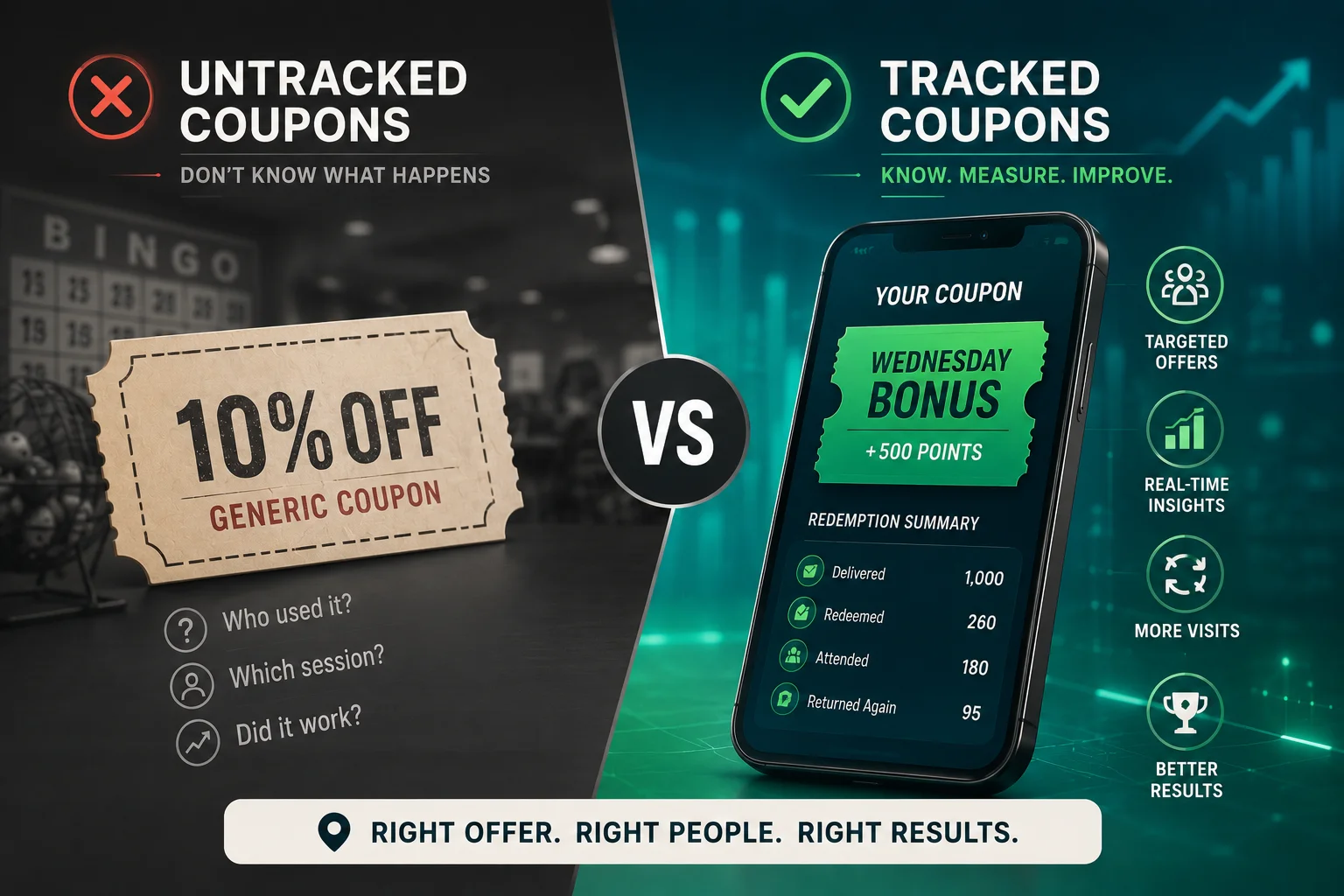
1,000 sent → 260 redeemed → 180 attended a targeted session → 95 returned again within 30 days
Now you have a much clearer picture of customer behaviour.
The value isn't simply that 260 people redeemed a voucher.
The real value is understanding what happened after they received it.
What Is an Untracked Coupon?
An untracked coupon is essentially a promotional offer without a reliable connection between distribution and customer behaviour.
It could be:
- A printed voucher
- A generic promotional code
- A flyer
- An offer shared through social media
- An email without individual redemption tracking
The venue may know how many offers were distributed, but not necessarily who used them or what they did afterwards.
That makes optimisation difficult.
What Makes a Coupon Trackable?
A tracked digital coupon connects the offer to measurable customer activity.
Depending on the system, operators may be able to see:
- Who received the coupon
- When it was issued
- When it expires
- Whether it was redeemed
- Where it was redeemed
- What customer segment received it
- Which campaign generated the redemption
This creates a direct connection between marketing activity and customer behaviour.
Instead of saying:
"We sent out a promotion."
You can ask:
"What did customers do after receiving it?"
That is a much more useful business question.
Redemption Rate Is Only the Starting Point
Redemption rate is one of the most obvious metrics.
For example:
1,000 vouchers issued
200 vouchers redeemed
20% redemption rate
That's useful.
But stopping there misses much of the available insight.
You also want to know whether those redemptions created valuable behaviour.
Did customers:
- Attend a normally quiet session?
- Visit for the first time?
- Return after being inactive?
- Attend again without another voucher?
- Participate in a fundraising event?
- Join the loyalty programme?
A strong campaign isn't necessarily the one with the highest redemption rate.
It's the one that produces the behaviour your venue actually needs.
Imagine Two Voucher Campaigns
Consider two hypothetical campaigns.
Campaign A: High Redemption
A bingo hall sends a generous Friday-night voucher to its regular Friday customers.
40% redeem it.
The campaign looks excellent.
But most of those customers were already attending Friday sessions.
The voucher may have reduced the value of visits that would have happened anyway.
Campaign B: Lower Redemption
The same venue sends a smaller incentive to inactive customers and encourages them to attend a quiet Tuesday session.
Only 15% redeem it.
At first glance, Campaign A appears more successful.
But suppose Campaign B brings 150 inactive players back into the venue and 60 of them return again without another voucher.
Suddenly, the lower redemption campaign may have generated considerably more long-term value.
Without tracking, the operator would never know.
Redemption Data Helps You Understand Your Audience
Every voucher redemption adds another piece to the customer profile.
Over time, patterns begin to emerge.
You may discover that:
- Weekend players respond poorly to discounts.
- Inactive customers respond strongly to comeback offers.
- VIP members prefer exclusive experiences over price reductions.
- New members respond well to first-return incentives.
- Midweek campaigns produce stronger engagement when paired with bonus loyalty points.
These insights can improve future marketing far beyond the original campaign.
Target the Right Customers Instead of Everyone
One of the biggest advantages of tracked coupons is segmentation.
Instead of sending the same voucher to your entire database, you can create specific audiences.
Inactive Players
Send a limited-time return offer.
Regular Weekend Players
Encourage an additional midweek visit.
New Members
Give them an incentive to make their second visit.
VIP Members
Offer exclusive rewards rather than generic discounts.
Event Participants
Promote related upcoming fundraising or special events.
The campaign becomes more relevant because the offer reflects the customer's relationship with the venue.
Track the Offer All the Way to the Visit
The strongest voucher systems don't stop at redemption.
They connect the voucher to actual venue activity.
Imagine a player receives:
"Attend Wednesday's session and receive 500 bonus loyalty points."
The operator can potentially track:
- Offer sent
- Offer viewed
- Voucher redeemed
- Wednesday session attended
- Loyalty points awarded
- Subsequent visit
This creates a complete customer journey.
It also helps answer a much more important question:
Did the campaign create a new behaviour?
Redemption Data Can Protect Your Margins
Discounts aren't free.
Every promotion has a cost, whether that's reduced revenue, complimentary products, loyalty rewards, or staff time.
Without redemption data, it's difficult to understand the actual cost of a campaign.
Tracking allows operators to compare:
- Number of offers issued
- Number redeemed
- Incentive cost
- Additional visits
- Repeat visits
- Revenue generated
- Customer retention
This helps identify campaigns that look attractive on paper but don't produce enough value.
Use Expiry Dates Strategically
Tracked digital vouchers can also create a sense of urgency.
For example:
"Your Wednesday Bonus expires at midnight."
Instead of leaving an offer open indefinitely, the venue can establish a clear action window.
This is particularly useful for:
- Quiet weekday sessions
- Limited-capacity events
- Fundraising nights
- Seasonal promotions
- Birthday offers
- Re-engagement campaigns
The important part is being able to measure what happens during that window.
Turn One Campaign Into the Next Insight
The real advantage of tracking isn't the report at the end of the campaign.
It's what you do with the information afterwards.
Suppose a Tuesday campaign produces a 12% redemption rate.
You learn that:
- Most redemptions came from players aged within a particular membership segment.
- Bonus points performed better than direct discounts.
- Players who redeemed the offer were more likely to return the following week.
The next campaign can use those insights.
Over time, your marketing becomes progressively more informed.
Instead of repeatedly asking:
"What promotion should we try?"
You start asking:
"What did the previous campaign teach us?"
A Practical Bingo Hall Scenario
A venue has noticed that Wednesday attendance is consistently below its target.
The operator creates two digital voucher campaigns.
Campaign 1: £5 discount for all loyalty members.
Campaign 2: Bonus loyalty points for inactive players who attend Wednesday.
After four weeks, the operator compares the results.
Campaign 1 produces more redemptions.
Campaign 2 produces fewer redemptions but a significantly higher rate of repeat visits among previously inactive customers.
The conclusion is clear.
If the objective is immediate voucher usage, Campaign 1 wins.
If the objective is long-term retention and midweek attendance, Campaign 2 may be the better strategy.
That distinction is only possible because redemption and customer activity are being tracked.
Don't Measure Coupons in Isolation
Voucher campaigns rarely exist on their own.
They can work alongside:
- Loyalty points
- VIP tiers
- Punch cards
- SMS marketing
- Gamification
- Customer segmentation
- Event promotions
For example, a voucher could encourage a visit, the visit could earn loyalty points, and those points could move the customer closer to a VIP tier.
Now the voucher isn't simply a discount.
It's one step in a broader retention strategy.
Common Tracking Mistakes
Measuring Only How Many Coupons Were Sent
Distribution is an activity metric, not a success metric.
Focusing Only on Redemption Rate
A high redemption rate doesn't automatically mean high business value.
Sending Every Customer the Same Offer
Different customer segments often respond to completely different incentives.
Ignoring Post-Redemption Behaviour
The most valuable question may be what customers did after using the voucher.
Never Comparing Campaigns
Without historical comparisons, it's difficult to know whether your marketing is improving.
How JustKonnect Turns Voucher Redemptions Into Useful Data
Digital coupons become significantly more valuable when redemption activity is connected to the rest of your customer engagement data.
JustKonnect Coupons & Vouchers enables operators to create digital offers, manage redemption activity, set campaign conditions, and connect promotions with customer profiles and loyalty activity. Combined with CRM, SMS marketing, loyalty points, VIP tiers, gamification, and analytics, operators can move beyond simply distributing coupons and start understanding which promotions influence customer behaviour.
For a bingo hall, that could mean identifying which offers bring inactive players back, which incentives fill quieter sessions, and which campaigns create repeat visits after the initial redemption.
The objective isn't to produce more coupons.
It's to produce better decisions from every campaign.
Frequently Asked Questions
What is the difference between tracked and untracked coupons?
An untracked coupon provides an offer without giving the operator meaningful visibility into customer behaviour. A tracked coupon records information such as distribution, redemption, expiry, and customer activity, allowing campaign performance to be measured.
Is redemption rate the most important coupon metric?
Not necessarily. Redemption rate shows how many customers used an offer, but operators should also consider whether those redemptions increased attendance, generated repeat visits, reactivated inactive customers, or produced other valuable behaviours.
Can digital coupons track individual customers?
When connected to customer profiles, digital coupon systems can associate offers and redemptions with individual members, allowing operators to understand engagement and personalise future campaigns.
How can redemption data improve future campaigns?
It shows which customer segments, incentives, days, and campaign types generate the strongest response. Operators can use these insights to refine future offers instead of relying on assumptions.
Should every customer receive the same coupon?
Usually not. Segmenting customers based on attendance, loyalty status, and engagement allows operators to create more relevant campaigns and avoid unnecessary discounting.
The Coupon Is Only the Beginning
The most useful thing about a digital voucher isn't the discount printed on it.
It's the information created when someone decides to use it.
A redemption can tell you that a customer responded. Their subsequent visits can tell you whether the campaign actually changed their behaviour. When those insights are connected to loyalty, CRM, and marketing data, each promotion becomes an opportunity to learn more about what keeps customers coming back.
That is where tracked coupons become more than promotional tools.
They become a source of customer intelligence.
Explore JustKonnect Coupons & Vouchers to see how digital voucher campaigns, redemption tracking, loyalty data, CRM, SMS marketing, and analytics can help your venue move from simply distributing offers to understanding exactly what makes them work.