A fundraising event does not have to feel like a donation request.
For many charities, the challenge is creating an experience that gives supporters a reason to participate, talk about the cause, invite others, and stay connected after the event is over.
That is where a reverse raffle can offer a different approach.
Instead of simply selling tickets and announcing a winner, a reverse raffle gives an organization an event around which it can build anticipation, communication, participation, and follow-up. Participants buy numbered tickets, numbers are gradually eliminated, and the final remaining ticket wins the grand prize.
The draw itself becomes part of the fundraising experience.
For charities, that creates several opportunities to engage supporters before, during, and after the event—not just at the moment a ticket is purchased.
Turn the Reverse Raffle Into More Than a Ticket Sale
It is easy to think about a reverse raffle in simple terms:
Sell tickets → run the draw → announce the winner.
But a charity can build a much larger supporter journey around those three steps.
Consider what happens before the draw.
A supporter sees the event announcement. They learn about the cause. They receive a reminder. They buy a ticket. They may purchase additional entries or encourage friends to participate.
Then the event arrives.
They follow the draw as numbers are eliminated. They hear updates about the fundraiser. They watch the field become smaller. They interact with other attendees.
Afterward, the organization has another opportunity.
It can thank participants, share the event outcome, explain what the fundraising supported, and invite attendees to the next event.
The reverse raffle becomes a reason to communicate with supporters rather than a one-time transaction.
Start With the Cause, Not Just the Prize
A large prize can attract attention, but charities should avoid making the prize the entire story.
People need to understand what their participation supports.
For example, instead of promoting an event only as:
“Enter to win a $5,000 cash prize.”
A charity could frame the event around both the experience and its purpose:
“Join our annual reverse raffle for the chance to win $5,000 while helping us fund community programs this year.”
The difference is important.
The prize explains why someone may want to participate.
The cause explains why the event matters.
This also gives the organization more material to use across its website, email campaigns, social media, SMS messages, printed materials, and conversations with supporters.
Build Engagement Before Event Night
The fundraising experience starts well before the first number is eliminated.
Once tickets go on sale, charities can use the period leading up to the event to create awareness and momentum.
A simple promotion sequence could look like this:
Six Weeks Before
Announce the reverse raffle and explain the cause.
Introduce the event date, ticket price, grand prize, and basic rules.
Four Weeks Before
Share stories about the organization and explain what funds raised will support.
This gives potential participants a reason to care about the event beyond the prize.
Two Weeks Before
Remind supporters that tickets are available.
Highlight remaining ticket availability, additional prizes, sponsors, or event details where appropriate.
One Week Before
Increase the frequency of reminders.
Tell participants what they can expect on event night and make it easy to find the event time and location.
Final 24 Hours
Send a concise reminder with the important details.
For example:
“Tomorrow is our Community Fundraiser Reverse Raffle. Your ticket is ready. Doors open at 6 PM and the draw begins at 7 PM.”
The exact schedule will vary by organization, but the principle is consistent: do not leave all communication until the day of the event.
Give Supporters More Than One Reason to Participate
A reverse raffle can attract different types of supporters.
Some may be interested in the prize.
Others may care strongly about the charity.
Some may enjoy live events.
Others may participate because friends, family members, coworkers, or community groups are involved.
Your promotion can acknowledge all of these motivations.
For example, an event campaign might highlight:
- The cause being supported
- The grand prize
- Additional prizes
- The live event experience
- A limited number of tickets
- Sponsor involvement
- Food or entertainment
- The opportunity to support a local organization
- The excitement of following the draw
This gives supporters multiple entry points into the event.
Use the Reverse Raffle to Tell the Fundraising Story
The draw provides a natural timeline for communicating the impact of the fundraiser.
Before the event, explain the need.
During the event, remind attendees why they are there.
After the event, show what their participation helped make possible.
For example, a charity raising money for community programs could communicate:
Before:
“Your participation will help us expand this year's community programs.”
During:
“Tonight's fundraiser is helping us continue this work with support from everyone in this room.”
After:
“Thanks to everyone who participated in this year's fundraiser. Your support will help us continue funding our community programs.”
This creates continuity.
The fundraiser becomes part of the organization's broader story rather than an isolated event.
Create Participation Moments Throughout the Draw
The reverse raffle format naturally creates multiple stages.
At the beginning, there may be hundreds of tickets.
Later, there may be 100.
Then 50.
Then 10.
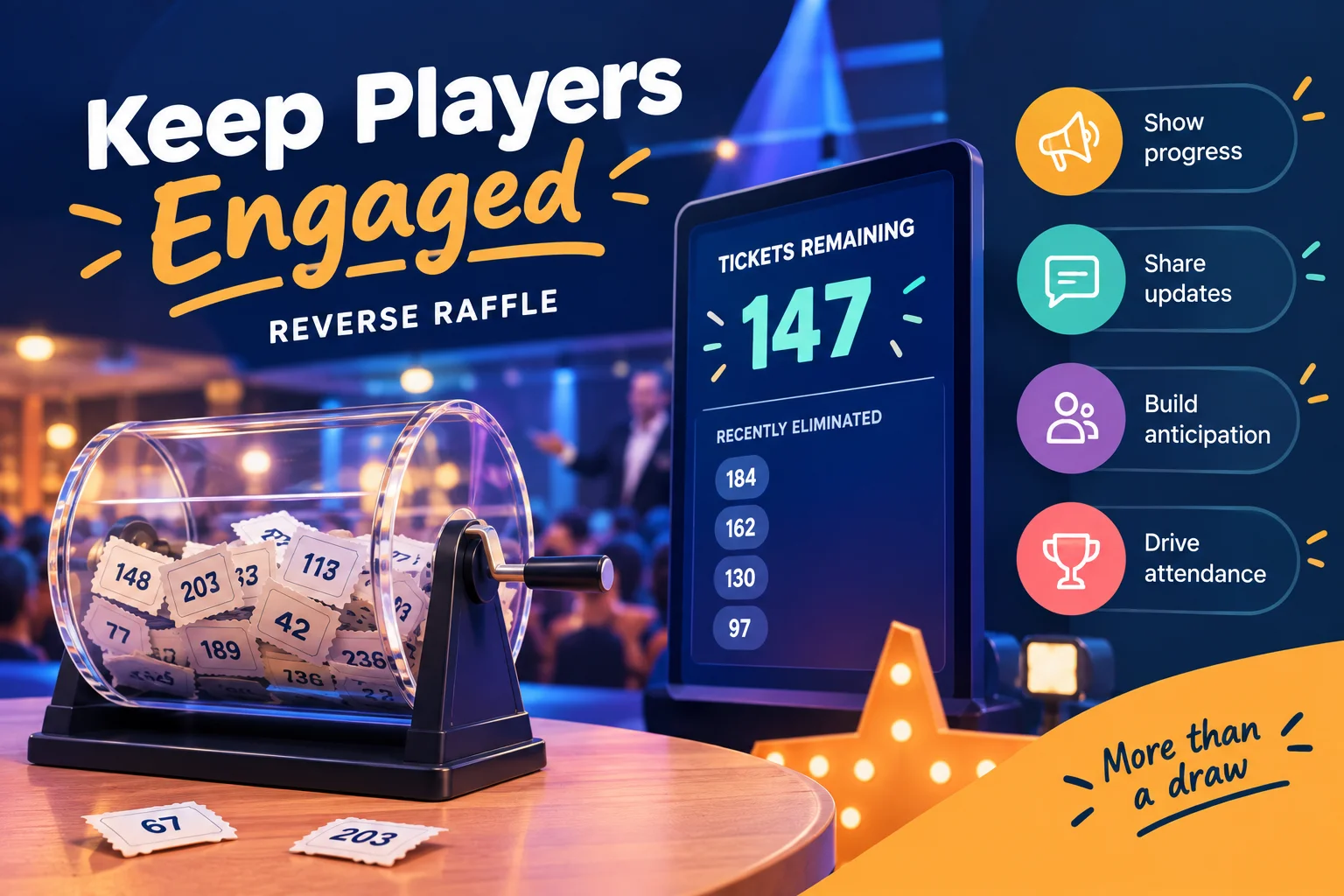
The shrinking field gives the charity opportunities to create moments around the fundraiser.
For example:
300 tickets remaining:
Welcome attendees and explain the cause.
100 tickets remaining:
Recognize sponsors or share a short impact story.
50 tickets remaining:
Remind the audience what the fundraiser is supporting.
10 tickets remaining:
Build anticipation for the final stage.
Final ticket:
Celebrate the winner and acknowledge everyone who participated.
The charity does not need to turn every elimination into a speech.
The point is to use the natural structure of the draw to give the event a sense of progression.
Keep Eliminated Participants Connected
One interesting challenge with a reverse raffle is that participants are progressively eliminated.
If someone hears their number called early, their chance of winning is over.
But their relationship with the charity does not have to end there.
This is where event design matters.
Once participants are eliminated, they can still:
- Follow the remaining draw
- Participate in side activities
- Hear updates about the fundraising goal
- Engage with sponsors
- Enjoy entertainment
- Learn more about the organization's work
- Take part in other fundraising opportunities
- Receive updates about future events
The organization should think beyond the question:
“Who is still eligible to win?”
A better question is:
“How do we keep everyone involved in the event?”
The answer may be different for every fundraiser.
Use Sponsors to Expand the Event
Reverse raffles can also create opportunities for local businesses and event sponsors to become part of the experience.
A sponsor might contribute:
- A prize
- Food or refreshments
- Event supplies
- Promotional support
- A gift certificate
- An experience package
- A cash contribution
In return, the organization can acknowledge sponsors through appropriate event materials and announcements.
This can help the fundraiser become a community event rather than simply a charity-hosted prize draw.
Sponsors can also help introduce the event to audiences that may not already be connected with the organization.
Use SMS to Keep the Conversation Moving
For organizations that already have permission-based supporter or attendee contact information, SMS can be useful throughout the fundraising cycle.
The messages do not all need to be sales messages.
They can serve different purposes.
Before Ticket Sales
“Our annual reverse raffle is coming soon. Tickets go on sale Friday.”
During the Campaign
“Tickets are now available for our charity reverse raffle. Join us for an evening of fundraising, prizes and live entertainment.”
Before the Event
“Your reverse raffle is tomorrow. Doors open at 6 PM and the draw begins at 7 PM.”
During the Event
“We're down to the final 25 tickets. Stay tuned—the final draw is getting closer.”
After the Event
“Thank you for supporting this year's reverse raffle. Your participation helped us continue our work in the community.”
This type of communication can make the event feel connected rather than fragmented.
JustKonnect's reverse raffle platform includes SMS notifications alongside ticket tracking, live displays, drawing and winner management features.
Make the Event Useful for First-Time Supporters
A reverse raffle can introduce new people to a charity.
Someone may initially participate because a friend invited them or because they were interested in the event.
That first interaction can become an opportunity to introduce them to the organization's wider work.
For example, during registration or follow-up, the organization can make it easy for attendees to:
- Learn about its programs
- Join a supporter list
- Discover future events
- Volunteer
- Donate separately
- Follow its social channels
- Participate in other fundraising activities
The objective is not to immediately ask every new participant for another donation.
It is to give them a clear path to remain connected.
Use the Event to Build a Supporter Database
Every fundraiser generates useful information.
Depending on the organization's setup and applicable privacy requirements, useful information might include:
- Ticket purchasers
- Event attendees
- Repeat participants
- New supporters
- Sponsor contacts
- Previous event participants
- Communication preferences
- Event participation history
This information becomes particularly valuable when the organization runs recurring fundraisers.
Instead of starting promotion from zero every year, the charity can communicate with people who have already demonstrated an interest in participating.
A supporter who attended last year's reverse raffle may be an obvious audience for this year's event announcement.
Measure Engagement, Not Just Revenue
Fundraising revenue is important, but it is not the only number worth reviewing.
After the event, charities can examine several parts of the supporter journey.
Ticket Sales
How many tickets were sold?
How quickly did sales build?
Which promotional channels generated the most interest?
Attendance
How many ticket holders actually attended?
Were there differences between early purchasers and last-minute purchasers?
Communication
How many supporters received event reminders?
Which messages generated responses or interaction?
New Supporters
How many participants were new to the organization?
Repeat Participation
How many attendees had participated in previous events?
Post-Event Engagement
How many people remained connected after the fundraiser?
Fundraising Efficiency
How much was raised after considering event costs and prize expenses?
Looking at these measurements gives the organization a more complete view of the fundraiser.
An event that generates strong ticket sales but little repeat participation may require a different follow-up strategy.
An event with strong attendance but slow early ticket sales may need a longer promotion period.
The numbers can help shape the next event.
Make Post-Event Follow-Up Part of the Fundraiser
The final draw should not be the final communication.
Within a reasonable period after the event, send participants a thank-you message.
But go further than simply saying “thank you.”
Show the result.
For example:
“Together, our supporters helped raise $18,000 for this year's community programs.”
If the final fundraising figure is not immediately available, share the confirmed outcome later.
Then explain what comes next.
Perhaps the funds will support a specific program, purchase equipment, provide services, or contribute toward an upcoming initiative.
This closes the loop between participation and impact.
It also gives supporters a reason to feel that their involvement mattered.
Turn One Reverse Raffle Into the Start of the Next One
The strongest opportunity may come after the event.
A charity can create a simple supporter journey:
Event participant → Thank-you → Impact update → Future event → Repeat participant
Someone who bought one ticket this year may become a regular supporter over time.
That does not happen automatically.
The organization needs a reason to stay in contact.
Future communication could include:
- Upcoming fundraisers
- Volunteer opportunities
- Community events
- Impact stories
- New campaigns
- Early event announcements
- Sponsor-supported activities
- Next year's reverse raffle
This is where fundraising engagement becomes a longer-term strategy rather than a single event.
A Simple Reverse Raffle Engagement Framework
Charities looking for a practical structure can think about the event in four stages.
1. Attract
Give people a clear reason to notice the fundraiser.
Focus on the cause, event experience, prize, date, and availability.
2. Participate
Make ticket purchase and event information easy to understand.
Remove unnecessary friction from registration and communication.
3. Engage
Use the live draw, updates, storytelling, sponsors, and event activities to keep participants involved.
4. Continue
Thank supporters, demonstrate impact, and give them a reason to stay connected.
This fourth stage is easy to overlook.
But if a charity wants to build a sustainable fundraising community, the relationship after the event can be just as important as the ticket sale before it.
Where Reverse Raffle Software Fits
Running a fundraiser this way creates more moving parts.
There are tickets to sell, participant information to manage, numbers to track, draws to conduct, winners to record, messages to send, and results to review.
A spreadsheet can work for a small event, but manual processes become harder to manage as participation grows.
JustKonnect's Reverse Raffle Software is designed to bring key parts of that workflow together, including digital and in-person ticket sales, real-time ticket tracking, automated drawing, live displays, SMS notifications, winner management, multiple prize tiers, and reporting.
That matters because the technology should support the fundraising experience rather than become another administrative task for staff.
For charities and fundraising organizations running recurring events, the broader value is having a structured process that connects promotion, participation, event management, and follow-up.
Build the Fundraiser Around the Relationship
A reverse raffle can certainly be about the prize.
But for a charity, it can also be about the people in the room and the cause they are helping support.
The most useful way to approach the format is to think beyond the draw itself.
Promote the cause before the event.
Make participation simple.
Create moments of engagement during the draw.
Keep eliminated participants involved.
Communicate with supporters throughout the event.
Thank them afterward.
Then use what you learned to make the next fundraiser more relevant and easier to manage.
The reverse raffle provides the event structure.
The real fundraising opportunity comes from everything the organization builds around it.
Frequently Asked Questions
Can charities use reverse raffles for fundraising?
Yes. Reverse raffles can be structured as fundraising events where participants purchase numbered tickets and the proceeds support the organization, subject to applicable laws and regulations.
How can a reverse raffle increase fundraising engagement?
The format creates a live event around the fundraising activity. Organizations can use pre-event promotion, storytelling, SMS communication, sponsor involvement, live updates, and post-event follow-up to keep supporters connected throughout the fundraising cycle.
Should a charity focus more on the prize or the cause?
Both can play a role. The prize can attract attention and encourage participation, while communicating the cause helps supporters understand the purpose behind the event. The balance will depend on the organization's audience and fundraising goals.
Can charities use SMS to promote reverse raffles?
Yes. Organizations with appropriate consent and compliant messaging practices can use SMS for event announcements, reminders, ticket-sale campaigns, event updates, and post-event communication.
What should a charity do after a reverse raffle?
Thank participants, communicate the fundraising result when available, explain the impact of the funds, recognize appropriate sponsors, and provide opportunities for supporters to remain connected with the organization.
Can reverse raffle software help charities manage fundraising events?
Dedicated software can help organize parts of the reverse raffle workflow, including ticket sales, entry tracking, automated draws, notifications, winner management, and reporting. This can reduce the amount of manual administration involved in running the event.
Turn Your Next Reverse Raffle Into a Supporter Engagement Event
A reverse raffle does not have to begin with a ticket sale and end with a winner announcement.
With the right planning, it can become a complete fundraising journey—one that introduces new supporters to your organization, keeps existing participants engaged, creates opportunities for community involvement, and gives your team useful information for future events.
If your organization is ready to move beyond spreadsheets and manual raffle management, explore JustKonnect's Reverse Raffle Software to see how digital ticket management, automated draws, live displays, SMS communication, winner management, and reporting can fit into your fundraising workflow.