A reverse raffle can have an attractive prize, a strong fundraising purpose, and a well-planned event and still struggle to sell enough tickets.
Often, the problem isn't the event itself.
It's that potential participants hear about it once and then get distracted.
Someone sees the announcement but doesn't buy a ticket. Another person intends to attend but forgets the date. A previous participant would have joined again but never receives a reminder.
SMS can help close those gaps.
Unlike a social media post that may or may not appear in someone's feed, a text message gives an organization a direct way to communicate with people who have opted in to receive messages.
But filling a reverse raffle isn't simply a matter of sending more texts.
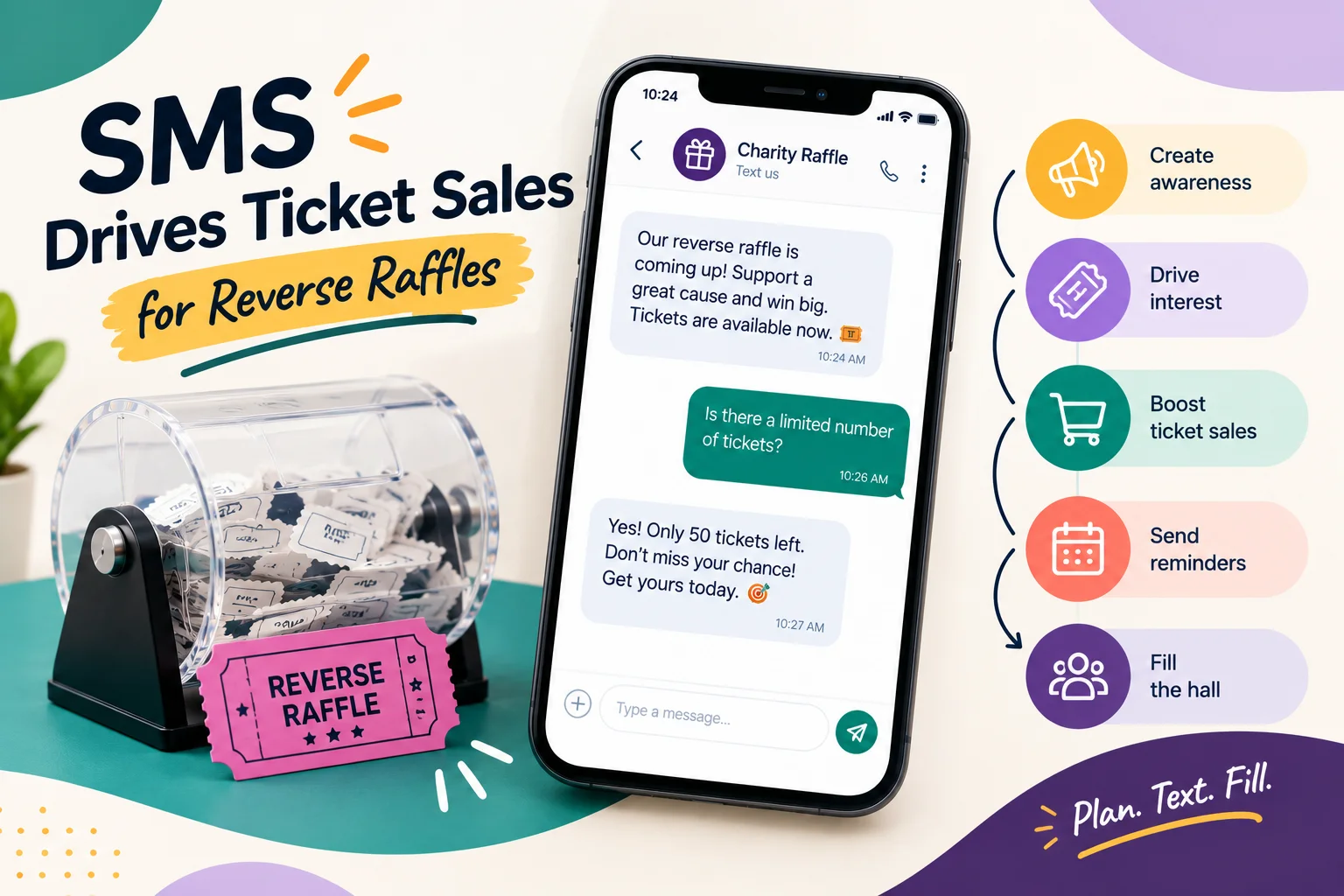
The real opportunity is to build a campaign around the ticket-buying journey:
Awareness → Interest → Ticket Purchase → Reminder → Attendance → Follow-Up
Each stage needs a different message.
Don't Start With "Send an SMS"
Start With the Ticket Sales Problem
Before writing the first message, identify what you are trying to solve.
Is the reverse raffle struggling to get initial awareness?
Are people interested but not purchasing?
Did early ticket sales start well and then slow down?
Is the event approaching with too many tickets still available?
Have previous participants not yet returned?
These situations may all require SMS, but they shouldn't necessarily receive the same message.
For example, someone who has never heard about the raffle needs an introduction.
Someone who clicked through to the ticket page but hasn't purchased needs a reminder or a clearer reason to act.
Someone who already bought a ticket needs event information, not another message asking them to buy one.
The campaign becomes more effective when the message reflects the person's stage.
Build the Campaign Around a Countdown
A reverse raffle naturally creates a deadline.
The draw is happening on a specific date.
That makes countdown messaging particularly useful.
Instead of sending one large promotional message several weeks before the event, build a communication sequence that gradually moves people toward the event.
A simple campaign could look like this:
4–6 weeks before: Introduce the event.
3 weeks before: Explain the fundraiser and prize.
2 weeks before: Encourage ticket purchases.
1 week before: Create urgency around the approaching event.
2–3 days before: Remind interested audiences.
Day before: Confirm event details.
Event day: Send a final practical reminder.
The exact timing should depend on the event, audience, ticket availability, and communication preferences.
The important point is that every message has a job.
Message One: Introduce the Reverse Raffle
Your first SMS shouldn't assume that everyone already knows what a reverse raffle is.
Give recipients enough information to understand the opportunity quickly.
For example:
Our charity reverse raffle is coming up! Join us for a night of fundraising, prizes, and excitement. Tickets are now available
The message establishes:
- What the event is
- Why it matters
- That tickets are available
- What the recipient should do next
You don't need to explain every rule in the first text.
The goal is to generate interest and move people toward the ticket information.
Message Two: Explain Why People Should Participate
Once awareness exists, the next communication can add context.
This is where the charity, fundraiser, event experience, or prize structure can become more prominent.
For example:
Your chance to support [cause] and take part in our reverse raffle is still open. Tickets are limited, and the final draw is [date]. Get yours here
Notice that the message isn't simply repeating the first announcement.
It answers another question:
Why should I care about this event?
That distinction matters when running a multi-message campaign.
Message Three: Use Ticket Availability to Create Urgency
If the raffle has a fixed ticket limit, availability can become part of the campaign.
For example:
Our reverse raffle is filling up! Don't miss your chance to take part on [date]. Secure your ticket before they're gone.
If you have accurate real-time ticket numbers, you can make the message more specific.
For example:
Only 50 tickets remain for our charity reverse raffle. Secure yours before the draw.
The key is accuracy.
Don't claim that tickets are limited or nearly sold out unless the information is genuine.
JustKonnect's Reverse Raffle Software includes real-time tracking of sold and available tickets, which can support this type of availability-based promotion.
Message Four: Make the Deadline Feel Real
People often delay decisions that don't have an immediate deadline.
A countdown gives them a reason to act.
For example:
One week to go! Our reverse raffle takes place next Saturday. Have you secured your ticket yet? Join us and support [cause].
A later message could be shorter:
3 days to go! Our reverse raffle is almost here. Get your ticket today.
The campaign is becoming more time-sensitive, so avoid repeating the same wording.
Message Five: Send a Final Ticket Push
The final sales message should be direct.
There is little value in hiding the call to action inside a long paragraph.
For example:
Last chance to join our reverse raffle! Tickets are available until [time/date]. Secure yours now.
If the ticket deadline has already passed, don't continue selling.
Your SMS campaign should always reflect the event's actual status.
Not Everyone Needs the Same SMS
One of the biggest mistakes in event marketing is treating the entire database as one audience.
Imagine a reverse raffle database containing:
- People who have never attended
- Previous raffle participants
- Current ticket holders
- Frequent event attendees
- People who showed interest but did not purchase
- Sponsors or partners
- People who have opted out of marketing
Sending the same message to everyone is unlikely to produce the best experience.
Instead, think in terms of groups.
Previous Participants
They already understand the format.
Your message can focus more heavily on this year's date, prize, cause, and ticket availability.
New Prospects
They may need a short explanation of what the reverse raffle is and why they should attend.
Existing Ticket Holders
They need confirmation, reminders, location details, start time, and event instructions.
They don't need repeated ticket-sales messages.
Inactive Contacts
If they are eligible to receive marketing communication, a carefully timed event invitation may give them a reason to re-engage.
Segmentation makes the campaign more relevant.
JustKonnect's broader platform includes customer segmentation, player profiles, campaign tools, and SMS features that can support more structured player communication.
Give Every SMS One Clear Job
A common SMS mistake is trying to fit the entire marketing campaign into one text.
Imagine a message containing:
- The reverse raffle
- The charity story
- Three prizes
- A bingo promotion
- A loyalty offer
- A sponsor announcement
- Event parking details
- A request to follow social media
The recipient has to work out what they are supposed to do.
Instead, give each message one primary purpose.
Announcement: Know about the event.
Promotion: Consider buying a ticket.
Urgency: Act before tickets or time run out.
Reminder: Remember the event.
Instructions: Know where and when to attend.
Follow-up: Understand the result and next step.
One message doesn't need to do everything.
Send People Somewhere Useful
An SMS can only do part of the job.
The recipient still needs somewhere to go after reading it.
If you're promoting ticket sales, the link should take them directly to the relevant ticket page.
Avoid sending someone to a general homepage where they have to search for the reverse raffle.
JustKonnect's Reverse Raffle Software supports an online ticket portal that can be shared through SMS or email.
The ideal journey is simple:
SMS → Ticket Page → Purchase → Confirmation
Every unnecessary step creates another opportunity for someone to abandon the process.
Use Different Messages for Buyers and Non-Buyers
Once someone purchases a ticket, the communication should change.
Imagine this sequence.
Before Purchase
“Tickets are now available for our charity reverse raffle. Get yours here”
After Purchase
“You're in! Your reverse raffle ticket is confirmed for [date]. We'll see you there.”
Before Event
“Your reverse raffle is tomorrow. Doors open at [time] and the draw begins at [time].”
The first message is designed to create a transaction.
The second confirms the transaction.
The third helps turn that transaction into attendance.
That is much more useful than continuing to ask someone who already purchased a ticket to buy one.
Use Countdown Messages Carefully
Countdowns can be powerful because they create a natural sense of progression.
But sending a countdown every day can quickly become repetitive.
Instead, vary the reason for the message.
One Week
Focus on anticipation.
“One week until our reverse raffle! Have you secured your ticket?”
Three Days
Focus on urgency.
“Only 3 days to go. Tickets are still available for our charity reverse raffle.”
One Day
Focus on preparation.
“Tomorrow's the night! Your reverse raffle starts at 7 PM. We can't wait to see you.”
Event Day
Focus on attendance.
“Tonight's the night! Doors open at 6 PM and the reverse raffle begins at 7 PM.”
The countdown becomes a sequence rather than the same message repeated with a different number.
Don't Ignore the Final Hours
The final day can be one of the most important points in the campaign.
Some people need repeated exposure before acting.
Others genuinely don't make decisions until a deadline is close.
A final-day SMS could be:
Today is your last chance to enter our reverse raffle. Tickets close at [time]. Join us and support [cause].
If the raffle sells out earlier, stop the sales promotion.
You can then shift the campaign toward attendance and event information.
That transition is important.
The objective changes once ticket sales close.
Use SMS to Reduce No-Shows
Selling a ticket is not the same as getting someone through the door.
A participant may buy a ticket weeks in advance and then forget the event date.
A short reminder can prevent that.
For example:
Your reverse raffle is tomorrow! Doors open at 6 PM at [venue]. The draw starts at 7 PM. See you there!
This message doesn't need to sell anything.
The recipient has already purchased.
Your job at this stage is to make attendance easy.
Include only the information they actually need.
Make the Event Day Message Practical
Event-day SMS should answer practical questions.
Depending on your event, this might include:
- Start time
- Doors-open time
- Venue
- Parking information
- Ticket requirements
- Check-in instructions
- Draw time
- Contact information
Don't turn an event-day reminder into another sales advertisement.
People who have already committed need clarity more than persuasion.
SMS Can Also Support the Live Draw
SMS doesn't have to stop once the event begins.
Depending on how the reverse raffle is configured, participants can receive notifications related to the draw.
JustKonnect's Reverse Raffle Software describes SMS notifications as part of its draw workflow, alongside live displays, automated drawing, ticket tracking, and winner management.
This can be particularly useful when participants aren't watching the display every second.
Someone may step away from the room.
Someone may be speaking with another guest.
Someone may miss a verbal announcement.
A notification provides another communication layer.
What About People Who Are Eliminated?
In a reverse raffle, being eliminated doesn't necessarily mean the event is over for that participant.
The SMS strategy can reflect that.
For example, if the organization has additional event activities, it can communicate those separately rather than continuing to send messages suggesting the participant can still win the grand prize.
Clear communication matters.
Don't send:
“You're still in the running!”
to someone whose number has already been eliminated.
Use the technology to make communication more accurate, not simply more frequent.
Create a Simple SMS Campaign Calendar
A practical campaign might look like this:
| Timing | Audience | Purpose |
| 5–6 weeks before | Eligible audience | Event announcement |
| 3–4 weeks before | Prospects + previous participants | Explain event and promote tickets |
| 2 weeks before | Non-buyers | Ticket reminder |
| 1 week before | Non-buyers | Countdown |
| 3 days before | Non-buyers | Urgency |
| 1 day before | Ticket holders | Attendance reminder |
| Event day | Ticket holders | Final practical details |
| During event | Participants | Relevant draw updates |
| After event | Participants | Thank-you and follow-up |
This is only a starting framework.
A smaller event might need fewer messages.
A longer ticket-sales period might need additional communication.
The important part is having a deliberate sequence instead of sending random reminders whenever ticket sales slow down.
Don't Let Every Message Sound Like an Advertisement
SMS is a direct communication channel.
That makes relevance especially important.
Compare these two messages.
Message A:
BUY NOW!!! HUGE REVERSE RAFFLE!!! DON'T MISS OUT!!! GET YOUR TICKET TODAY!!!
Message B:
Our charity reverse raffle is coming up on Saturday. Tickets are still available, with proceeds supporting [cause]. Get yours here.
The second message gives the recipient context and a clear action without sounding like a constant sales alert.
Your audience should understand why the message is reaching them.
Use the Data to Adjust the Campaign
A reverse raffle campaign shouldn't be treated as something you design once and repeat forever.
Look at what happened.
Did ticket sales increase after the first announcement?
Did the countdown message generate more purchases?
Did previous participants respond differently from new prospects?
Did the final-day message create a noticeable sales increase?
Did reminder messages reduce no-shows?
These questions help identify where the campaign is working and where it needs adjustment.
JustKonnect's wider platform includes campaign performance, revenue and ROI tracking, customer behavior analytics, and exportable reporting, providing a broader foundation for measuring player communication and engagement.
Watch the Difference Between Reach and Results
Sending 5,000 SMS messages doesn't mean you've run a successful campaign.
Reach is only the beginning.
For a reverse raffle, more useful measurements can include:
Ticket sales: How many tickets were purchased?
Conversion: How many recipients moved from communication to purchase?
Sales timing: When did most purchases happen?
Attendance: How many ticket holders attended?
Repeat participation: How many previous participants returned?
Campaign response: Which messages generated the strongest response?
Revenue: What did the event ultimately generate?
The exact metrics will depend on how your organization runs its fundraiser.
But measuring outcomes helps prevent SMS from becoming a simple “send and forget” activity.
Avoid These Reverse Raffle SMS Mistakes
Sending the Same Message to Everyone
A ticket holder and a potential buyer have different needs.
Starting Too Late
Waiting until two days before the event gives your campaign very little room to build awareness.
Sending Too Frequently
More messages do not automatically mean more ticket sales.
Using Vague Calls to Action
“Learn more” is less direct than telling someone exactly where to get their ticket.
Forgetting the Landing Page
A strong SMS cannot compensate for a confusing purchase process.
Continuing Sales Messages After Sellout
Once tickets are sold out, switch communication toward event information.
Ignoring Consent and Opt-Out Requirements
Marketing SMS should follow applicable laws, regulations, and the recipient's communication preferences.
Treating Buyers Like Prospects
Once someone has purchased, move them into an attendee communication journey.
A Reverse Raffle SMS Campaign in Practice
Imagine a charity is running a 300-ticket reverse raffle six weeks from now.
The campaign could develop like this:
Week 6:
Introduce the fundraiser and open ticket sales.
Week 4:
Share the purpose of the fundraiser and remind previous participants.
Week 3:
Promote the prize and event experience.
Week 2:
Send a targeted reminder to people who haven't purchased.
Week 1:
Begin the countdown.
Three days before:
Create urgency around the remaining ticket window.
Day before:
Send attendance information to ticket holders.
Event day:
Send a practical reminder.
During the draw:
Provide relevant notifications where appropriate.
After the event:
Thank participants and communicate the fundraising result.
The campaign isn't one SMS.
It's a connected series of messages that moves people from awareness toward participation.
Where JustKonnect Fits Into the Process
Managing a reverse raffle campaign can involve several separate tasks:
- Selling tickets
- Tracking available entries
- Communicating with participants
- Sending reminders
- Running the draw
- Notifying winners
- Managing prize information
- Reviewing results
JustKonnect's Reverse Raffle Software brings ticket sales, real-time entry tracking, automated draws, live displays, SMS notifications, winner management, multiple prize tiers, and reporting into the reverse raffle workflow.
Its wider platform also includes SMS blast marketing, SMS drip campaigns, two-way texting, customer segmentation, and campaign analytics.
That creates an opportunity to treat the reverse raffle as a campaign rather than a standalone event.
The technology handles the operational side.
Your marketing strategy decides what people should receive, when they should receive it, and what you want them to do next.
Frequently Asked Questions
How many SMS messages should I send to promote a reverse raffle?
There is no universal number. A campaign might use several messages spread across the ticket-sales period, with additional reminders closer to the event. The appropriate frequency depends on the event timeline, audience, consent, and how much information genuinely needs to be communicated.
When should I start promoting a reverse raffle by SMS?
Starting several weeks before the event generally gives you more opportunities to build awareness, explain the event, and remind people about tickets without relying on excessive last-minute messaging.
Should I send the same SMS to previous participants and new prospects?
Not necessarily. Previous participants already understand the format, while new prospects may need more context. Segmenting the audience can make the campaign more relevant.
Can SMS be used after someone buys a reverse raffle ticket?
Yes. After purchase, communication can shift from ticket promotion to confirmation, event reminders, practical instructions, and appropriate event updates.
Can SMS help promote limited reverse raffle tickets?
Yes, provided the availability information is accurate. A genuine limited-ticket situation can be communicated as part of a countdown or urgency campaign.
Can reverse raffle software connect SMS with ticket management?
JustKonnect's Reverse Raffle Software includes SMS notifications alongside digital and in-person ticket sales, real-time tracking, automated drawing, live display, winner management, and reporting.
Fill the Event by Building the Right Sequence
The strongest SMS campaigns don't rely on one perfect message.
They build momentum gradually.
First, make people aware of the reverse raffle.
Then explain why they should participate.
Make ticket purchase simple.
Remind people as the event approaches.
Use genuine ticket availability or deadlines to create urgency.
Once someone buys, stop selling and start helping them attend.
Then follow up after the event.
That sequence turns SMS from a promotional megaphone into a practical part of the reverse raffle experience.
If you're planning your next reverse raffle, explore JustKonnect's Reverse Raffle Software to see how ticket sales, entry tracking, automated draws, live displays, SMS notifications, winner management, and reporting can work together in one workflow.