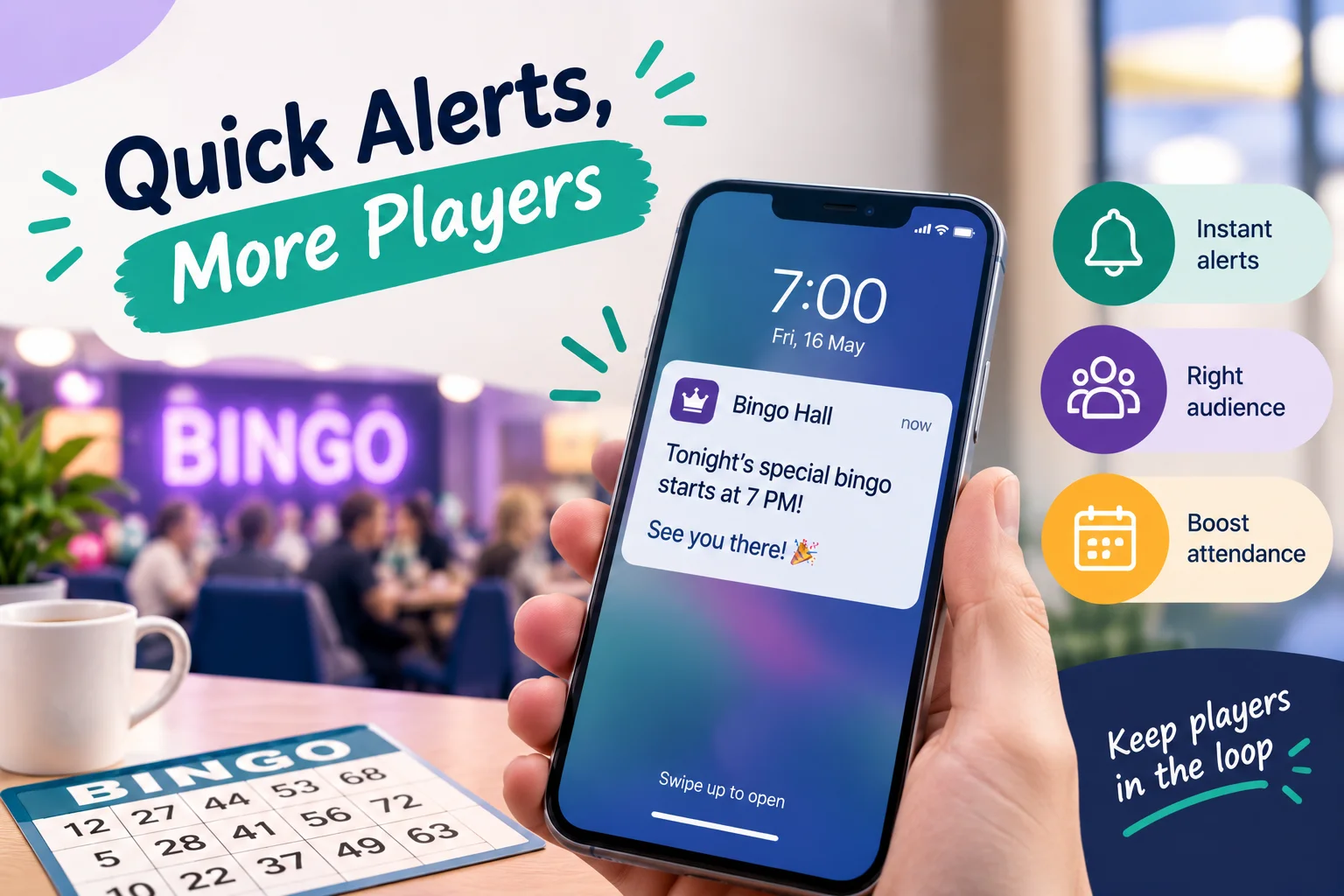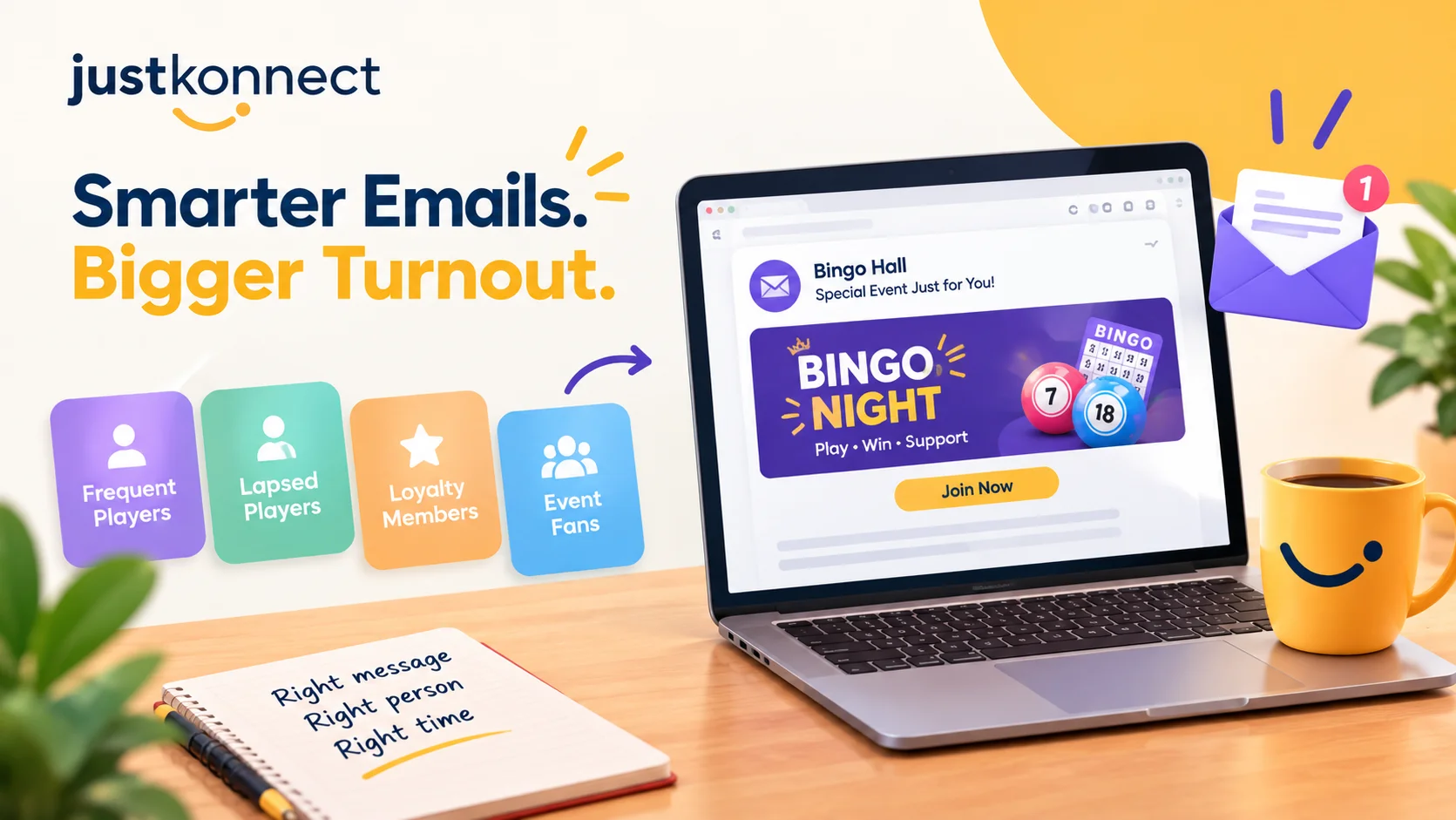
A bingo hall has a special event tonight. Some players need a reminder. Others have a loyalty reward waiting. A few haven't visited in weeks, while regular attendees may already know exactly when the next session starts.
Should the operator send an SMS, a push notification, or both?
The answer depends on more than which channel has the highest engagement rate. It depends on the player's situation, the urgency of the message, the audience the hall needs to reach, and the action it wants that audience to take.
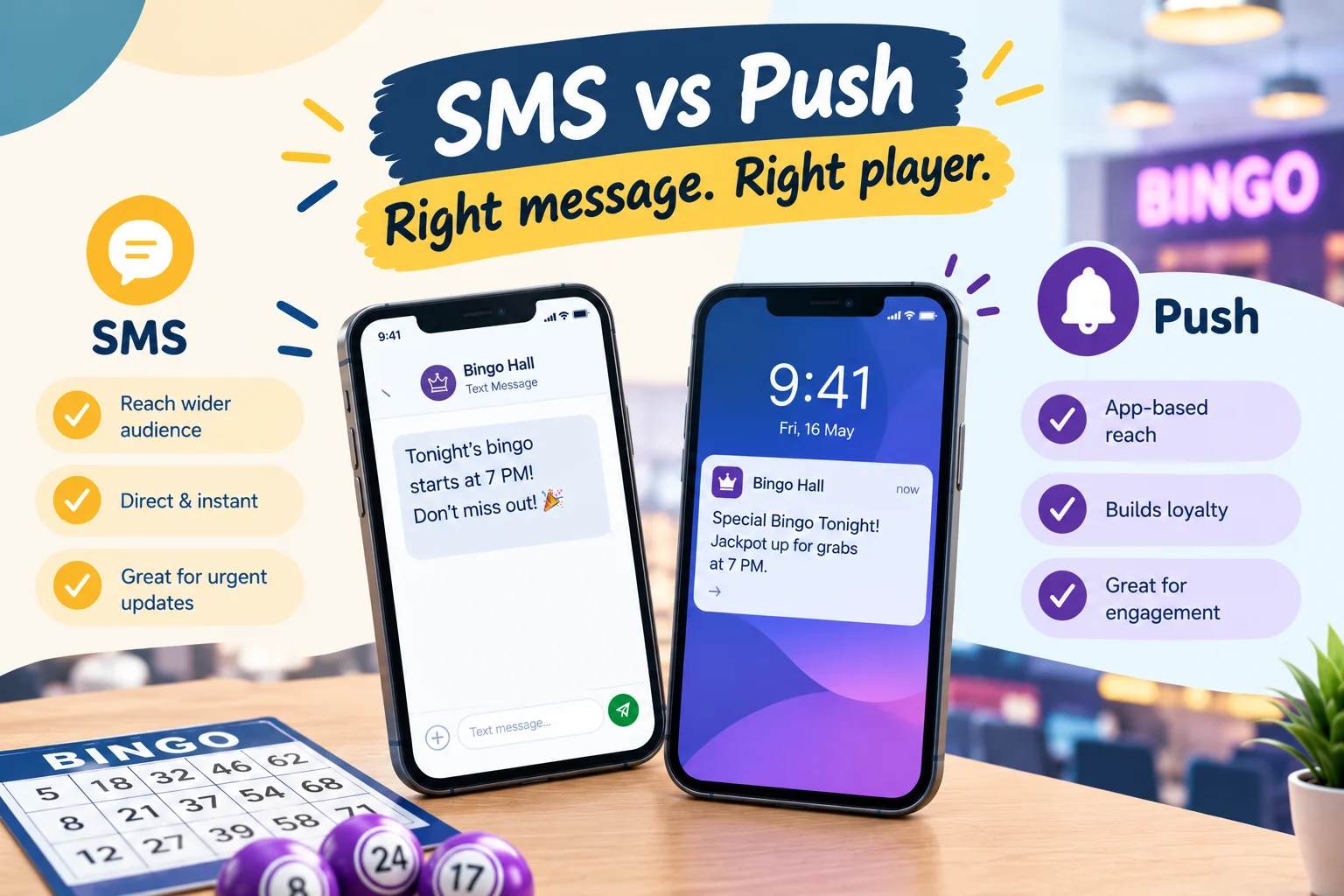
SMS and push notifications can both support attendance and loyalty, but they work differently. SMS reaches players through text messaging, while push notifications provide a direct communication route through a mobile app to players who have enabled notifications. Neither channel automatically guarantees attention or a visit.
For bingo operators, the opportunity is to stop treating communication as a choice between two competing tools and start using each channel for the job it does best.
Two Channels, Two Different Starting Points
The simplest way to compare SMS and push notifications is to begin with the audience.
SMS starts with a reachable phone number and appropriate messaging permission.
A player does not necessarily need to have your loyalty app installed to receive a text message. That can make SMS useful for communicating with eligible contacts across a broader player database.
Push notifications start with an app-based relationship.
Players generally need the relevant app installed and notifications enabled to receive app push notifications. This makes push particularly relevant when a bingo hall already has an active loyalty app and wants to bring players back into that experience.
These differences influence how operators should plan campaigns.
| Consideration | SMS | Push Notifications |
| Primary route | Mobile text messaging | Mobile app notification |
| Audience requirement | Reachable number and appropriate permission | Relevant app access and notification permission |
| Useful for | Direct reminders, urgent updates, event promotions | App engagement, loyalty updates, event reminders |
| Message style | Concise and action-focused | Brief, contextual, often linked to an app interaction |
| Potential limitation | Message costs, contact fatigue, and applicable messaging rules | App adoption, notification settings, and notification fatigue |
| Measurement | Delivery, responses where supported, clicks, and campaign outcomes | Delivery or visibility where supported, opens, app actions, and campaign outcomes |
Actual functionality and measurement depend on the messaging platform, app configuration, and available tracking.
The important distinction is that SMS can help a hall communicate with eligible contacts who are not active app users, while push notifications can reinforce the relationship with players already connected to its app.
The Reach Question: Who Can You Actually Contact?
Before choosing a channel, identify the audience you want to reach.
Imagine a hall has 2,000 contacts in its database. Some have joined the loyalty app, some receive SMS marketing, and others may be eligible for neither channel.
Sending a push notification to the entire database will not work if many contacts have never installed the app or have disabled notifications.
Likewise, an SMS campaign cannot reach contacts who lack a usable phone number or the required permission.
This means the first task is to understand the reachable audience for each channel.
When SMS Has the Advantage
SMS can be a practical choice when the hall wants to reach eligible players directly without relying on app adoption.
Examples include:
- Announcing a significant change to tonight's session
- Sending a timely reminder about a special event
- Promoting an upcoming charity bingo night
- Reaching a segment of inactive players
- Communicating a relevant, time-sensitive offer
SMS is particularly useful when the message needs to reach beyond the hall's active app community.
When Push Notifications Have the Advantage
Push notifications are especially useful when the hall wants to engage players through its loyalty app.
Examples include:
- Reminding app users about an upcoming session
- Bringing players back to view loyalty information
- Highlighting a relevant reward or milestone
- Promoting an event through an app-connected player experience
- Encouraging players to explore an available offer
Push notifications can also support more ongoing engagement between visits, helping the app remain useful rather than being opened only when a player wants to check something.
Match the Channel to the Player's Next Decision
A campaign should start with the decision the player needs to make, not with the channel the marketing team wants to use.
Consider four situations.
Situation 1: The Hall Needs to Communicate a Schedule Change
A session time has changed, and eligible players need to know before leaving home.
SMS may be appropriate for a direct, time-sensitive update because it does not depend on the recipient actively using a loyalty app.
A push notification may also be useful for app users, especially if the hall wants to direct them to more detailed information.
If the update is important, prioritise clarity and reliable delivery over promotional wording.
Situation 2: A Loyalty Reward Is Available
A player has reached a reward milestone.
If the reward is managed through the loyalty app, a push notification can prompt the player to open the app and view the details.
SMS may be a suitable alternative or complement for eligible players who are not active app users, provided the communication is appropriate and the available system supports it.
The message should explain the benefit without making the player work to understand what is waiting for them.
Situation 3: A Quiet Night Needs More Attendance
The hall wants to encourage more players to attend a quieter midweek session.
SMS may reach a broader eligible audience, while push notifications can target app-connected players with a timely reminder.
The choice should reflect audience overlap, campaign urgency, and the hall's available player data.
If both channels are used, coordinate them so players do not receive repetitive messages simply because they appear in two lists.
Situation 4: The Hall Wants to Re-Engage Inactive Players
A player who has not visited recently may need a different reason to return from someone who attends every week.
An SMS campaign can be useful for eligible inactive contacts, while a push notification may help reconnect with inactive app users.
The key is to define inactivity using a sensible period and select a relevant message. A generic “Come back tonight” notification is unlikely to be compelling if the player has no clear reason to return.
The Three Campaign Patterns Worth Testing
Rather than building a separate strategy for every possible situation, start with three repeatable campaign patterns.
Pattern 1: SMS for Broad Reach, Push for App Engagement
Use SMS to communicate a relevant event to an eligible audience, then use push notifications to encourage app users to explore the event details, loyalty activity, or related information.
This pattern works when the channels have distinct roles.
It does not mean every recipient should receive both messages. If the SMS already communicates everything the player needs, an additional push notification may be unnecessary.
Pattern 2: Push First, SMS for an Appropriate Follow-Up
Suppose the hall announces an upcoming loyalty event through its app.
A push notification can introduce the event to app users. If a later reminder is genuinely useful, SMS could be used for eligible players who need a more direct prompt.
The follow-up should be planned around actual campaign needs, not triggered automatically just because the first message has been sent.
Pattern 3: Separate Audiences by Their Communication Access
Some players may be reachable through SMS only, some through push only, and others through both.
Create campaign rules that account for these differences.
For example:
- SMS-eligible, non-app players receive the relevant text message.
- App users receive the push notification when it suits the campaign.
- Players reachable through both channels receive a coordinated sequence only when the additional contact provides value.
This avoids wasting effort on duplicate communication and makes campaign results easier to interpret.
A Realistic Example: Filling a Quiet Wednesday Session
Imagine a bingo hall wants to improve attendance for a Wednesday evening session.
The hall has an upcoming event, a loyalty app, and a database of players with varying attendance patterns.
Here is how a coordinated campaign could work.
Monday — Set the audience
Identify players who regularly attend midweek, occasional visitors, and app users who have been less active. Confirm which contacts are eligible for each communication channel.
Wednesday afternoon — Send the relevant reminder
Send a concise SMS to an appropriate segment that needs a direct reminder. Send a push notification to a suitable app audience with a clear reason to check the event details.
Before the session — Avoid unnecessary repetition
Review which audiences have already received a message. Send another reminder only if the timing and information justify it.
After the session — Review the result
Compare attendance with similar Wednesday sessions, alongside campaign engagement and any tracked offer activity.
This is an illustrative campaign model, not a claim that either channel will produce a guaranteed attendance increase.
The purpose is to make the campaign measurable and improve the next decision.
Message Examples: Same Event, Different Channel
Suppose the hall is promoting a special Friday bingo night.
The message should reflect the strengths of the chosen channel.
SMS example
“Special Bingo Night is this Friday at 7 PM. Join us at [Hall Name] for the evening's games. Check the event details before you visit.”
This message provides the essential information directly.
Push notification example
“Friday's Bingo Night Is Coming 🎉”
“Open the app to view the event details and your available loyalty information.”
This version gives the player a reason to interact with the app.
Coordinated approach
The SMS could provide the essential event details to an eligible audience, while the push notification could focus on an app-based loyalty benefit for a relevant group.
The messages do not need to be identical. In fact, they are more useful when each channel has a distinct purpose.
Only make claims about rewards, offers, or event details that are accurate and available to the recipient.
Don't Let Frequency Undermine Reach
It is easy to assume that using two channels doubles the opportunity.
It can also double the annoyance if both send the same promotion at the same time.
Imagine a player receives an SMS at 4:00 p.m., a push notification at 4:05 p.m., and another reminder at 5:00 p.m. Nothing about the event has changed, and no additional information has been provided.
The hall has increased message volume without necessarily increasing value.
A coordinated communication plan should account for:
- Which message the player has already received
- How urgent the information is
- Whether the second channel adds anything useful
- How frequently the player has been contacted
- Whether the player has opted out or changed notification preferences
A simple rule helps: use another channel when it improves the communication, not merely because it is available.
Measure the Result Beyond Delivery
SMS and push notifications have different engagement signals, so comparing them by a single metric can produce misleading conclusions.
An SMS delivery does not prove that the recipient read the message. A push notification sent does not prove that the player noticed it. A click or app open does not automatically translate into attendance.
Choose metrics based on the campaign's objective.
| Campaign objective | Useful measures |
| Communicate an urgent update | Successful delivery where available, support enquiries, and whether the update reached the intended audience |
| Promote an event | Clicks, event responses, registrations where applicable, and attendance |
| Encourage loyalty engagement | App activity, reward views, redemptions, and subsequent visits |
| Re-engage inactive players | Responses, returning visitors, and repeat attendance |
| Compare SMS and push | Reachable audience, engagement rate, campaign cost, and attributable outcomes |
For a more reliable comparison, test similar audiences and comparable sessions where practical. Account for other factors that may affect attendance, such as the event itself, weather, seasonality, or competing activities.
The aim is not to prove that one channel always wins. It is to learn which channel works best for a particular audience and objective.
Where JustKonnect Fits Into the Strategy
Running SMS and push campaigns separately can make it difficult to understand how they contribute to the wider player relationship.
Bingo operators also need to consider player profiles, attendance behaviour, loyalty status, and campaign results when deciding whom to contact.
JustKonnect offers push notifications as part of its bingo-focused platform, with a feature designed around event reminders, player engagement, attendance, and reporting. Its wider feature set also includes SMS marketing, player profiles and CRM, loyalty tools, and analytics. These capabilities can help operators plan communication as part of a broader player-engagement workflow rather than treating every message as an isolated send.
Explore JustKonnect Push Notifications to learn more about its app-based communication capabilities, and review the JustKonnect platform features to understand how messaging can fit alongside CRM, loyalty, and reporting.
The practical value comes from having a clear purpose for each campaign, selecting an appropriate audience, and reviewing what happened after the message was sent.
Common Mistakes When Using SMS and Push Together
Assuming Both Channels Reach Everyone
SMS and push notifications have different audience requirements. Check reachability and permission before launching a campaign.
Copying the Same Message Across Both Channels
A repeated message can create fatigue. Give each channel a clear role when both are used.
Using Push Without an Active App Audience
Push notifications depend on app adoption and notification settings. Build app engagement rather than assuming every player can receive an alert.
Using SMS for Every Minor Update
SMS is valuable for direct communication, but unnecessary messages can lead to opt-outs and reduced attention.
Comparing Opens With Attendance
Opens and clicks are useful signals, but the hall should evaluate them alongside actual campaign outcomes.
Forgetting Consent and Preferences
Follow applicable messaging laws, platform requirements, and player preferences. Maintain appropriate records and respect opt-outs and notification settings.
Frequently Asked Questions
Is SMS better than push notifications for bingo halls?
Neither channel is universally better. SMS can reach eligible contacts without requiring an active loyalty app, while push notifications can be useful for engaging players through an app-based loyalty experience. The best choice depends on the audience, message, and objective.
Can a bingo hall use SMS and push notifications for the same event?
Yes, if each message serves a clear purpose and the audience is appropriate. For example, SMS may communicate essential event information while push encourages app users to view relevant event or loyalty details. Avoid sending duplicate reminders without a clear benefit.
Do push notifications require a bingo loyalty app?
App-based push notifications generally require the relevant app to be installed and notifications to be enabled. This makes app adoption and notification permissions important considerations when planning a campaign.
Which channel is better for last-minute bingo reminders?
SMS can be a practical option when the hall needs to contact eligible players directly at short notice. Push notifications can also work well for app users. The right choice depends on reach, urgency, permissions, and how players typically respond.
How can operators tell which channel drives more attendance?
Track engagement alongside attendance and other relevant outcomes. Compare similar campaigns or sessions where possible, and account for other factors that might affect turnout. Do not assume a delivery, open, or click alone proves that a visit occurred.
Should bingo halls send push notifications every day?
Not necessarily. Push notifications should be reserved for useful, relevant information. Excessive alerts can lead players to ignore notifications or disable them, reducing the effectiveness of future communication.
Build a Channel Strategy Around the Player, Not the Technology
The SMS-versus-push decision becomes much easier when operators stop asking which channel is best in general.
Instead, ask three practical questions:
Who needs to receive this message?
What do they need to know or do?
Which channel can deliver that information most appropriately?
SMS can help a hall reach eligible players directly. Push notifications can bring app-connected players back into a loyalty experience. Used thoughtfully, both can support event promotion, timely reminders, and ongoing engagement without turning every campaign into a duplicate broadcast.
For bingo halls, maximum reach is not simply about sending a message through every available channel. Maximum response comes from matching the right message to the right audience, respecting player preferences, and measuring the result.
That is the foundation of a communication strategy that supports stronger player relationships and more informed attendance decisions.