A bingo hall can have a strong game schedule, loyal players, and a solid evening promotion and still have empty seats by late afternoon.
That is because having something worth attending doesn't guarantee players will remember it, plan around it, or decide to leave home and visit the hall.
Sometimes the difference between an ordinary night and a stronger turnout is simply a well-timed reminder.
Push notifications give bingo halls a direct way to reach players through their loyalty app when an event, promotion, reward, or game-night opportunity is still relevant. JustKonnect positions its Push Notifications feature around attendance-focused communication, including event reminders and alerts designed to keep the hall top of mind before game nights.
The opportunity is particularly interesting for same-night attendance.
Instead of communicating only days in advance, operators can use the right message at the right moment to turn existing player interest into an actual visit.
The Gap Between “Interested” and “Coming Tonight”
Think about a typical player.
They may know that bingo is running tonight. They may have seen the event earlier in the week. They may even have intended to attend.
But then the day gets busy.
Work runs late. Dinner takes longer than expected. Another plan appears. The player simply forgets.
By 4:30 or 5:00 p.m., the hall may still have an opportunity to influence that decision.
A useful push notification can act as the bridge between:
“I know there is bingo tonight.”
and
“I could actually go tonight.”
That distinction matters.
Push notifications are not necessarily about introducing a player to an event from scratch. In many cases, they are about removing the small amount of friction or forgetfulness that prevents an existing opportunity from becoming a visit.
Why Push Notifications Fit the Same-Night Problem
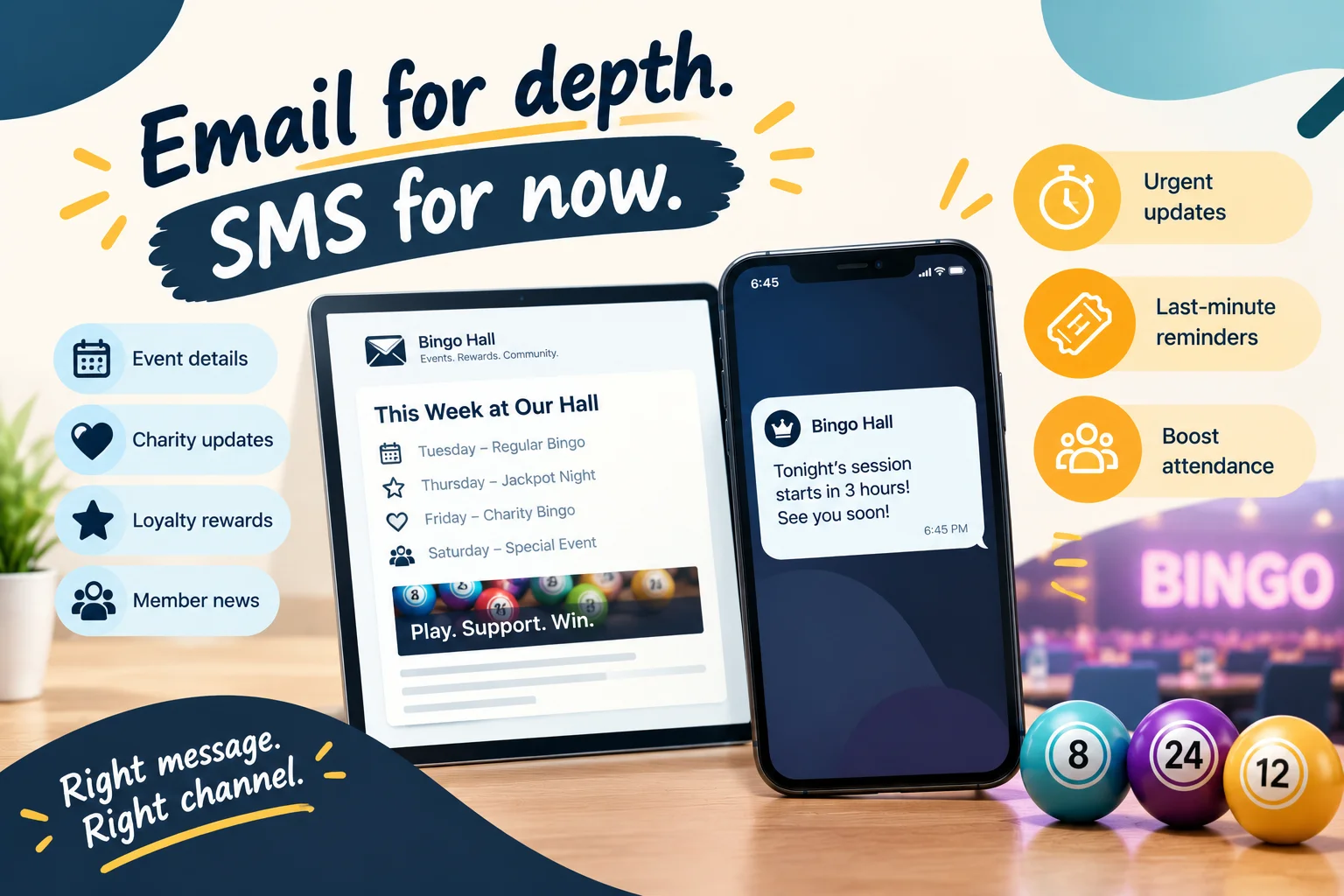
Email can be useful when players need more information. SMS can be effective for direct, time-sensitive communication.
A push notification has another advantage when a player is already connected to a loyalty app: the message can appear directly through an app experience that is already associated with the hall.
JustKonnect describes push notifications as a way to reach players instantly with event reminders and alerts, while keeping communication connected to attendance and loyalty activity.
That creates an interesting workflow:
Player has a reason to visit → notification reminds them → player checks the offer/event → player decides whether to attend → visit becomes measurable activity.
The notification itself is not the entire marketing strategy.
It is the timely trigger inside a larger player relationship.
Start With the Nights That Need Help
One mistake is treating push notifications as something that should be sent every evening.
That can quickly train players to ignore them.
Instead, begin with the attendance problem.
Which nights typically need more support?
For example:
- A quieter weekday session
- A special charity event
- A newly introduced game
- A night with a particularly attractive jackpot
- A loyalty promotion
- An event that has not generated the expected response
- A session where regular attendance is lower than usual
The notification should have a job.
If Tuesday is consistently quieter than Friday, Tuesday may deserve more carefully timed communication.
If a major Saturday event is already near capacity, repeatedly pushing the same attendance message may add little value.
The objective is not more notifications.
It is more useful notifications.
Build the Message Around One Immediate Reason to Attend
Same-night notifications work best when the player can understand the reason for the message almost immediately.
Compare:
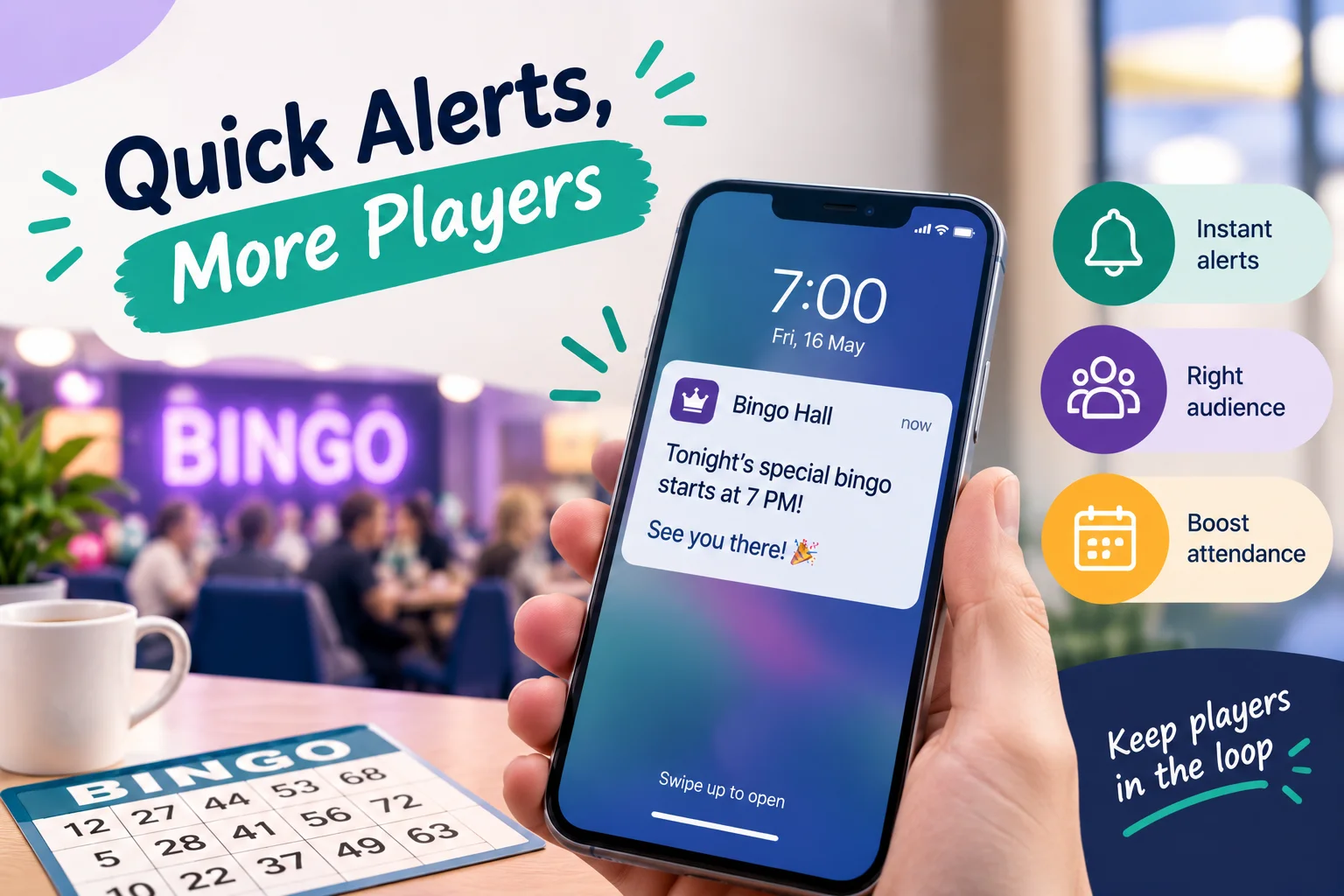
Don't forget to check out what's happening at the hall tonight!
with:
🎉 Tonight: Special Bingo Starts at 7 PM
The second message answers an important question:
Why should I care right now?
A strong notification can focus on:
- A special event
- A game starting soon
- A time-sensitive promotion
- A loyalty reward
- A jackpot announcement
- A limited-time opportunity
- A reminder about something the player has previously shown interest in
The message does not need to explain everything.
Its job is to prompt the next step.
Timing Is the Real Strategy
A push notification sent at the wrong time can be almost as ineffective as not sending one at all.
Send it too early, and the player may forget.
Send it too late, and they may already have made other plans.
The useful question is:
When does the player still have enough time to change tonight's plan?
That window will vary by audience and event.
A general evening game might justify a reminder earlier in the day, while a later event could support a notification closer to the start time.
For example:
Morning: Awareness
Tonight's Special Bingo Night - Save the Date
This gives the player an early reminder.
Afternoon: Decision
Tonight at 7 PM: Special Games + Loyalty Rewards
Now the player has enough information to decide whether they are going.
Pre-Event: Final Reminder
Doors Are Open - Tonight's Bingo Starts Soon
This is a much more immediate prompt.
The exact timing should be tested against your hall's audience and attendance patterns rather than treated as a universal formula.
Don't Send the Same Notification to Every Player
The biggest opportunity comes when push notifications are connected to player information.
A frequent player and an inactive player do not necessarily need the same message.
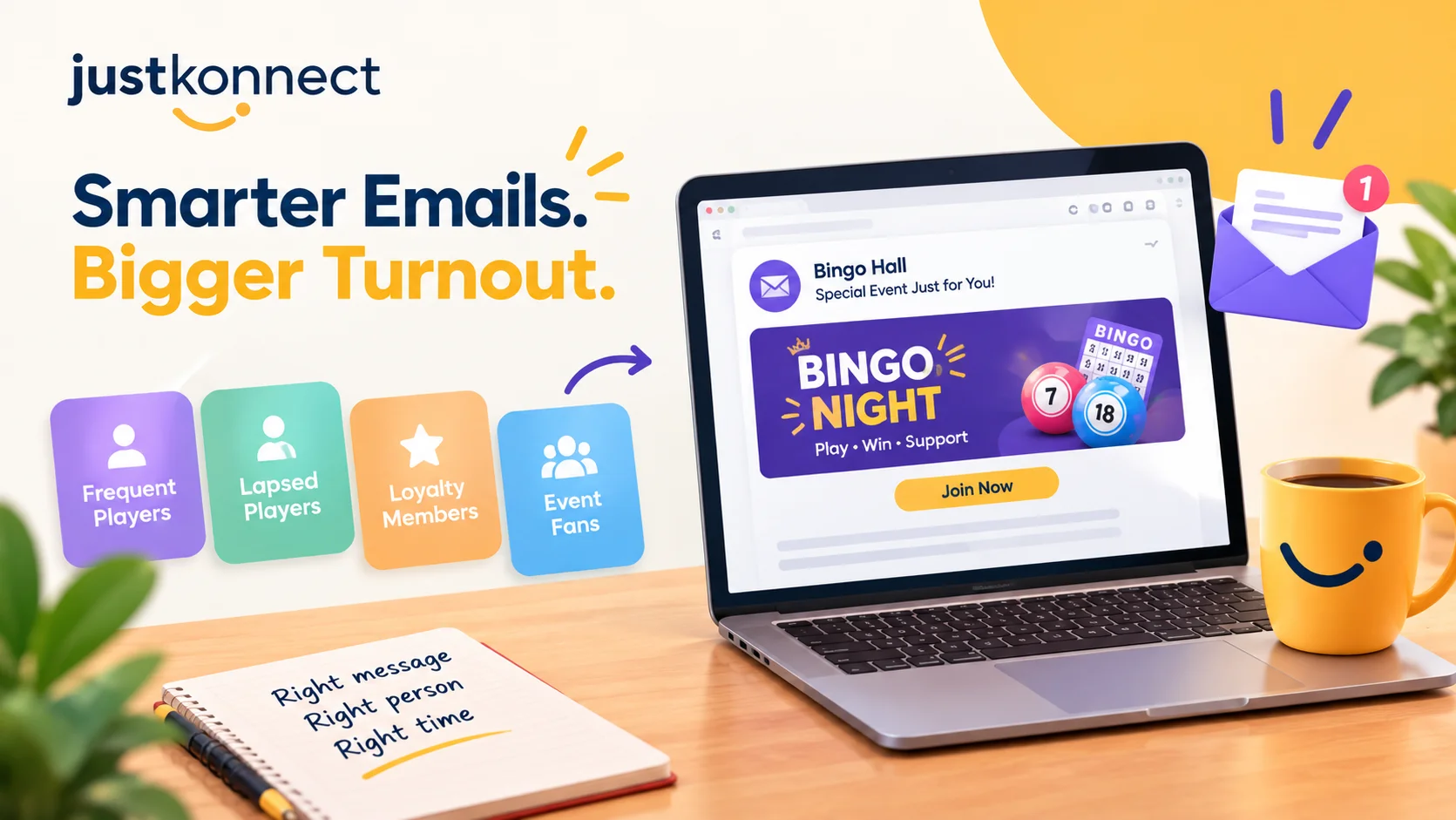
Consider three hypothetical groups.
The Regular
This player already visits frequently.
Their notification can focus on what is different tonight:
Your Usual Bingo Night Just Got More Interesting
The message assumes familiarity.
The Occasional Player
This player visits from time to time.
Their communication can focus more directly on the reason to make tonight another visit:
Looking for a Bingo Night Tonight? We've Got Something Special Planned
The Lapsed Player
This player has not visited recently.
The message may need to reintroduce the reason to return:
It's Been a While - See What's Happening Tonight
The event may be identical.
The communication context is not.
This is why push notifications become more useful when they sit alongside player profiles, attendance information, loyalty status, and engagement data.
JustKonnect's broader platform includes player profiles with visit history, loyalty information, contact details, and engagement data, allowing operators to segment players around attendance behaviour rather than treating them simply as a generic customer list.
Use Loyalty to Give the Notification a Second Layer
A notification can become more compelling when it connects attendance with progress.
Instead of simply saying:
Bingo Tonight at 7 PM
the communication could remind a player about a relevant loyalty opportunity:
Bingo Tonight at 7 PM - You're One Visit Away From Your Next Reward
Now the player has two reasons to consider attending:
The event itself + personal progress.
JustKonnect's loyalty tools are designed around visits and engagement, with players able to earn points and rewards based on attendance and other loyalty activity.
This creates a useful behavioural loop:
Visit → earn progress → receive relevant communication → return → earn more progress.
The notification becomes part of that loop rather than a standalone advertisement.
Same-Night Promotions Should Have a Clear Endpoint
Urgency works better when it is genuine.
If a promotion is available all week, presenting it every afternoon as “tonight only” can undermine trust.
But if an offer genuinely applies to a particular session, the notification can make that clear.
For example:
Tonight Only: Extra Loyalty Reward for Your Visit
The important element is that the player understands why the message needs attention now.
Avoid manufacturing urgency simply to generate clicks.
Give Players a Reason to Open the App
A notification should not always be the complete experience.
Sometimes its purpose is to bring the player back into the loyalty app.
For example:
Your Loyalty Reward Is Ready to View
or:
Check Your App for Tonight's Player Offer
This approach turns the push notification into the first step of a broader interaction.
The player receives the reminder, opens the app, sees the relevant information, and potentially takes action.
That can make the app more useful between bingo sessions rather than something players only open when they want to check their points.
Connect Push Notifications With the Player Journey
The strongest campaigns do not treat every player interaction as a separate marketing activity.
Instead, think about the journey.
Before the Visit
The player receives a relevant event or game reminder.
At the Hall
Their visit contributes to the loyalty relationship.
After the Visit
Their activity can inform future communication and rewards.
Before the Next Visit
A new notification gives them another reason to return.
This creates a cycle rather than a series of disconnected messages.
JustKonnect describes its push notification feature as working alongside attendance, rewards, and communication, with operators able to configure messages and then track and refine results based on attendance data.
That last part is important.
A notification campaign should not end when the message is sent.
Measure the Attendance Lift, Not Just the Click
A notification being delivered or opened does not necessarily mean it produced a visit.
For bingo operators, the more important question is:
Did the communication help change attendance?
Depending on the data available, useful measurements can include:
- Notification delivery
- Notification opens
- App interactions
- Offer engagement
- Reward activity
- Same-day visits
- Attendance by player segment
- Attendance compared with similar sessions
- Repeat visits following the campaign
Suppose a hall usually sees 180 players on a particular Tuesday.
After introducing a targeted same-day notification campaign, comparable Tuesdays average 205.
That difference does not automatically prove the notifications caused every additional visit. Other factors may have influenced attendance.
But it gives the operator something measurable to investigate.
The goal is to move from:
“We sent a notification.”
to:
“We tested a specific communication against an attendance problem and can see what happened afterward.”
Test the Trigger Before You Test the Wording
Operators often focus heavily on the copy.
But the bigger question may be who receives the message and why.
Test different triggers such as:
Event trigger:
Send a reminder before a major event.
Attendance trigger:
Remind players about an upcoming session based on their normal visit behaviour.
Loyalty trigger:
Notify players when they are approaching a reward milestone.
Re-engagement trigger:
Reach out after a defined period without a visit.
Time trigger:
Send a same-day reminder at a carefully selected point before the evening session.
Once the trigger is working, test different messages.
That gives you a clearer understanding of what actually influences behaviour.
Avoid Turning the App Into a Notification Machine
More communication does not necessarily mean more attendance.
If players receive constant alerts for minor updates, they may begin dismissing notifications without reading them.
Use push notifications selectively.
A useful internal test is:
Would the player be disappointed if they missed this information?
If the answer is no, it may not deserve a push notification.
Save the channel for information that is genuinely timely, useful, or personally relevant.
A Practical Same-Night Campaign
Imagine a charity bingo hall has a quieter Wednesday evening.
The operator has a loyalty app and wants to improve attendance without sending the same promotion to everyone.
A simple campaign could look like this:
Morning:
Identify players who normally attend midweek and those who have recently become less active.
Early afternoon:
Send a short event reminder to the appropriate audience.
Late afternoon:
Send a more specific notification highlighting the reason to attend tonight.
Before the session:
Send a final reminder only where it adds genuine value.
After the session:
Compare attendance and engagement with similar nights.
Following week:
Adjust the audience, timing, or message based on what happened.
The important part is that the campaign starts with an attendance objective.
The notification is simply one mechanism for influencing it.
What Generic Push Tools Often Miss
A generic push notification platform can send a message.
But bingo operators need to think beyond message delivery.
They need to understand:
- Who the player is
- How often they visit
- When they were last in the hall
- What loyalty activity they have
- Which campaigns they engage with
- Whether communication is affecting attendance
JustKonnect positions Push Notifications specifically around bingo attendance, loyalty, event reminders, and player engagement rather than generic retail messaging.
That distinction matters because the useful outcome is not simply “notification sent.”
It is “player engaged, and attendance influenced.”
Common Push Notification Mistakes Bingo Halls Should Avoid
Sending Too Many Notifications
Constant alerts reduce the importance of genuinely useful messages.
Writing Vague Messages
Players should understand the reason for the notification quickly.
Ignoring Timing
A good message sent at the wrong point in the day may have little effect on attendance.
Treating Everyone the Same
Frequent players, occasional visitors, and lapsed players can have very different motivations.
Making Every Notification a Discount
Not every attendance opportunity needs a price-based incentive. Events, loyalty progress, jackpots, recognition, and experiences can also provide reasons to visit.
Measuring Only Opens
An opened notification is an engagement signal, not proof of an attendance lift.
Failing to Learn From Results
Every campaign creates information that can improve the next one. If operators never review the results, they are repeatedly guessing.
Frequently Asked Questions
What are push notifications in a bingo loyalty app?
Push notifications are messages delivered through a mobile app to communicate timely information such as event reminders, alerts, promotions, loyalty updates, or other relevant player messages.
Can push notifications help increase same-night bingo attendance?
They can support same-night attendance by reminding players about an event or opportunity while they still have time to decide whether to visit. The actual impact depends on factors such as the audience, offer, timing, event, and overall campaign strategy.
When should a bingo hall send a same-night push notification?
There is no single ideal time for every hall. Test communication windows based on when players typically make their attendance decisions and how much time they need to travel and plan their evening.
Should every player receive the same push notification?
Not necessarily. Segmenting communication around attendance patterns, loyalty status, engagement, or other useful player information can make messages more relevant.
Can push notifications be connected to loyalty rewards?
Yes. Push notifications can be used to remind players about loyalty progress, rewards, events, or other engagement opportunities. JustKonnect's platform is designed to connect communication with attendance and loyalty activity.
How should bingo halls measure push notification performance?
Track more than delivery and opens. Where data is available, compare notification engagement with offer activity, loyalty actions, same-day attendance, and repeat visits to understand whether campaigns are contributing to meaningful player behaviour.
Make the Last Few Hours Before Game Time Count
A player does not always need another advertisement.
Sometimes they simply need a timely reminder that gives them a reason to act.
That is where push notifications can become valuable for bingo halls. Instead of relying entirely on broad promotional campaigns planned days, operators can use timely app communication to stay connected with players when tonight's attendance decision is still being made.
The strongest approach is not to send more notifications.
It is to send fewer, more relevant messages to the right players at the right moment, then measure what happens afterward.
JustKonnect's Push Notifications feature is built around that attendance-focused approach, allowing operators to configure messages, launch them to players, track results, and refine communication using attendance data.
If your loyalty app is already part of your player relationship, the next opportunity is to make it useful at the exact moment a player is deciding whether to come through the doors.
Explore JustKonnect Push Notifications and see how timely, bingo-focused player communication can fit into a broader loyalty and attendance strategy.