A bingo hall may have the same players coming through the doors every week, but those players are not all at the same point in their relationship with the venue.
One person signed up yesterday.
Another has attended every Friday for six months.
Someone else hasn't visited since last month.
A VIP player may need a completely different message from someone who has just joined the loyalty programme.
Then there are the moments when everyone needs to know something now—a major event, an important announcement, or a last-minute promotion.
This is where bingo operators often have to choose between two very different SMS approaches: SMS drip campaigns and SMS blasts.
They are not interchangeable.
A blast is designed for a broad, immediate communication.
A drip campaign is designed to deliver a series of messages over time, often triggered by a customer's action, status, or lack of activity.
The most effective bingo marketing strategy doesn't necessarily choose one.
It knows when to use each—and how to make them work together.
Start With the Situation, Not the Software
Imagine two customers.
Player One
They join your loyalty programme on Monday.
Should they receive the same message as 3,000 existing players on Friday?
Probably not.
They are new and need to be introduced to the venue, the programme, and what they can do next.
Player Two
They regularly attend Friday bingo but haven't been in for three weeks.
They don't need a welcome message.
They may need a reason to return.
Now consider a third situation.
Friday Night Special
Your venue has announced a special bingo event for tonight.
Thousands of eligible players may need to know about it quickly.
That is where a blast can make sense.
Three situations.
Three different communication needs.
And that is the simplest way to understand the difference between drip campaigns and blasts.
What Is an SMS Drip Campaign?
An SMS drip campaign is a sequence of messages delivered according to a predefined schedule, trigger, or customer action.
Instead of sending one message to everyone at the same time, the system can communicate with people at different stages of their journey.
A simple example might be:
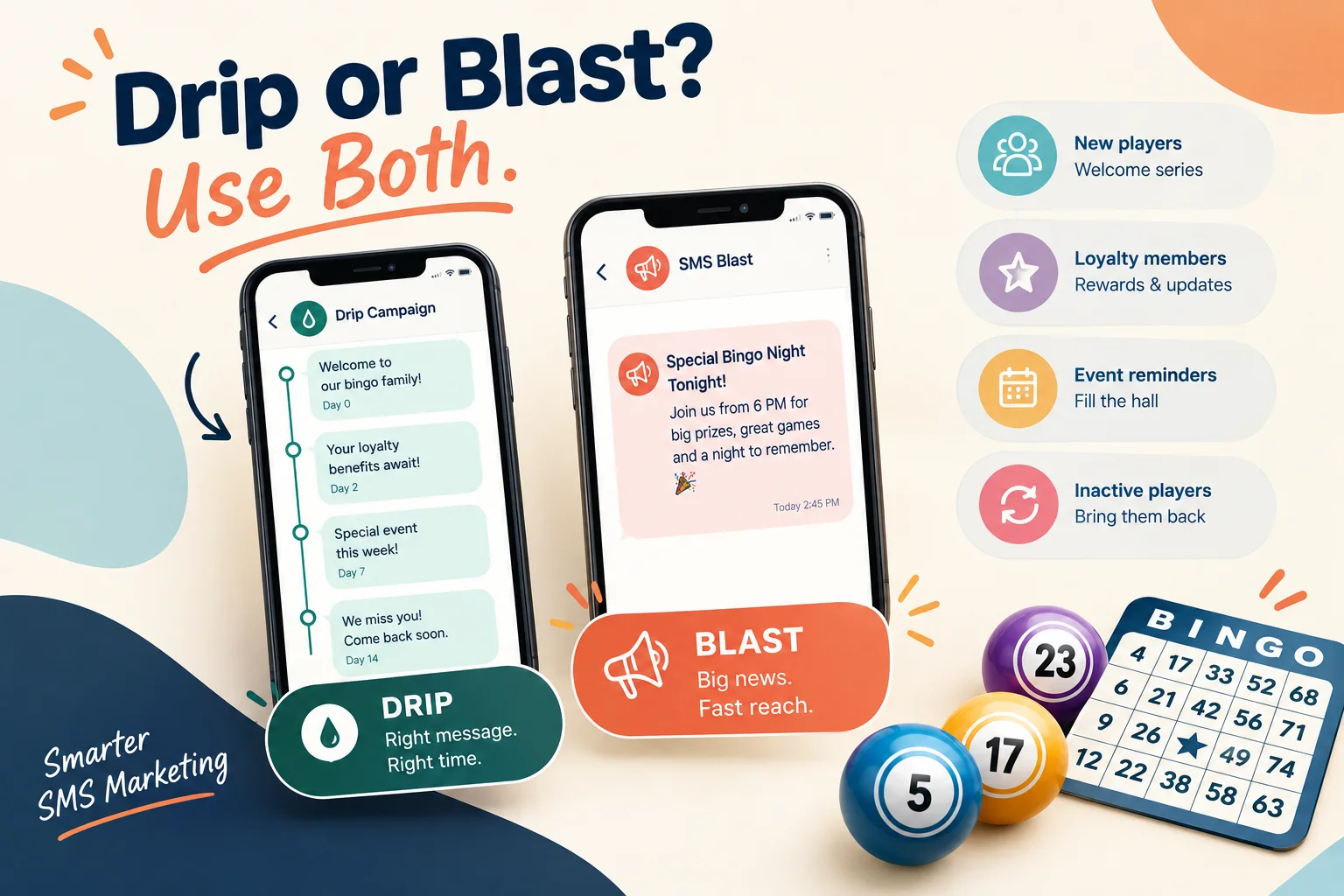
Day 0: Welcome message
Day 2: Introduction to the loyalty programme
Day 7: Invitation to an upcoming event
Day 14: Engagement reminder
The customer receives a planned sequence rather than one isolated communication.
For a bingo hall, that can be useful because player relationships develop over time.
A Drip Campaign Follows the Player
A good drip campaign answers:
What happened?
Then:
What should happen next?
For example:
A player signs up.
↓
Welcome SMS.
↓
Player attends their first session.
↓
Follow-up communication.
↓
Player earns loyalty points.
↓
Reward or progress notification.
↓
Player becomes inactive.
↓
Re-engagement message.
The communication changes because the player's situation changes.
That is fundamentally different from a standard blast.
What Is an SMS Blast?
An SMS blast is a message sent to a broad audience, usually around the same time.
It is useful when the same information is relevant to a large group of customers.
For example:
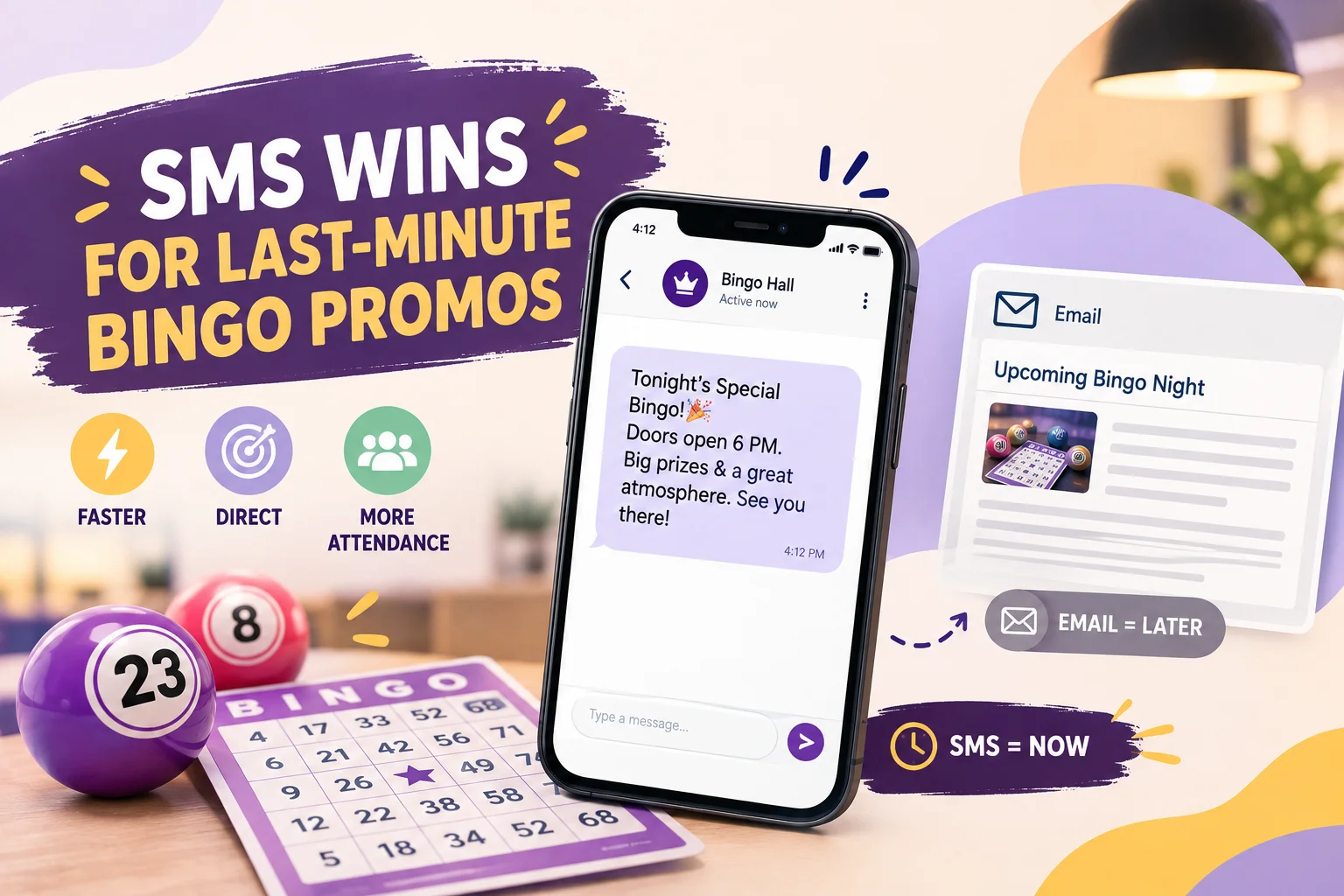
Special Bingo Night is tonight! Join us from 6 PM for an evening of bingo, entertainment and prizes. Check the details and plan your visit.
The message has a single purpose.
Everyone receiving it has a reason to know about the event.
A blast is therefore particularly useful for time-sensitive or widely relevant communication.
JustKonnect supports SMS communication to a full player list or targeted segments, making broad campaigns useful without requiring every message to be treated as a one-to-one communication.
The Difference in One Sentence
If you need a simple distinction:
SMS drip = the right message at the right stage.
SMS blast = the same important message to a broad audience at the right moment.
Neither is automatically better.
They solve different problems.
Where SMS Drips Make More Sense
Drip campaigns become particularly valuable when the communication depends on what a player has done—or hasn't done.
New Player Welcome Series
Someone has just joined your database.
Rather than sending one generic welcome message and forgetting about them, create a short sequence.
For example:
Immediately: Welcome them.
A few days later: Explain the loyalty programme.
Later: Introduce an upcoming event.
After their first visit: Encourage another visit.
The objective is to turn registration into participation.
New Player Conversion
A new member who has never visited is different from someone who has already attended several sessions.
A drip campaign can help bridge that gap.
The messages can gradually introduce reasons to visit without requiring staff to manually remember who needs to be contacted.
Lapsed Player Re-Engagement
This is another natural use case.
Suppose your system identifies players who haven't visited within a defined period.
Instead of sending a single message to every inactive customer, you can create a sequence.
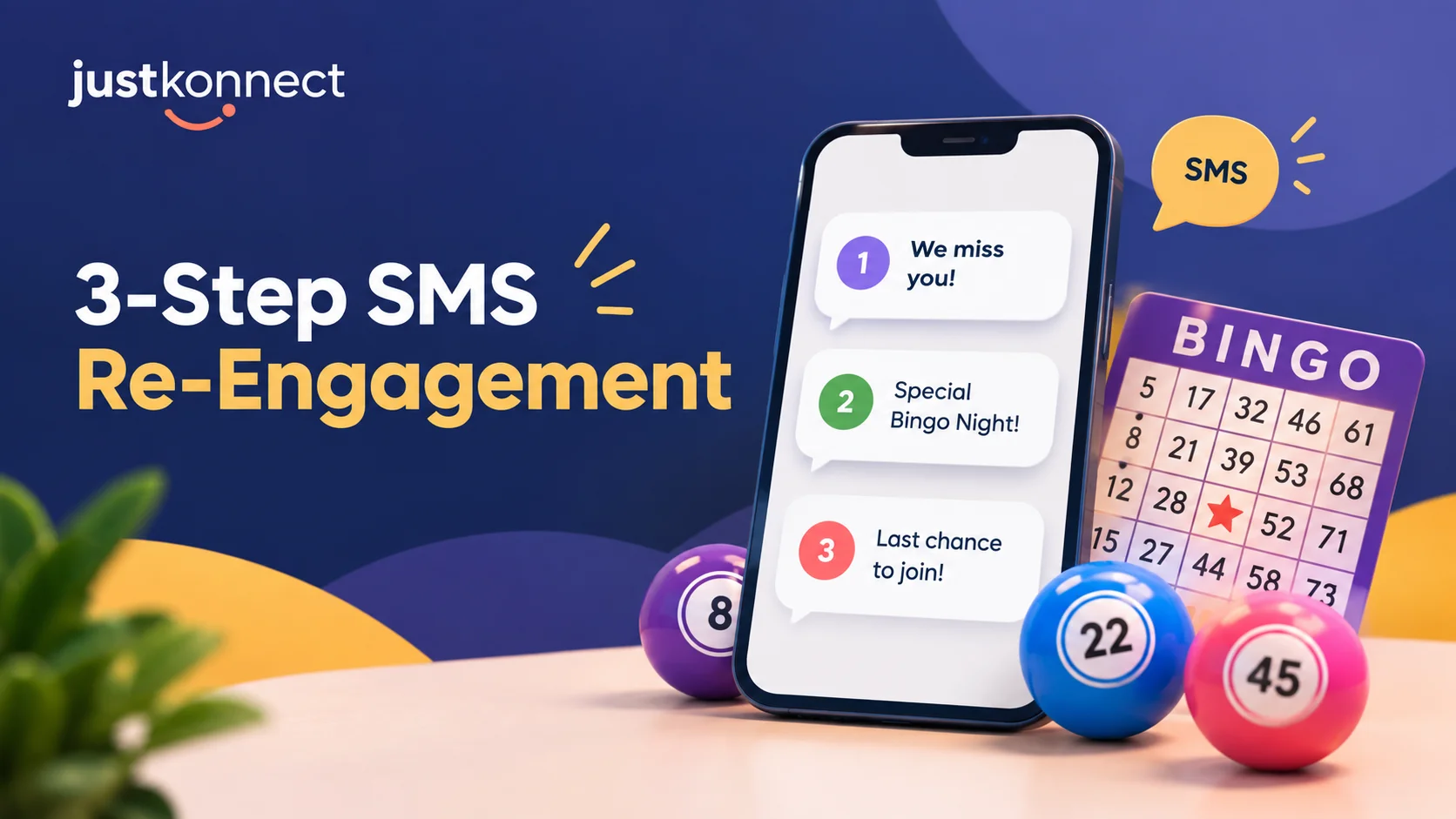
First message: Friendly reminder.
Second message: Relevant reason to return.
Third message: Final re-engagement communication.
The timing and content can be adjusted to your customer strategy.
JustKonnect specifically describes automated re-engagement sequences based on inactivity thresholds, including 7-, 14-, and 30-day logic.
Where SMS Blasts Make More Sense
Blasts are better suited to moments where the communication needs to reach a broad audience quickly.
Major Bingo Nights
If a special event is happening tonight or tomorrow, a broad SMS can put the information directly in front of your player base.
Jackpot Announcements
When an important jackpot or special game needs promoting, a timely blast can create awareness across a wider audience.
Charity Fundraisers
A major fundraising event may be relevant to a large portion of your customer community.
SMS can help promote the event and remind people as the date approaches.
Schedule Announcements
If the venue has an important change that customers need to know, a broad message may be more appropriate than waiting for individual automated journeys.
Last-Minute Opportunities
Sometimes the opportunity only becomes obvious a few hours before a session.
A blast can be useful when you need to communicate at scale without building a new customer journey.
The Biggest Mistake: Treating Drips and Blasts as Competitors
Some operators think they have to choose one.
That creates an unnecessary either/or decision.
A better approach is to give them separate jobs.
Think about a new player.
They could receive a drip campaign after signing up.
Then, when your venue announces a major charity night, that same player could receive a relevant blast if they are eligible for that communication.
The drip manages the relationship.
The blast communicates the event.
Both have a place.
A Realistic Week at a Bingo Hall
Let's say your venue has:
- A regular Tuesday session
- A Friday special
- A Saturday fundraiser
- A loyalty programme
- Several inactive players
- New members joining throughout the week
Your communication might look like this.
Monday
Drip: New-player welcome messages continue automatically.
Tuesday
Blast: Relevant players receive a session reminder.
Wednesday
Drip: Inactive players receive a re-engagement message.
Thursday
Blast: Promote Friday's special event.
Friday
Drip: Eligible players receive a loyalty-related message based on their activity.
Saturday
Blast: Promote the fundraiser to the appropriate audience.
The important point isn't the exact schedule.
It is that different types of communication have different purposes.
Don't Let Automation Make Your Marketing Feel Robotic
A drip campaign can become annoying if it is written like a machine.
For example:
Welcome to our programme.
Here is another message.
Here is another promotion.
Here is another reminder.
The customer may technically be receiving relevant communication, but it doesn't feel relevant.
Better drip campaigns respond to context.
If someone has already visited, don't keep treating them as a first-time customer.
If someone has already redeemed a reward, don't keep telling them to claim it.
If someone becomes highly active, their communication may need to change.
Automation should reduce manual work without removing customer awareness.
Use Customer Actions as the Starting Point
The strongest drip campaigns often begin with a meaningful event.
For example:
New signup
→ Start welcome sequence.
First visit
→ Start post-visit sequence.
Reward unlocked
→ Send reward communication.
Achievement completed
→ Send recognition message.
No visit for a defined period
→ Start re-engagement sequence.
VIP status reached
→ Send appropriate tier communication.
The system does the repetitive work while operators define the strategy.
Blasts Should Still Be Thoughtful
Because blasts can reach large audiences, it is tempting to make them the easiest possible option:
Select all → Type message → Send.
That's exactly where problems can begin.
Before sending a blast, ask:
Does everyone need this information?
Is this message relevant to this audience?
Has this group already received another campaign?
Is the timing appropriate?
Is the call to action clear?
Are consent and applicable communication requirements being followed?
A broad message still needs careful planning.
One Database Doesn't Mean One Audience
A bingo hall might have 5,000 player records.
That doesn't mean it has one audience.
Within those 5,000 people, there may be:
- First-time visitors
- Frequent players
- VIPs
- Loyalty members
- Lapsed players
- Event attendees
- Customers who regularly attend particular sessions
This is why segmentation matters to both drip and blast marketing.
A blast can still be targeted.
A drip can still be highly relevant.
The difference is primarily how and when the communication is delivered, not whether the audience is carefully selected.
The Most Useful Combination: Drip + Blast
The real power appears when the two approaches operate together.
Consider a charity bingo event.
Two Weeks Before
A broad announcement creates awareness.
Blast.
One Week Before
Relevant players receive another event reminder.
Blast or targeted campaign.
Three Days Before
Players who have shown interest receive a reminder.
Targeted message.
Event Day
Attendees receive the appropriate final information.
Blast or targeted message.
After the Event
Participants receive a follow-up.
Drip or triggered communication.
Now the customer isn't experiencing “SMS marketing.”
They're experiencing a sequence of useful communications around an event.
Measure the Two Campaign Types Differently
This is an area where operators can easily make the wrong comparison.
A blast and a drip don't necessarily have the same objective.
For a blast promoting a Friday event, you might measure:
- Delivery
- Engagement
- Registrations
- Attendance
- Offer redemption
- Campaign cost
For a drip campaign, you might measure:
- Sequence completion
- Repeat visits
- Reactivation
- Loyalty engagement
- Reward activity
- Conversion from signup to first visit
The question isn't:
“Which type gets the highest response?”
The better question is:
“Did this campaign achieve the objective it was designed for?”
Look for the Point Where Players Drop Off
Drip campaigns give operators another useful piece of information.
Suppose a four-message welcome sequence produces these results:
Message 1: Strong engagement
Message 2: Moderate engagement
Message 3: Lower engagement
Message 4: Very low engagement
That could suggest the sequence is becoming less relevant or too frequent.
The answer isn't necessarily to send more messages.
You might shorten the sequence, change the content, adjust the timing, or introduce a more relevant trigger.
Automation gives you the opportunity to test these decisions systematically.
Keep an Eye on Message Fatigue
The danger of having both systems is obvious.
A player could receive:
- A welcome drip
- A loyalty message
- A promotional blast
- A reminder
- A re-engagement campaign
all within a short period.
From the operator's perspective, these are separate campaigns.
From the player's perspective, they are all messages from the same venue.
That is why communication frequency needs to be considered across the whole programme.
A centralised approach makes this easier to manage than having separate teams sending messages from separate systems.
What Spreadsheets Can't Easily Handle
You can technically plan a drip campaign in a spreadsheet.
You can write:
| Player | Day | Message | Status |
| Player A | Day 1 | Welcome | Sent |
| Player A | Day 4 | Loyalty | Pending |
| Player A | Day 10 | Event | Pending |
But now imagine doing that for thousands of players.
Then add:
- New signups
- Visits
- Reward activity
- Inactivity
- Opt-outs
- Different segments
- Multiple campaigns
- Different schedules
The spreadsheet becomes the thing you're managing rather than the players.
Automation exists to remove that administrative burden.
Build Drip Campaigns Around Simple Journeys
You don't need twenty automated sequences on day one.
Start with the journeys that have obvious business value.
Journey 1: New Member
Sign-up → Welcome → Loyalty introduction → First-visit encouragement.
Journey 2: Lapsed Player
Inactivity → Reminder → Relevant incentive or event → Follow-up.
Journey 3: Loyalty Progress
Milestone → Progress notification → Reward → Next milestone.
Journey 4: Event Engagement
Registration → Reminder → Event → Follow-up.
Once these are working, you can add more sophisticated journeys.
Let Blasts Handle the Big Moments
Keep your broad campaigns focused on events that genuinely deserve wider attention.
That might include:
Major fundraiser
Special bingo night
Seasonal event
Important venue announcement
Time-sensitive promotion
This prevents the blast channel from becoming a daily stream of generic promotions.
When customers know that a message is likely to contain something relevant, broad communication becomes more valuable.
Compliance Still Matters With Both
Whether a message is automated or sent as a blast, operators need to follow applicable rules concerning consent, opt-outs, privacy, and marketing communications.
Automation does not remove that responsibility.
In fact, automated campaigns make it particularly important to understand what triggers a message, who qualifies for it, and how communication preferences are respected.
Your SMS strategy should therefore include compliance considerations from the beginning, rather than treating them as an afterthought.
How JustKonnect Fits Into the Picture
For bingo operators, the challenge isn't simply choosing between a drip campaign and an SMS blast.
It is managing both without creating another collection of disconnected processes.
JustKonnect brings SMS marketing and automation into a platform built around bingo operations, with player profiles, attendance information, loyalty activity, segmentation, and messaging working within the broader system.
Its SMS Drip Campaigns approach is particularly relevant when communication needs to happen automatically based on player journeys, while its broader SMS capabilities can support campaigns sent to larger audiences when a venue has something important to communicate.
That gives operators a way to think beyond individual SMS sends and start building a communication system around actual player behaviour.
A Simple Decision Framework
When you're unsure which approach to use, start with one question:
“Does this message depend on something the player did?”
If yes, consider a drip campaign.
For example:
They signed up.
They visited.
They earned a reward.
They became inactive.
They reached a milestone.
If the answer is:
“Does almost everyone need to know this now?”
Consider an SMS blast.
For example:
Tonight's special event.
Major charity fundraiser.
Important schedule announcement.
Time-sensitive promotion.
And if both apply?
Use both.
Frequently Asked Questions
What is the difference between an SMS drip and an SMS blast?
An SMS drip campaign sends a planned sequence of messages based on timing, triggers, or player activity. An SMS blast sends a message to a broad audience, generally at the same time.
When should a bingo hall use an SMS drip campaign?
Drips are useful for ongoing customer journeys such as new-member onboarding, post-visit communication, loyalty engagement, and lapsed-player reactivation.
When should a bingo hall use an SMS blast?
Blasts are useful for broad, time-sensitive communication such as major bingo nights, charity events, seasonal promotions, important announcements, and relevant last-minute opportunities.
Can SMS drips and blasts be used together?
Yes. They can serve different purposes within the same player journey. A blast might announce an event to a broad audience while a drip sequence handles follow-up communication based on player activity.
How can bingo halls avoid sending too many messages?
Coordinate campaigns across the entire SMS programme, segment audiences carefully, avoid unnecessary broadcasts, and review communication frequency regularly.
What should bingo halls measure?
Measure each campaign against its purpose. For blasts, this could include engagement, registrations, attendance, and redemptions. For drips, useful measures can include repeat visits, reactivation, loyalty activity, and journey conversion.
The Difference Is Small on the Screen, but Big in the Strategy
Both approaches ultimately produce the same thing: an SMS appearing on a customer's phone.
What happens behind that message is very different.
A blast says:
“This is important to a large group of our players right now.”
A drip says:
“This is the next useful message for this player based on where they are in their journey.”
A bingo hall needs both perspectives.
One helps you respond to the moments happening across the venue.
The other helps you build relationships that continue between those moments.
When they are planned together, SMS stops being a collection of promotional texts and becomes a structured part of player engagement.
For bingo operators looking to automate player journeys while keeping broader SMS communication organised, JustKonnect's SMS Drip Campaigns feature is a useful next step to explore.
Use blasts for the moments that matter to everyone. Use drips for the journeys that matter to each player.