There is a marketing channel sitting inside almost every successful bingo hall.
It doesn't require an advertising budget.
It doesn't need a complicated campaign calendar.
And it certainly doesn't depend on another social media post.
It's your existing players.
Think about what happens when a regular player tells a friend, "You should come with me next Friday."
That recommendation carries something a paid advertisement can't easily replicate: personal trust.
The friend already knows the invitation comes from someone they know. They have a reason to visit. And the existing player has a reason to bring them along.
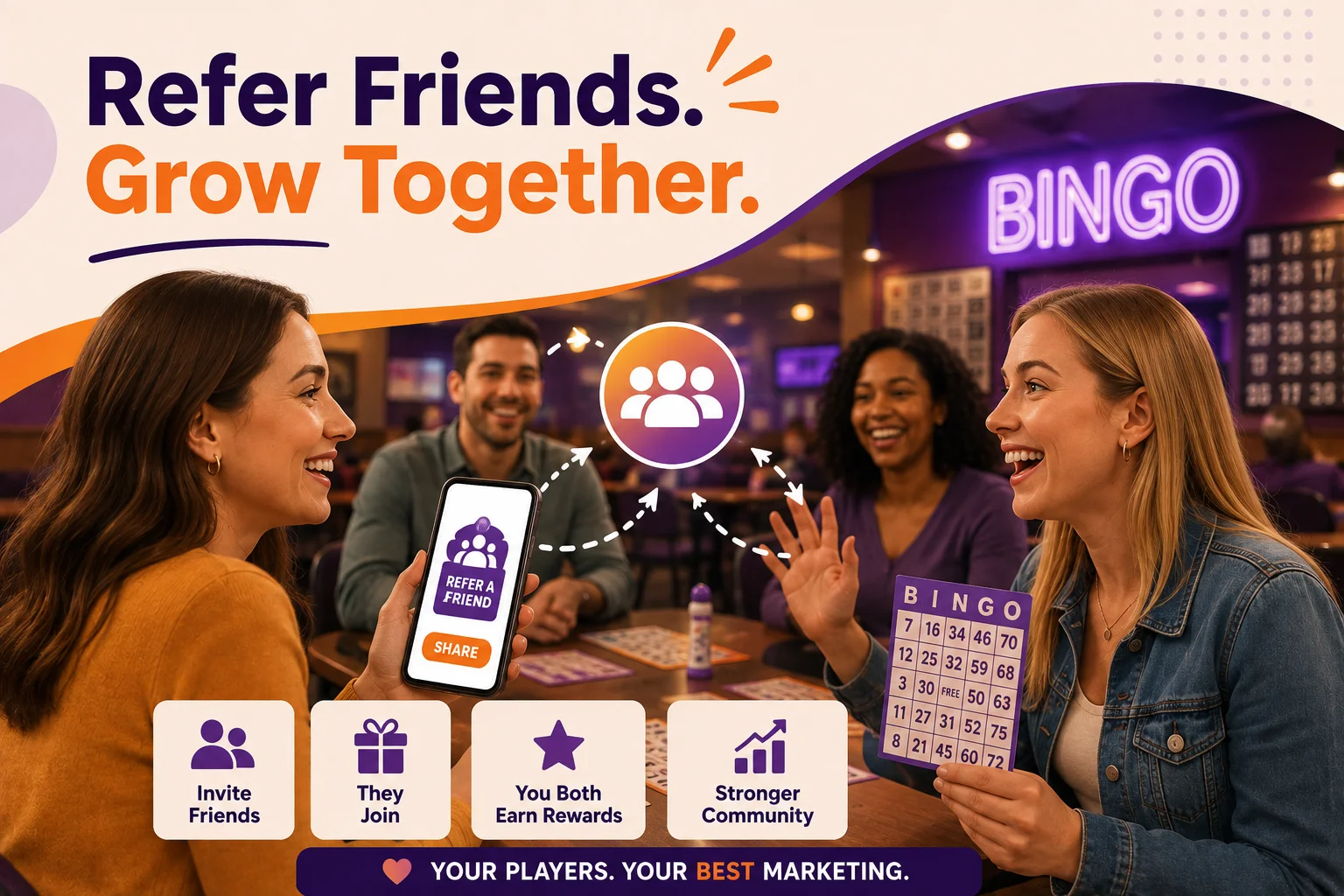
A well-designed player referral programme turns that informal word-of-mouth into a structured acquisition strategy.
Instead of hoping loyal members naturally recommend the venue, operators can give them a simple way to refer friends, track those referrals, and reward the behaviour.
The result is a marketing channel that can grow alongside the customer community.
Why Recommendations Can Be More Powerful Than Another Promotion
Bingo is inherently social.
Players don't simply arrive, complete a transaction, and leave. They come for entertainment, conversation, community, events, and shared experiences.
That makes personal recommendations particularly valuable.
A new customer may ignore a generic advertisement.
They are less likely to ignore a message from a friend saying:
"We're going to the bingo hall tonight. Come with us."
The referral has already removed some of the uncertainty around trying somewhere new.
The potential player knows:
- Who they will go with
- What to expect
- Where they're going
- Why they're being invited
A referral programme simply gives that natural behaviour a structure.
Your Loyal Players Already Know How to Sell the Experience
The best referral advocates aren't necessarily professional marketers.
They're regular players who genuinely enjoy the venue.
They can explain things that advertising often struggles to communicate:
- What the atmosphere is like
- Which nights they enjoy
- Which events are worth attending
- Why they keep coming back
- What makes the venue different
That personal context can make a referral much more persuasive than a generic promotional message.
Instead of the business saying:
"Come and try our bingo hall."
The customer says:
"Come with me. You'll enjoy this."
That is a fundamentally different type of marketing.
What Is a Player Referral Programme?
A player referral programme gives existing customers an incentive to introduce new customers to the venue.
The basic journey is simple:
Existing player → Referral → New player → First visit → Reward
The reward can go to the referring player, the new customer, or both.
For example:
"Invite a friend. When they make their first qualifying visit, you both receive a loyalty reward."
The important part isn't the exact reward.
It's creating a clear connection between advocacy and recognition.
The Best Referral Programmes Reward Both Sides
Imagine two approaches.
Option One
Refer a friend and receive a reward.
The new customer receives nothing.
Option Two
Invite a friend and, when they complete their first qualifying visit, both of you receive a reward.
The second approach gives the new customer an immediate reason to participate too.
It creates a shared experience rather than making the referral feel like a sales request.
For a social venue such as a bingo hall, that can be particularly effective.
Make the Referral Process Almost Effortless
A referral programme shouldn't require customers to complete a complicated form.
If the process involves too many steps, participation will drop.
A simple experience might look like:
- Player opens their loyalty account.
- They select "Refer a Friend."
- They share a referral link or code.
- Their friend registers.
- The friend visits the venue.
- The referral is recorded.
- The appropriate reward is issued.
The fewer obstacles between "I want to invite someone" and "my friend has joined," the better.
Don't Reward Referrals Too Early
One important distinction is the difference between a referral and a qualified customer.
Someone filling out a registration form doesn't necessarily mean you've acquired a valuable player.
A stronger structure could require the referred customer to:
- Complete registration
- Make a first qualifying visit
- Participate in a qualifying event
- Remain active for a defined period
This protects the programme from rewarding low-quality or incomplete referrals.
The goal isn't to generate the highest number of referral links.
It's to generate genuine new players.
Make the Reward Match the Behaviour You Want
The reward should reinforce your business objective.
If you want first visits, reward the first qualifying visit.
If you want repeat attendance, make the reward unlock after a second visit.
If you want loyalty programme registrations, connect the reward to membership.
For example:
Referral completed: Both players receive 250 loyalty points.
Second visit completed: Referring player receives an additional reward.
Now the referral programme isn't just acquiring customers.
It's helping move them towards repeat engagement.
Referral Programmes Can Work Alongside VIP Tiers
Your most loyal players are often your strongest potential advocates.
That's where referral marketing and VIP programmes can complement one another.
For example:
Standard Members
Receive a basic referral reward.
Gold Members
Receive an enhanced reward for qualified referrals.
Platinum Members
Receive exclusive referral incentives or recognition.
This gives VIP members another reason to remain engaged while turning their loyalty into an acquisition channel.
The programme becomes part of the overall customer journey rather than an isolated promotion.
Use Digital Tracking Instead of Guesswork
A paper referral card might tell you that someone referred a friend.
A connected digital referral programme can tell you much more.
Operators can potentially track:
- Who made the referral
- Who was referred
- When the referral occurred
- Whether the new customer registered
- Whether they completed a qualifying visit
- Whether the reward was issued
- Whether the referred customer returned
This information makes the programme measurable.
It also helps identify your most effective advocates.
Your Best Referrers Are Worth Understanding
Suppose your venue has 2,000 loyalty members.
Only 100 regularly refer friends.
Those 100 customers deserve attention.
You may discover that your strongest advocates:
- Visit more frequently
- Participate in more events
- Have higher loyalty status
- Engage with SMS campaigns
- Bring friends to specific sessions
This tells you something important.
Your best advocates aren't simply customers.
They're community connectors.
Understanding who they are can help you design better campaigns around them.
A Bingo Hall Example
Imagine a bingo hall has a large base of regular Friday-night players but wants to attract more first-time visitors.
The operator launches a referral programme:
"Bring Someone New: When your friend joins and completes their first qualifying visit, you both receive a loyalty reward."
Sarah, a regular player, shares her referral link with two friends.
One friend registers and attends.
The system records the referral.
Sarah receives her reward.
The new player joins the loyalty programme.
A few weeks later, that player returns without another referral incentive.
Now the original referral has created more than one visit.
It has created the beginning of a customer relationship.
Measure More Than Referral Numbers
A programme can generate hundreds of referrals and still produce disappointing results.
The metrics that matter include:
Referral Conversion Rate
How many referrals become qualified new customers?
First-Visit Rate
How many referred customers actually visit?
Repeat Visit Rate
How many return after their initial visit?
Referral Revenue
What value do referred customers generate over time?
Advocate Performance
Which existing members generate the most successful referrals?
These measurements help distinguish between a programme that generates activity and one that generates meaningful growth.
Don't Turn Referrals Into a Spam Machine
A referral programme can become counterproductive if customers feel pressured to repeatedly invite everyone they know.
Keep the experience natural.
Give members easy tools to share the programme, but avoid excessive reminders.
Good referral communication should feel like:
"Think a friend would enjoy this? Invite them."
Not:
"Refer five people today!"
The difference matters.
Your customers should feel like they're sharing something they enjoy rather than becoming unpaid salespeople.
Use Referrals Around Events and Experiences
Some referral opportunities are naturally stronger than others.
A special event can give players an immediate reason to invite someone.
Examples include:
- Charity fundraising nights
- Anniversary events
- Themed bingo sessions
- Jackpot events
- Holiday celebrations
- Community nights
- Member appreciation events
Instead of promoting only the referral programme, connect referrals to something customers already want to attend.
For example:
"Bringing a friend to our charity night? Refer them through your member account and unlock a special reward when they attend."
Now the referral has a clear context.
What About Fraud and Duplicate Referrals?
Digital referral programmes also need sensible controls.
Without safeguards, someone could attempt to refer duplicate accounts simply to collect rewards.
Operators should consider rules around:
- Existing customers
- Duplicate accounts
- Self-referrals
- Reward eligibility
- Qualifying visits
- Referral limits
Automated tracking makes these rules easier to enforce than manual referral cards.
The objective is to keep the programme generous enough to encourage genuine advocacy while protecting the business from abuse.
How JustKonnect Turns Word-of-Mouth Into a Trackable Growth Channel
The strongest referral programmes combine a simple customer experience with reliable tracking behind the scenes.
JustKonnect Referral Program allows bingo halls and other physical venues to create structured referral campaigns that connect existing players with new customer acquisition. Operators can establish referral rules, track activity, reward successful referrals, and connect the programme with customer profiles and wider loyalty activity.
Because referrals can work alongside CRM, loyalty points, VIP tiers, SMS marketing, gamification, and analytics, operators can see how referred players progress after their first visit instead of treating the referral as the end of the campaign.
That creates a much more useful marketing loop:
Advocate → Referral → First Visit → Loyalty → Repeat Attendance
Frequently Asked Questions
What is a player referral programme?
A player referral programme rewards existing customers for introducing new customers to a venue. A successful referral typically requires the new player to complete a defined action, such as registration or a qualifying first visit.
Why are referrals effective for bingo halls?
Bingo is a social and community-driven experience, so personal recommendations can carry significant trust. Players can introduce friends to the venue in a way that feels more authentic than traditional advertising.
Should both the referrer and new player receive a reward?
Rewarding both sides can create a stronger incentive because the existing player has a reason to invite someone and the new player has a reason to complete the referral journey.
What should count as a successful referral?
Rather than rewarding every referral link or registration, venues can require a meaningful action such as a first qualifying visit, membership registration, or another defined engagement milestone.
How can bingo halls measure referral programme performance?
Operators can track referral volume, conversion rate, first visits, repeat visits, reward redemptions, and the longer-term value of referred customers.
Your Customers Can Become Part of Your Growth Strategy
Advertising can tell people that your bingo hall exists.
Your loyal players can tell them why they should come.
That's what makes referral marketing so valuable.
The customer already knows the experience. They already have a relationship with the venue. And when they invite someone they know, they're transferring some of that trust to a potential new player.
A digital referral programme simply gives that behaviour a structure that can be measured, rewarded, and improved.
Instead of treating word-of-mouth as something that happens by chance, operators can turn it into a deliberate part of their customer acquisition strategy.
Explore JustKonnect Referral Program to see how referral tracking, rewards, customer profiles, loyalty programmes, and engagement tools can help turn your most loyal players into a measurable source of new customers.