For generations, the bingo card has been the centre of the experience.
Players buy their tickets, listen for the numbers, mark their cards, and wait for that final call.
But the card isn't the only thing that can create excitement.
Modern bingo halls are discovering that game mechanics can extend beyond the game itself. Progress bars, achievement badges, challenges, rewards, VIP levels, digital punch cards, spin-to-win experiences, and other interactive features can give players additional reasons to engage with the venue.
The important distinction is that gamification doesn't replace bingo.
It adds another layer around it.
Instead of asking customers to return only because they want to play, operators can create a wider experience where attendance, participation, loyalty, and progress all contribute to the feeling of achievement.
That can make the relationship between player and venue much stronger.
Bingo Is Already a Game. So Why Add More Game Mechanics?
At first, gamification might sound unnecessary.
After all, bingo already has:
- Rules
- Numbers
- Competition
- Winners
- Prizes
- Suspense
- Progress toward an outcome
But traditional bingo has one important limitation from a loyalty perspective.
The game ends.
A player can win or lose a particular session, and the next visit starts again.
Gamification can create continuity between visits.
A player might finish tonight's bingo session but still be:
- Two visits away from a new badge
- 100 points away from a reward
- One session away from completing a challenge
- Close to reaching a VIP tier
- Working toward a monthly achievement
The game may end.
The player's progress doesn't have to.
The Shift From Playing Bingo to Playing the Venue
This is where gamification becomes particularly interesting.
Without additional game mechanics, the customer's primary interaction may be:
Arrive → Play → Finish → Leave
With a connected loyalty experience, the journey can become:
Arrive → Play → Earn → Progress → Unlock → Return → Repeat
The player isn't only participating in a bingo session.
They're participating in a broader venue experience.
That creates more opportunities for engagement without changing the core bingo product.
Game Mechanics Give Players Something to Work Toward
People generally understand the appeal of having a goal.
The goal doesn't always need to be financially significant.
Consider a player who sees:
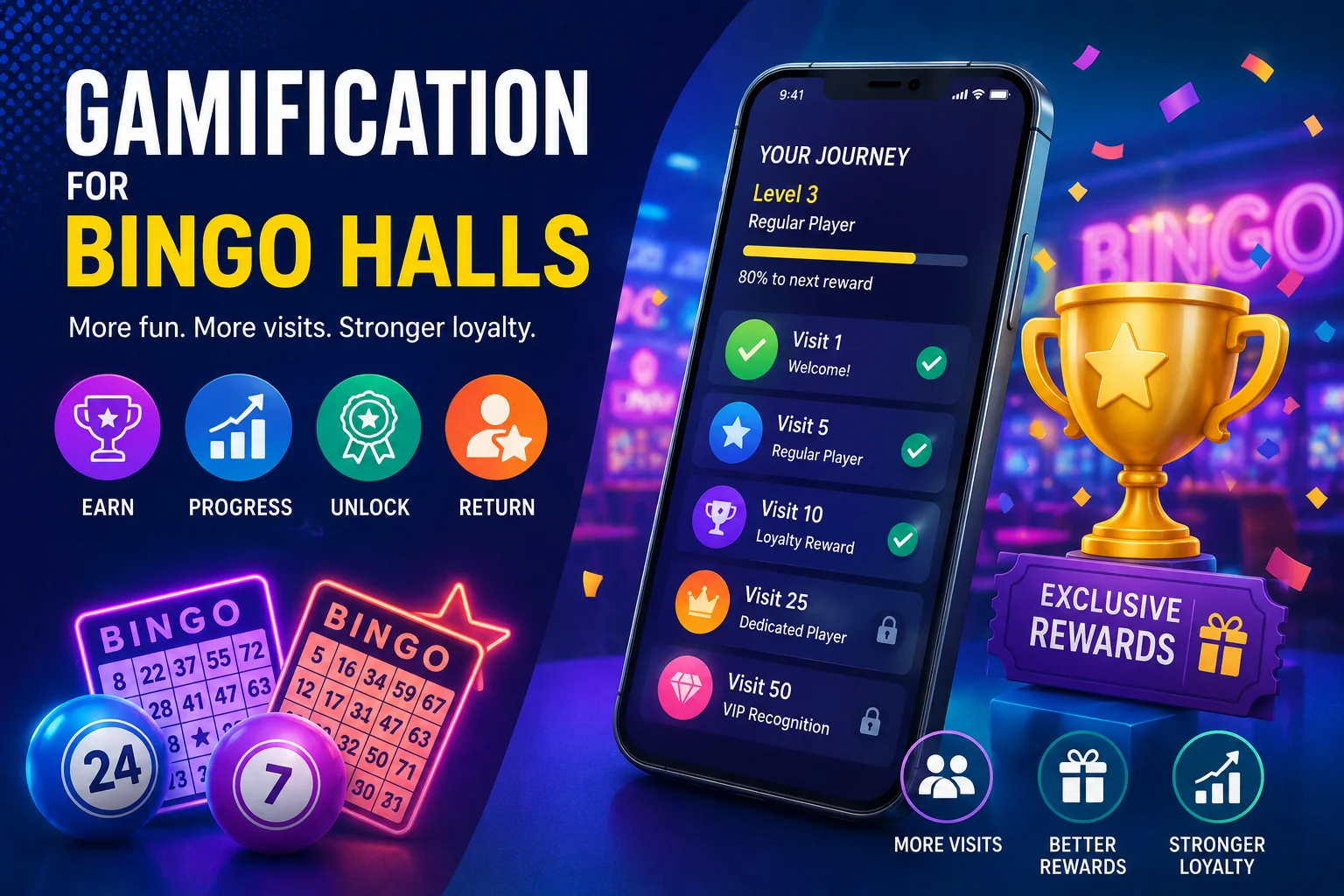
You're 80% of the way to your next achievement.
That message creates a different reaction from:
Thank you for visiting.
The first gives the customer a reason to think about their next action.
They can see where they are.
They can see where they're going.
And, importantly, they know what they need to do to get there.
Attendance Can Become Part of the Game
One of the biggest opportunities for bingo operators is using gamification to encourage repeat attendance.
Instead of simply rewarding a player after every visit, create a progression.
For example:
Visit 1: Welcome achievement
Visit 5: Regular Player badge
Visit 10: Loyalty reward
Visit 25: Dedicated Player badge
Visit 50: VIP recognition
Now each visit contributes to a larger journey.
This can be particularly useful for venues trying to build more consistent attendance habits.
Use Challenges to Influence Specific Behaviour
Gamification becomes more valuable when the challenge has a business purpose.
Suppose your Friday sessions are busy, but Wednesday sessions have spare capacity.
You could create:
Midweek Challenge
Attend four Wednesday sessions this month and unlock a special achievement.
The player receives a clear target.
The venue gets a mechanism for encouraging a specific behaviour.
This is different from simply sending a generic Wednesday discount to the entire database.
The customer isn't only being told:
"Come on Wednesday."
They're being given something to accomplish.
Not Every Game Mechanic Needs to Involve Money
This is an important principle.
If every gamification feature immediately leads to a discount or monetary reward, customers may learn to participate only when there's financial value attached.
Game mechanics can provide other forms of motivation.
For example:
- Recognition
- Status
- Achievement
- Progress
- Competition
- Collection
- Exclusivity
- Surprise
A digital badge can be meaningful.
A VIP tier can create status.
A challenge can create anticipation.
A progress tracker can encourage completion.
The financial reward can remain part of the strategy without becoming the entire strategy.
Achievement Badges Give Loyalty a Story
A points balance tells players what they've accumulated.
A badge can tell them what they've accomplished.
Imagine a player earning:
First Visit
10-Visit Regular
Midweek Master
Community Champion
50-Visit Hall Champion
Those achievements create a record of the customer's relationship with the venue.
The player can look back and see more than points.
They can see their participation.
This is particularly useful for bingo halls because long-term customers often develop a strong sense of connection with their venue.
Progress Can Be More Motivating Than Another Reward
Imagine two loyalty experiences.
Experience A
"You have 4,200 points."
Experience B
"You're two visits away from unlocking your 25-Visit Champion badge."
The second message gives the customer a specific next action.
That's an important difference.
Good gamification reduces the distance between where the player is now and what they could achieve next.
Create Multiple Paths Through the Programme
Not every customer is motivated by attendance milestones.
Some players love events.
Others enjoy challenges.
Some respond to VIP status.
Others simply enjoy collecting achievements.
A good gamification strategy can offer several routes.
Attendance Path
Reward consistent visits.
Event Path
Reward participation in special sessions.
Community Path
Recognise charity and fundraising participation.
Loyalty Path
Reward engagement with the broader loyalty programme.
VIP Path
Recognise sustained high-value engagement.
This gives players different ways to participate without forcing everyone into the same journey.
Make the Challenge Visible
A game mechanic only works if players understand it.
Imagine a customer receives:
Midweek Challenge
2 of 4 visits completed.
Two more Wednesday visits to unlock your reward.
That's clear.
The player knows:
- What the challenge is
- What they've completed
- What remains
- What they will receive
A vague message such as "Keep playing to earn rewards" isn't nearly as useful.
Specificity creates action.
Use Gamification to Create Reasons to Return
The strongest gamification strategies don't focus only on what happens inside one session.
They create reasons for the next session.
For example:
A player completes tonight's challenge.
They receive a badge.
A new challenge appears.
They are halfway toward another reward.
They receive a reminder before the next qualifying session.
Now the venue has created a continuous loop:
Participate → Progress → Unlock → Discover next goal → Return
That loop is where gamification can support retention.
Combine Gamification With Loyalty Points
Gamification and loyalty points don't need to compete.
They can perform different jobs.
Points provide tangible value.
Game mechanics provide motivation and progression.
For example:
Attend 5 sessions → Earn 500 points + unlock a badge
The points can eventually be redeemed.
The badge recognises the achievement.
The player gets both an economic incentive and a psychological one.
Add VIP Tiers to Increase Status
VIP tiers introduce another powerful game mechanic: progression through status.
A player might move through:
Member → Silver → Gold → Platinum
Each level can provide different benefits.
Now the player has another target beyond their immediate reward balance.
Gamification can therefore operate on several timescales:
Immediate: Complete today's challenge.
Short-term: Unlock the next badge.
Medium-term: Reach the next VIP tier.
Long-term: Become one of the venue's most recognised members.
That creates a much richer loyalty journey.
Digital Punch Cards Can Become Part of the Game
Traditional punch cards already contain a basic game mechanic.
Get enough visits → Complete the card → Receive the reward.
Digitising that process makes the progress easier to track and opens the door to more sophisticated engagement.
Instead of:
3 of 10 punches
a customer might see:
3 of 10 visits — 70% until your next reward
That progress can then connect with badges, loyalty points, SMS reminders, or other challenges.
The simple punch card becomes part of a wider gamification system.
Don't Forget Surprise and Variety
Predictability can weaken engagement.
If every challenge follows the same format, customers may eventually stop paying attention.
Operators can introduce occasional variety:
- Limited-time challenges
- Surprise rewards
- Event-specific achievements
- Seasonal badges
- Bonus-point days
- Mystery rewards
- Special member challenges
The objective isn't to make the programme complicated.
It's to keep the experience fresh.
A Practical Bingo Hall Example
Imagine a venue launches a monthly gamification programme.
Players can complete three different challenges.
Challenge One: Midweek Master
Attend four Wednesday sessions.
Challenge Two: Event Explorer
Attend two special events.
Challenge Three: Community Champion
Participate in one charity fundraising night.
A player might complete all three.
Another might focus only on midweek attendance.
A third might care most about community events.
At the end of the month, the venue can see which challenges attracted the strongest participation.
More importantly, customers had additional reasons to visit throughout the month.
The programme didn't change the bingo game.
It changed what happened around the game.
What Operators Should Measure
Gamification shouldn't be introduced simply because it looks engaging.
Measure whether it changes customer behaviour.
Useful metrics include:
- Visit frequency
- Repeat attendance
- Challenge completion
- Badge unlocks
- Loyalty programme engagement
- Midweek attendance
- Event participation
- VIP progression
- Customer retention
- Reward redemption
For example, if players who participate in gamification return more frequently than comparable non-participants, that provides evidence that the mechanics are contributing to engagement.
Common Gamification Mistakes
Making Everything About Discounts
If the only motivation is money, the programme can become expensive and predictable.
Creating Too Many Rules
Customers should understand a challenge immediately.
Hiding Progress
Players need to know how close they are to achieving something.
Making Every Player Follow the Same Path
Different customers respond to different motivations.
Forgetting the Venue's Actual Objectives
A challenge should ideally encourage behaviour that matters to the operator.
Treating Gamification as a Standalone Feature
Its real potential comes from connecting it with loyalty, CRM, messaging, rewards, and analytics.
How JustKonnect Brings Game Mechanics Into the Wider Loyalty Experience
Gamification becomes much more useful when it connects with the systems already managing player engagement.
JustKonnect Gamification provides venues with tools to introduce game mechanics that encourage participation, recognition, and repeat engagement beyond the traditional bingo card. Operators can use gamified experiences alongside loyalty programmes, achievement badges, VIP tiers, digital punch cards, points, coupons, and customer communications.
That means an operator can create a journey where a player attends a session, earns progress, unlocks an achievement, receives a reward, moves toward a VIP tier, and gets a relevant reminder about the next opportunity.
The aim isn't to turn bingo into a completely different game.
Frequently Asked Questions
What does gamification mean for a bingo hall?
Gamification means applying game mechanics such as challenges, achievements, progress, rewards, badges, and status levels to activities around the core bingo experience.
Can gamification increase bingo hall loyalty?
It can encourage repeat engagement by giving players additional goals and reasons to return. Its effectiveness should be measured through changes in attendance, participation, retention, and other relevant customer behaviours.
Does gamification have to involve discounts?
No. Gamification can use recognition, badges, progress, VIP status, challenges, points, exclusive access, and other incentives alongside or instead of discounts.
What game mechanics work well for bingo halls?
Attendance challenges, achievement badges, loyalty points, VIP tiers, digital punch cards, limited-time challenges, and event-based achievements can all support different engagement objectives.
Can gamification help increase midweek attendance?
Yes. Operators can create challenges specifically around quieter sessions, such as completing a certain number of Tuesday or Wednesday visits to unlock an achievement or reward.
The Card Starts the Game. The Experience Keeps It Going.
Bingo already gives players excitement inside the session.
The opportunity for modern operators is to extend that feeling beyond the card.
A visit can become progress.
Progress can become an achievement.
An achievement can lead to another challenge.
A challenge can encourage another visit.
And repeated visits can develop into genuine loyalty.
That's the real value of gamification.
It doesn't need to compete with bingo. It works around it, creating a wider experience that gives players more opportunities to participate, achieve, and feel recognised.
For operators, that means loyalty no longer has to depend entirely on points or discounts.
It can be built around progress, participation, recognition, and the simple desire to see what comes next.
Explore JustKonnect Gamification to see how game mechanics can help your venue create more engaging player journeys and stronger reasons for customers to keep coming back.