A player calls the bingo hall.
Maybe they want to know what time tonight's session starts.
Maybe they are checking the jackpot.
Maybe they have a question about a fundraiser, special event, loyalty reward, or tomorrow's schedule.
The phone rings while staff are helping players at the counter.
Nobody answers.
The player hangs up.
And that interaction can quietly disappear.
For a busy bingo hall, missed calls are easy to dismiss as part of the day. Phones get busy before sessions. Staff are dealing with check-ins, payouts, questions, and activity on the floor.
But a missed call is different from a random unanswered phone call.
Someone who calls your hall has already taken an action.
They were interested enough to pick up their phone, find your number, and make contact.
The problem is that the hall may not know why they called.
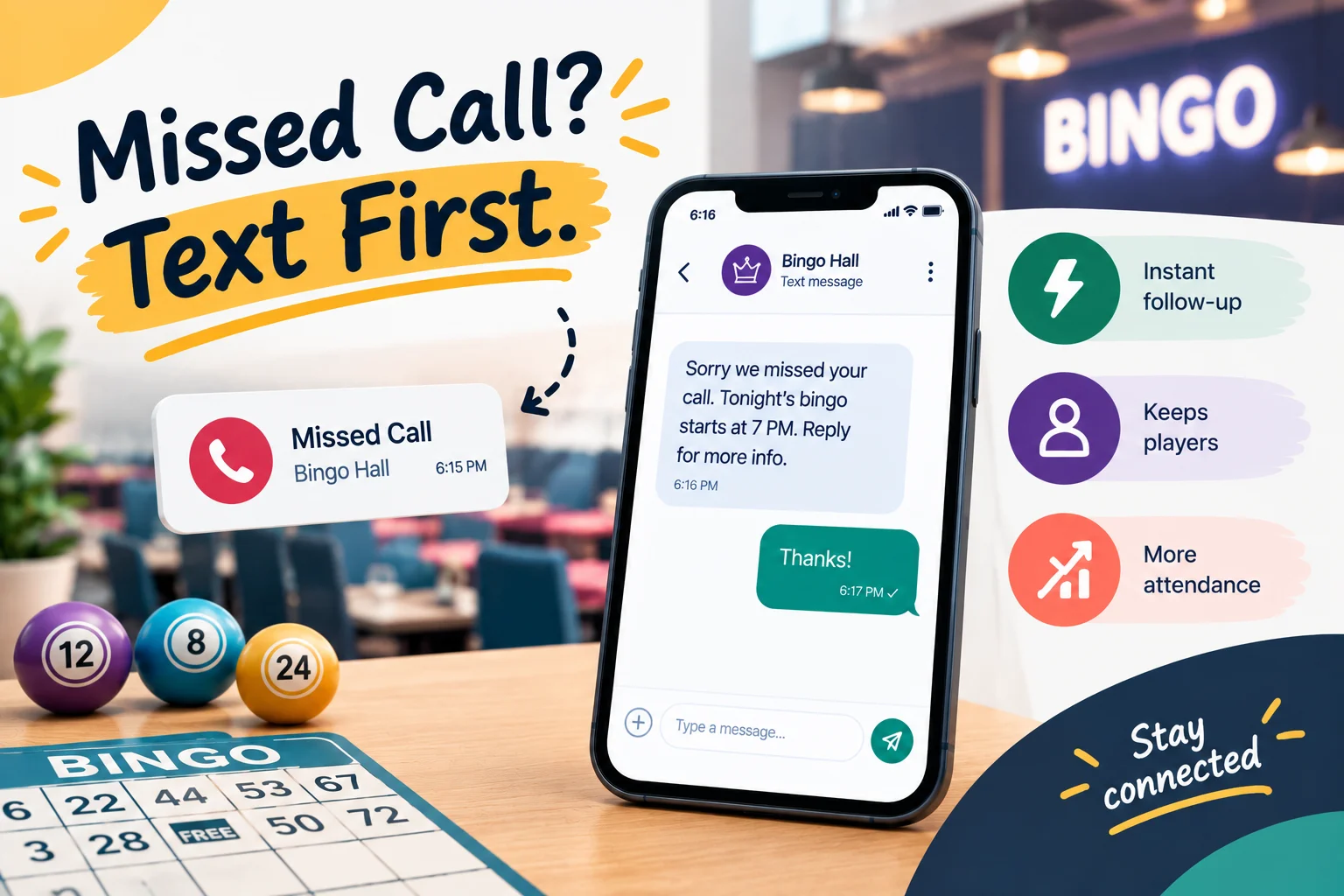
Missed-call texting creates a simple second opportunity: when an opted-in player calls and the call goes unanswered, an automated SMS can acknowledge the interaction and provide useful information instead of leaving the player with silence. JustKonnect's feature is designed specifically around this workflow, with every missed call and automated reply logged.
That changes the question from:
“How many calls did we miss?”
to:
“What happens after we miss one?”
The 30-Second Problem Behind a Missed Call
Imagine a player calling at 6:15 PM.
They want to know whether the 7 PM session is still running.
Nobody answers.
They have two choices.
They can call again.
Or they can make a decision without the answer.
Some players will call back.
Some will leave a voicemail.
Some will search the website.
Others will simply move on.
The hall may never know which outcome occurred.
This is why missed calls are not simply a phone-management issue. They can become a player communication gap.
The player had intent.
The hall had no response.
The opportunity ended between those two points.
A missed-call text helps bridge that gap.
What Is Missed-Call Texting?
Missed-call texting is an automated communication process that sends an SMS after an eligible incoming call goes unanswered.
With JustKonnect, the feature is designed for bingo hall operations. When an opted-in player calls and nobody answers, the system can automatically send a configurable SMS reply. The message can be used for information such as event times, jackpot details, or a callback message. The missed call and automated response are logged within the platform.
The basic journey looks like this:
Player calls → Call is unanswered → System identifies the missed call → Automated SMS is sent → Player receives a next step
There is no requirement for a staff member to notice the missed call first and manually type a message.
That is the important part.
Why the Timing Matters
A missed-call message works because it reaches the player close to the moment they attempted to make contact.
Compare two situations.
Scenario A: Manual follow-up
A player calls.
Nobody answers.
The call appears on a staff member's phone.
The team is busy.
The missed call is forgotten.
Someone notices it later.
They call back.
The player does not answer.
The opportunity is gone.
Scenario B: Automated follow-up
A player calls.
Nobody answers.
The system triggers the configured response.
The player receives a text shortly afterward.
The message tells them where to find the information or how to continue the conversation.
The difference is not simply speed.
It is consistency.
The second workflow does not depend on someone remembering what happened ten minutes earlier.
The Message Does Not Need to Be Complicated
One mistake operators can make is trying to turn every missed-call message into a marketing campaign.
That is not necessary.
The first job of the message is to acknowledge the attempted contact.
For example:
“Sorry we missed your call. Tonight's bingo starts at 7 PM. Reply to this message if you need help.”
Or:
“Sorry we missed you. Our next bingo session is Friday at 7 PM. We hope to see you there.”
Or:
“Thanks for calling [Hall Name]. Sorry we missed your call. Call us again or reply to this message, and our team will help.”
The appropriate message depends on how the hall wants the feature configured and what communication permissions apply.
JustKonnect's privacy policy specifically states that missed-call SMS replies are only activated for players who have previously opted in to receive SMS communications from that hall.
That distinction matters.
The objective is not to automatically text every unknown caller.
It is to create a controlled follow-up process for eligible player contacts.
Missed Calls Can Reveal Player Intent
A normal SMS campaign starts with the operator.
The hall decides:
“Let's send this group a message.”
A missed call starts with the player.
The player decides:
“I need to contact the hall.”
That makes the interaction interesting from a customer-engagement perspective.
The operator may not know what the player wanted, but the call itself provides useful context.
A player who calls shortly before a special event may be looking for information.
A regular player calling before a session may have a question about the schedule.
A player calling during a jackpot promotion may want more details.
The missed-call system does not need to guess their exact intent.
It simply needs to make sure the interaction does not end with an unanswered phone.
Four Jobs a Missed-Call Text Can Perform
The best use of missed-call texting is not necessarily “send a promotion.”
It can perform several smaller jobs.
1. Acknowledge the player
The simplest response tells the player:
We saw that you tried to reach us.
That alone is better than complete silence.
2. Answer a predictable question
If calls frequently concern opening times, session schedules, or upcoming events, the automated message can provide that information.
3. Point players toward the next action
The message can direct the player toward a callback, reply, event information, or another appropriate contact route.
4. Keep the interaction visible
JustKonnect logs missed calls and their automated replies, giving operators a record of the interaction rather than leaving it entirely on an individual staff member's phone.
That last point becomes increasingly useful as call volume increases.
Where Manual Follow-Up Starts Breaking Down
A small hall might manage missed calls manually without much trouble.
But consider a busy evening.
The phones start ringing.
Players arrive at the same time.
Staff answer questions.
The counter gets busy.
Someone misses five calls.
Then ten.
A staff member writes two numbers down.
Another call comes through.
Someone remembers to return three calls.
The rest are forgotten.
This is not necessarily a staff-performance problem.
It is a workflow problem.
The process asks people to remember an event while they are simultaneously handling everything else happening inside the hall.
Automation removes one of those memory requirements.
Missed-Call Texting Is Not the Same as a Generic Auto-Reply
A generic business auto-reply might say:
“Thanks for contacting us. We'll get back to you soon.”
That is better than nothing, but it may not be particularly useful to a bingo player.
A bingo hall can have very different reasons for receiving calls.
Players may want to know:
- When the next session starts
- Whether a special event is happening
- Jackpot information
- Fundraiser details
- Promotion information
- Loyalty-related information
- How to contact the team
- What is happening on a particular night
JustKonnect positions missed-call texting around bingo-specific communication rather than generic retail customer service. Its platform connects missed-call follow-up with player CRM, SMS, loyalty, and reporting.
That makes the feature more useful when the hall wants the missed call to become part of its broader player-engagement workflow.
The Difference Between a Missed Call and a Lost Player
Not every missed call represents a lost visit.
That would be impossible to know from the call alone.
But the interaction can represent an opportunity that was not completed.
Consider this sequence:
Player interest
↓
Player calls
↓
Nobody answers
↓
No follow-up
↓
Player makes another choice
Now compare it with:
Player interest
↓
Player calls
↓
Nobody answers
↓
Automated text
↓
Player receives information
↓
Player decides what to do next
The second process does not guarantee attendance.
What it does is remove one avoidable communication failure.
That is a more realistic way to think about missed-call texting.
Use It Around the Moments When Calls Spike
Operators do not need to guess when missed-call texting matters most.
Look at when the hall's phone tends to become busy.
For many venues, call volume may increase around:
- Evening sessions
- Weekend games
- Major jackpots
- Special events
- Charity fundraisers
- Promotional nights
- Holiday events
- Changes to the normal schedule
These are precisely the moments when staff may also have more work on the floor.
That creates an operational mismatch:
More player interest + more staff activity = greater chance of unanswered calls.
Automated follow-up becomes particularly useful in that environment.
Example: A Special Fundraiser
Suppose a hall is promoting a Saturday charity event.
The team has already sent SMS messages to opted-in players.
As Saturday approaches, players start calling.
One wants to know the start time.
Another wants to confirm the event date.
Another simply wants more information.
The staff is preparing the hall and answering questions from players already onsite.
Several calls go unanswered.
Without missed-call texting, those callers may receive nothing.
With an automated follow-up, an eligible caller could receive something like:
“Sorry we missed your call. Our Charity Night is Saturday, with doors opening at 6 PM and bingo starting at 7 PM. Reply to this message if you need more information.”
Now the missed call has become another communication touchpoint.
It is not replacing staff.
It is buying the staff time.
Example: The Regular Player
The feature is not only useful for major events.
Imagine a regular player who usually attends Thursday night bingo.
They call on Wednesday because they want to confirm whether the normal session is happening.
The hall is busy.
Nobody answers.
An automated response could provide the next scheduled session or invite the player to continue the conversation through the appropriate channel.
The player gets an answer without having to keep calling.
That small improvement can matter because repeat attendance often depends on removing small sources of friction.
Example: The Jackpot Caller
Jackpots can create spikes in interest.
Players may call because they want to know:
- When the game starts
- Whether the jackpot is still available
- What night the jackpot is running
- Whether a special session is taking place
A missed-call response can provide the relevant information immediately.
JustKonnect specifically identifies jackpot information as one potential use of its missed-call texting capability.
The important word is relevant.
The automated response should help answer the likely reason for the contact rather than simply turning every missed call into an advertisement.
What Should a Good Missed-Call Message Contain?
There is no single message that works for every hall.
But a useful message generally has four components.
Recognition
Acknowledge the missed call.
“Sorry we missed your call…”
Identification
Make it clear which hall is responding.
“This is [Hall Name]…”
Useful information
Give the player something relevant.
“Tonight's bingo begins at 7 PM…”
Next step
Tell the player what to do if they still need help.
“Reply to this message or call us back…”
Keep it short.
The purpose is to continue the interaction, not reproduce the entire website inside an SMS.
Don't Turn Every Missed Call Into a Sales Pitch
This deserves emphasis.
If someone calls and receives:
“Sorry we missed your call! Don't forget our jackpot, Friday fundraiser, loyalty rewards, VIP programme, birthday offer, referral programme, and special promotion!”
The hall may technically have followed up, but it has not necessarily improved the experience.
The player called for a reason.
If the automated message can help with that reason, start there.
Helpful first. Promotional second.
This approach also keeps the feature aligned with the broader principle behind player communication: use the available information to make interactions more relevant, rather than sending more messages simply because the technology allows it.
What Happens If the Player Calls Again?
This is where missed-call texting can complement, rather than replace, good phone service.
The automated message is not designed to eliminate human contact.
It gives the player another route after an unanswered call.
A player may:
- Call back
- Reply to the message
- Use the information provided
- Attend the next session
- Ask a follow-up question
The important point is that the first missed call does not have to be the end of the interaction.
The Value of Logging Every Interaction
Suppose the hall receives 500 calls over a month.
Without structured tracking, management may know that the phone rang frequently but have little visibility into what happened afterward.
With logged missed calls and automated responses, the hall can begin asking better operational questions.
For example:
How many calls were missed?
When were most missed calls occurring?
Which days generated the most missed calls?
How many automated responses were sent?
Were missed calls concentrated around major events?
Did certain periods consistently create more communication demand?
JustKonnect states that missed calls and automated replies are logged, while its broader platform connects communication activity with player and campaign data.
That makes the feature useful beyond the individual text message.
The data can reveal where the hall's communication process is under pressure.
Measure the Problem Before Trying to Improve It
Operators should avoid judging missed-call texting purely by the number of texts sent.
A better measurement approach starts with the underlying problem.
Track:
Missed-call volume
How many calls went unanswered?
Missed-call timing
When do unanswered calls happen most frequently?
Response volume
How many automated messages were triggered?
Player engagement
Where the platform and campaign setup support it, examine subsequent player activity.
Attendance patterns
Look for changes around the periods where missed-call follow-up is being used.
Common call periods
Use the data to identify when staffing or phone coverage may need additional attention.
The goal is not to prove that every missed call becomes an attendance opportunity.
The goal is to determine whether the hall is reducing communication gaps and making better use of player interactions.
Missed-Call Texting Works Best as Part of a Larger System
A missed call is one small piece of a player's relationship with a bingo hall.
The same player may also have:
- A CRM profile
- Attendance history
- Loyalty activity
- SMS interactions
- Campaign history
- Visit frequency data
- Reward activity
JustKonnect is designed to connect missed-call texting with those broader player-engagement functions rather than operating it as a completely separate system.
That matters because the objective is not simply:
“Send a text when a call is missed.”
The bigger objective is:
“Keep player communication connected when the normal route fails.”
A Simple Implementation Approach for Bingo Operators
The feature does not need to become another complicated project.
Start with the most common reason players contact the hall.
Step 1: Identify the missed-call problem
Look at unanswered calls over a typical week.
Step 2: Identify eligible players
Make sure the process follows the hall's applicable communication permissions. JustKonnect states that its missed-call SMS feature is activated only for players who have opted in to receive SMS communications from that hall.
Step 3: Write one useful response
Do not start with five different messages.
Create one clear response that acknowledges the call and provides the most useful next step.
Step 4: Configure the automation
Set the missed-call response within the operator platform.
Step 5: Monitor the pattern
Look at missed-call volume and timing.
Step 6: Improve the message
If players repeatedly ask about schedules, make the schedule clearer.
If they frequently need staff assistance, make the callback route clearer.
If a particular event generates a surge of calls, prepare information around that event.
The automation should evolve based on actual player behavior.
Common Mistakes to Avoid
Sending the same message regardless of context
A generic response may be easy to create but less useful to players.
Making the message too promotional
The first objective should be helping the caller continue their interaction with the hall.
Forgetting SMS permissions
Not every caller should automatically receive a text. JustKonnect's policy specifically limits missed-call auto-replies to players who have opted in to SMS communications.
Treating automation as a replacement for staff
Some questions still require a person.
The automated text should create a bridge, not pretend that every issue can be solved automatically.
Ignoring the data
If missed calls are consistently concentrated at certain times, that information can reveal staffing or communication problems worth addressing.
Frequently Asked Questions
What is missed-call texting for bingo halls?
Missed-call texting automatically sends an SMS after an eligible player calls the bingo hall and the call goes unanswered. JustKonnect allows operators to configure the response and logs the missed call and automated reply.
Does every person who calls receive a missed-call text?
Not necessarily. JustKonnect's published privacy policy states that the feature is only activated for players who have previously opted in to receive SMS communications from the relevant hall.
What can a bingo hall include in a missed-call text?
The message can be configured around the hall's needs. JustKonnect gives examples such as event times, jackpot information, and callback messages.
Can missed-call texting replace answering the phone?
No. It is better viewed as a backup communication layer. The goal is to acknowledge the player's attempted contact and give them another way to continue when staff cannot answer immediately.
Does JustKonnect log missed calls?
Yes. JustKonnect states that every missed call and automated reply is logged.
Why is missed-call texting useful during busy bingo sessions?
Calls can increase around sessions, jackpots, and special events while staff are simultaneously handling activity inside the hall. Automated follow-up ensures eligible callers receive a response without requiring staff to manually monitor every unanswered call.
A Missed Call Should Not Mean a Missed Opportunity
A busy bingo hall will always have moments when the phone rings and nobody can answer.
That is normal.
The problem begins when the unanswered call becomes the end of the player's interaction.
Missed-call texting changes what happens next.
The player calls.
The hall cannot answer.
The system responds.
The player receives useful information.
The interaction remains visible.
And staff can deal with the people standing in front of them without leaving every caller to try again.
That is the real value of the feature.
It is not about sending more texts.
It is about making sure an unanswered phone call does not automatically become an unanswered player.
With JustKonnect's Missed-Call Texting, bingo operators can build automated missed-call follow-up into the same player engagement environment used for SMS, CRM, loyalty, and reporting.